


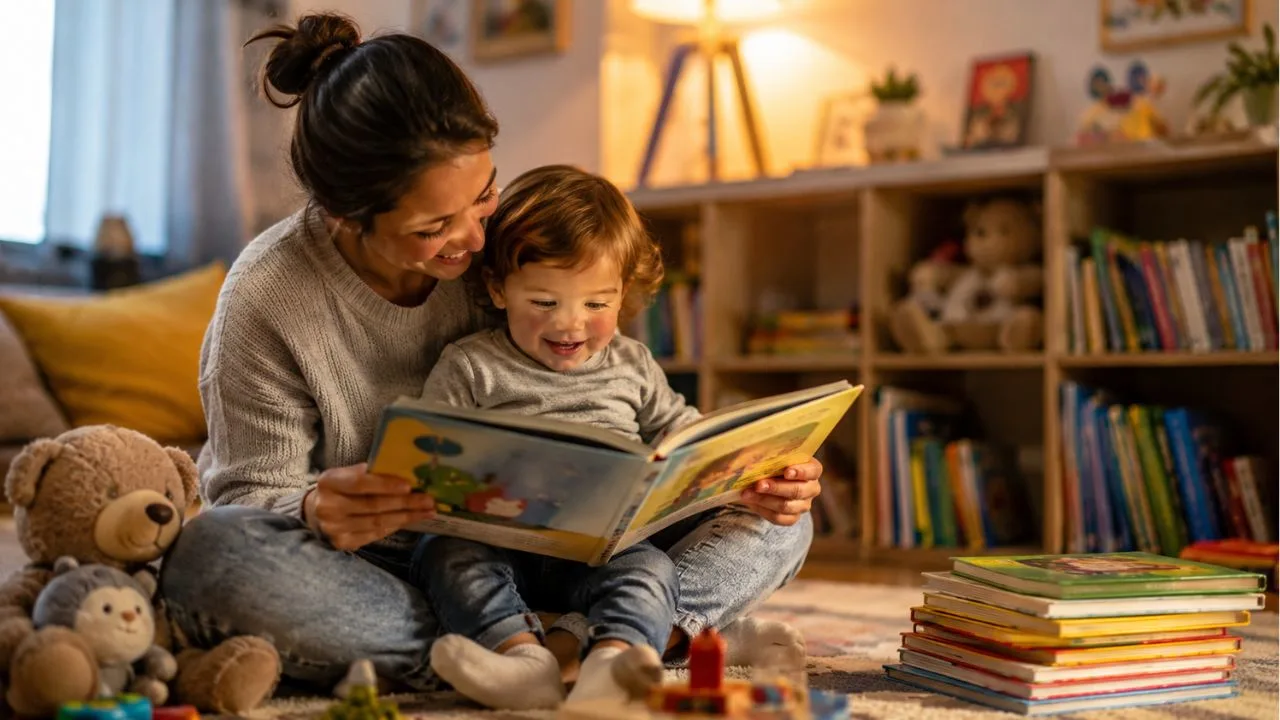
Reading with a toddler does not need to look like a quiet classroom lesson. A young child may turn several pages at once, point at one picture repeatedly, interrupt with questions, or walk away before the story ends. These behaviours are normal parts of early literacy, and they do not mean the reading session has failed.
The best books to read to toddlers invite participation through rhythm, repetition, bright illustrations, predictable phrases, familiar situations, and playful surprises. A toddler may not understand every word, but listening to language, studying pictures, and sharing attention with a trusted adult can make books feel comforting and enjoyable.
The American Academy of Pediatrics explains that sharing books can support language development and prepare toddlers to listen and learn. Two- and three-year-olds may choose favourite books, repeat familiar phrases, ask questions, pretend to read, and retell parts of stories in their own words.
Building a love of reading is therefore less about finishing a certain number of pages and more about creating positive experiences. The following toddler book recommendations include calming bedtime stories, interactive lift-the-flap books, rhyming read-alouds, concept books, and imaginative picture books that families can enjoy repeatedly.
Why Reading Aloud Matters During the Toddler Years
Toddlers are rapidly developing vocabulary, listening skills, memory, and an understanding of how conversations work. Reading aloud introduces words that may not appear regularly in ordinary family conversations. Pictures also help children connect spoken words with animals, objects, actions, colours, emotions, and familiar routines.
Shared reading gives adults opportunities to respond to a child’s interests. A toddler may point to a dog, imitate an animal sound, or notice a small object hidden in the illustration. When a caregiver responds with enthusiasm and adds a few words, the book becomes the beginning of a conversation rather than a script that must be read perfectly.
Reading can also strengthen emotional connection. Sitting together, hearing a familiar voice, and returning to a favourite story can create a predictable moment of comfort. Reach Out and Read recommends making reading part of everyday life, talking about pictures, allowing children to turn pages, creating character voices, and asking simple questions.
Repeated reading is especially valuable during toddlerhood. Adults may become tired of the same book, but repetition allows children to remember language, anticipate what comes next, and participate confidently. Familiarity can turn a toddler from a passive listener into an enthusiastic storyteller who supplies sounds, names, and missing phrases.
What Makes a Toddler Book Easy to Love?
Strong toddler books usually have a clear pattern. Repeating words, actions, questions, or sounds help children predict what will happen next. This predictability creates confidence because toddlers can join in before they are able to recognize printed words independently.
Illustrations should carry much of the meaning. A toddler needs to understand something about the story by examining faces, actions, colours, and objects on the page. Books with clear visual storytelling remain enjoyable even when the adult shortens the text or simply talks about the pictures.
Physical format also matters. Board books can withstand energetic page-turning and are easier for small hands to hold. Flaps, textures, holes, tabs, and interactive instructions can encourage participation, although these features should support the story rather than distract the child from it.
The subject should connect with the child’s interests or daily experiences. Many toddlers enjoy books about animals, food, vehicles, families, bedtime, colours, and other children. Reach Out and Read notes that one- and two-year-olds often enjoy books with few words, animal noises, familiar objects, repetition, silliness, and opportunities to point or fill in known phrases.
Brown Bear, Brown Bear, What Do You See? by Bill Martin Jr. and Eric Carle
Brown Bear, Brown Bear, What Do You See? introduces a sequence of brightly coloured animals through a repeated question-and-answer pattern. A bear, bird, duck, horse, frog, cat, dog, sheep, and other figures appear one after another, giving toddlers a simple structure they can quickly understand.
Bill Martin Jr.’s rhythmic language and Eric Carle’s bold collages make the book particularly effective as a read-aloud. The publisher describes its combination of melodic text and vividly coloured animal images as central to the book’s lasting appeal.
This is one of the best toddler books for encouraging participation. After several readings, pause before naming the next colour or animal and allow your child to respond. Even a sound, gesture, or partial word can become a meaningful contribution to the story.
Parents can extend the experience without turning it into a formal lesson. Ask which animal the child likes, find objects around the room that match the colours, or imitate the animals together. The book’s familiar pattern also makes it a useful choice for toddlers beginning to speak or learning more than one language.
Goodnight Moon by Margaret Wise Brown and Clement Hurd
Goodnight Moon follows a little bunny saying goodnight to the familiar objects in a softly lit room. Nothing dramatic happens, yet that gentle simplicity is exactly what makes the book suitable for bedtime. The words and pictures gradually create the feeling that the busy day is becoming quieter.
The publisher highlights the story’s repetitive language, calming illustrations, and gradual movement toward sleep. The visual details also change subtly, giving toddlers small things to notice during repeated readings rather than presenting the book as exactly the same experience every night.
This book works best when it becomes part of a consistent bedtime reading routine. Use a soft voice, slow down as the room becomes darker, and invite your toddler to say goodnight to favourite objects. The repetition can help signal that active play is ending and sleep is approaching.
Toddlers may enjoy finding the mouse, noticing the moon, or naming objects instead of listening to every line. That participation is part of the value. Reach Out and Read specifically recommends repetitive bedtime books such as Goodnight Moon for establishing an enjoyable nighttime routine.
The Very Hungry Caterpillar by Eric Carle
The Very Hungry Caterpillar begins with a small egg and follows a caterpillar as it eats through an expanding selection of foods. The story eventually leads to a cocoon and transformation into a butterfly, giving young children a satisfying beginning, middle, and end.
The publisher lists the book for children from birth to age three and emphasizes its colourful pictures and the caterpillar’s journey through different foods. The board-book format also makes the pages practical for toddlers who want to touch, point, and explore while listening.
The story naturally introduces counting, food vocabulary, days, size, and change without feeling like a worksheet. Toddlers can count the fruit, name favourite foods, trace the holes, or pretend to nibble across the pages. These actions keep a familiar story engaging after many readings.
Parents do not need to test children on every concept. Follow the toddler’s attention instead. One day the child may care about the strawberry, while another reading may focus entirely on the butterfly, and both experiences can support curiosity and positive feelings about books.
Dear Zoo by Rod Campbell
Dear Zoo begins when a child asks the zoo to send a pet. The zoo repeatedly delivers unsuitable animals hidden behind flaps, including creatures that are too large, too tall, too fierce, or too difficult to keep. The search continues until the right companion finally arrives.
The publisher recommends the book for ages two to five and describes it as a lift-the-flap story with bright artwork, repeated language, and familiar zoo animals. Its short length and predictable refrain make it especially suitable for toddlers who are not yet ready for longer narratives.
The flaps provide an immediate reason to stay involved. Before opening one, ask what might be inside or allow the child to lift it independently. Toddlers can also copy the animal noises, movements, and facial expressions, turning storytime into active play.
Because the pattern repeats, children soon learn when to join in. They may say that an animal should be sent back, remember which creature comes next, or announce the final pet. That feeling of knowing the story helps children see themselves as capable participants in reading.
Where’s Spot? by Eric Hill
In Where’s Spot?, a mother dog searches around the house for her missing puppy. Each possible hiding place reveals a different animal, creating a simple game of hide-and-seek. The central question remains easy to understand even for a toddler with a short attention span.
The publisher identifies editions for young children and describes the story as an interactive search with straightforward vocabulary, familiar household locations, and hidden animals. The combination of flaps and repeated questions gives toddlers a clear role in moving the story forward.
Use the book to practise location words such as behind, inside, under, and in. Toddlers may not repeat these words immediately, but seeing the hiding places while hearing the language helps connect meaning with action. Naming household objects can provide additional vocabulary naturally.
The story also supports simple emotional understanding. Spot’s mother is looking for him because he has not appeared for dinner, and the reunion provides a reassuring conclusion. Children who enjoy this book can explore other Spot stories featuring everyday experiences such as birthdays, outings, and bedtime.
Chicka Chicka Boom Boom by Bill Martin Jr., John Archambault, and Lois Ehlert
Chicka Chicka Boom Boom turns the alphabet into an energetic adventure. The letters race up a coconut tree until the growing crowd becomes too heavy and everyone tumbles down. Its chant-like rhythm makes the text feel closer to a song than a formal alphabet lesson.
The official publisher describes the book as a lively rhyming alphabet story with bold, high-contrast artwork. Its repeated sounds and memorable pattern introduce letters and early phonics through playful storytelling rather than isolated drills.
Toddlers do not need to name all 26 letters to enjoy it. They can clap to the rhythm, shout the repeated phrase, point to familiar letters, or pretend to climb and fall. The physical energy of the language makes it a useful choice for children who find quiet stories difficult to follow.
As children grow, the same book can support new skills. A younger toddler may respond only to the colours and rhythm, while an older toddler may search for the first letter of their name. This ability to change with the child makes it valuable in a long-lasting home library.
Llama Llama Red Pajama by Anna Dewdney
Llama Llama Red Pajama begins with a familiar bedtime routine, but Baby Llama becomes worried when Mama Llama leaves the room. His concern grows while he waits, creating a dramatic but recognizable emotional experience for children who dislike separation at bedtime.
Penguin Random House lists the book for ages two to five and describes its rhyming text as a story about bedtime and separation anxiety. The repeated sounds, expressive illustrations, and emotional build-up make it especially enjoyable to perform aloud.
This book gives toddlers language for feelings that they may not yet be able to explain. Adults can name Baby Llama’s worry, ask what might help him feel safe, and notice how Mama responds. These conversations can support emotional vocabulary without turning the reading into a lecture.
Some toddlers may find the increasingly worried expressions intense, particularly near bedtime. Watch the child’s reaction and use a calm voice during those pages. For many families, the reassuring conclusion makes the story a helpful way to discuss waiting, comfort, and a caregiver’s return.
The Snowy Day by Ezra Jack Keats
The Snowy Day follows Peter as he explores his neighbourhood after fresh snow has transformed the world outside. He walks, makes tracks, experiments with the snow, and experiences the small discoveries that can make an ordinary day feel extraordinary.
The book won the 1963 Caldecott Medal, and its publisher recommends it for ages two to five. It is also recognized for placing a Black child at the centre of an everyday urban story at a time when such representation was uncommon in mainstream picture books.
The story moves at a gentle pace, making it suitable for children who enjoy observing details. Toddlers can copy Peter’s movements, talk about hot and cold weather, examine his footprints, and predict what will happen to the snowball he places in his pocket.
Families living in warm climates can enjoy the story even when children have never seen snow. The unfamiliar setting can invite questions and imaginative play, while Peter’s curiosity remains universal. The book reminds adults that toddler stories can be quiet and still hold a child’s attention.
Press Here by Hervé Tullet
Press Here asks the reader to press coloured dots, shake the book, clap, tilt the pages, and observe what appears to happen next. It creates the feeling of an interactive digital experience using only printed shapes, simple instructions, and the child’s imagination.
Chronicle Books recommends the title for ages three to five and describes it as an interactive read-aloud involving colours and shapes. There are no electronic buttons or sounds; the enjoyment comes from pretending that each action has changed the following page.
This book is particularly useful for active older toddlers who want to do something during storytime. It supports listening, following simple directions, turn-taking, and cause-and-effect thinking. Children often enjoy taking control and instructing the adult once they understand the sequence.
Younger toddlers can still explore it with simplified instructions, although children closer to age three may understand the playful illusion more fully. Avoid correcting movements too strictly. The purpose is imaginative participation, not performing each command with perfect accuracy.
The Gruffalo by Julia Donaldson and Axel Scheffler
The Gruffalo follows a small mouse travelling through the woods while several animals imagine that the mouse would make a convenient meal. The clever mouse protects itself by describing a terrifying creature called the Gruffalo, only to discover that the invented monster is real.
Julia Donaldson’s rhyming story and Axel Scheffler’s illustrations have made the book a modern picture-book classic. Macmillan describes it as an internationally popular story, while the official author information identifies it among Donaldson’s best-known children’s books.
The story is longer than books such as Dear Zoo, so it may work best for older toddlers who can follow a developing plot. Repeated encounters and rhyming phrases make it easier to remember, while the mouse’s clever responses create humour and suspense.
Some sensitive children may initially find the Gruffalo’s appearance frightening. Use playful voices and allow the child to examine the pictures before continuing. Once toddlers understand that the mouse remains in control, the story can become a favourite for dramatic family read-alouds.
Goodnight, Bruce by Ryan T. Higgins
Families interested in a newer toddler book can consider Goodnight, Bruce, published in March 2026. The story follows a tired bear trying to put his family of mice and geese to bed while they invent reasons to remain awake and continue their evening activities.
Penguin Random House lists the book for ages zero to two and describes it as a humorous bedtime story that children and caregivers can recognize. Its 48 pages make it longer than many basic board books, but the visual comedy can help maintain attention.
This book is a useful fresh addition for toddlers who prefer funny bedtime stories to quiet, soothing ones. Adults can exaggerate Bruce’s exhaustion and the family’s excuses, creating a shared joke about the familiar difficulty of ending the day.
Because it belongs to the wider Mother Bruce series, children who enjoy the characters have more stories to discover later. New books should not replace proven classics, but adding an occasional recent release can keep the family reading routine interesting for adults as well as children.
How to Choose the Best Book for Your Toddler
Begin with the child’s present interests. A toddler who constantly points at dogs may enjoy Where’s Spot?, while an animal lover may choose Brown Bear, Brown Bear, What Do You See? or Dear Zoo. A child fascinated by food may respond immediately to The Very Hungry Caterpillar.
Consider attention span without treating it as a fixed ability. Short lift-the-flap books may suit an active one-year-old, while an older toddler may enjoy the longer plot of The Gruffalo. A child may also listen longer when the subject is especially interesting, even if the book contains more words.
Choose durable editions when possible. Board books are useful for independent handling, while larger picture books make detailed illustrations easier to share. Library borrowing can help families test different stories before purchasing copies of the books a toddler requests repeatedly.
A balanced collection can include rhythmic books, bedtime stories, interactive books, emotional stories, alphabet books, and books showing varied families and communities. No single title needs to teach every skill. The goal is to give children many enjoyable reasons to return to books.
How to Make Toddler Storytime More Enjoyable
Allow the child to lead part of the reading session. Let them choose the book, turn the pages, skip backward, or spend extra time on one illustration. Reading every printed sentence is less important than maintaining shared interest and positive interaction.
Use expression, gestures, animal sounds, and different character voices. Pause before repeated phrases so the child has an opportunity to join in. Reach Out and Read encourages caregivers to make stories come alive, discuss familiar objects, ask what might happen next, and allow children to retell stories.
Avoid asking too many testing questions. Repeatedly demanding the correct colour, number, or animal can make reading feel like an examination. Mix occasional questions with simple observations, such as noticing that the dog looks surprised or that the caterpillar has eaten a large meal.
Stop when the experience becomes frustrating. Toddlers do not need to finish every book, and even a few enjoyable minutes can be worthwhile. A child who walks away may still be listening, and the family can return to the story later without treating the interruption as misbehaviour.
How to Build a Lasting Love of Reading
Make books easy for toddlers to reach. Store a small selection in baskets, low shelves, the bedroom, and the main family area. When books are visible and treated as everyday objects rather than special items that require permission, children can explore them independently.
Create predictable reading moments without making the routine rigid. A family might read after breakfast, before a nap, during travel, or as part of bedtime. The American Academy of Pediatrics suggests setting aside a quiet period for book sharing and allowing toddlers to choose and repeat favourite books.
Visit libraries and story sessions when they are available. Borrowing allows toddlers to experience different authors, subjects, illustration styles, cultures, and languages without requiring families to purchase every book. It also gives children the exciting responsibility of choosing what to take home.
Most importantly, let children see that adults value books. Show enjoyment, laugh at funny scenes, talk about favourite pictures, and respond warmly when a toddler brings a familiar story. A love of reading grows through connection and pleasure more reliably than pressure, rewards, or early academic competition.
Conclusion
The best books to read to toddlers combine accessible language with memorable pictures, sounds, emotions, and opportunities to participate. Classics such as Goodnight Moon, Brown Bear, Brown Bear, What Do You See?, and The Very Hungry Caterpillar remain effective because their patterns invite children to return repeatedly.
Interactive books such as Dear Zoo, Where’s Spot?, and Press Here give busy toddlers an active role. Rhyming stories such as Chicka Chicka Boom Boom, Llama Llama Red Pajama, and The Gruffalo help adults create energetic, expressive reading sessions.
Books such as The Snowy Day show that a gentle everyday experience can become an absorbing story, while a recent title such as Goodnight, Bruce can add fresh humour to a family’s bedtime collection. Different books will appeal to different children, and preferences can change rapidly during toddlerhood.
A successful storytime does not require a perfectly still child or a completed book. It requires an adult, a child, and a shared moment of curiosity. When reading feels warm, playful, and responsive, toddlers begin to associate books with connection—and that association can become the foundation of a lifelong love of reading.
Frequently Asked Questions
How many books should I read to my toddler each day?
There is no required number. One enjoyable book or a few minutes of shared reading every day can be more valuable than forcing several stories when the child has lost interest.
What books are best for a two-year-old?
Two-year-olds often enjoy short board books, repeated phrases, animal sounds, flaps, humour, and familiar routines. Dear Zoo, Where’s Spot?, and Brown Bear, Brown Bear, What Do You See? are strong choices.
Is it normal for toddlers to request the same book repeatedly?
Yes. Repetition helps toddlers remember vocabulary, anticipate events, and participate confidently. A favourite book may support learning differently each time it is read.
Should I continue reading when my toddler walks around?
You can continue when the child appears comfortable and is still listening. Toddlers often move during reading, so sitting completely still should not be treated as a requirement.
Are ebooks as good as printed books for toddlers?
Both formats can support shared reading, but printed books reduce distractions and allow easy page-turning and pointing. The adult’s conversation and attention matter more than the format alone.