


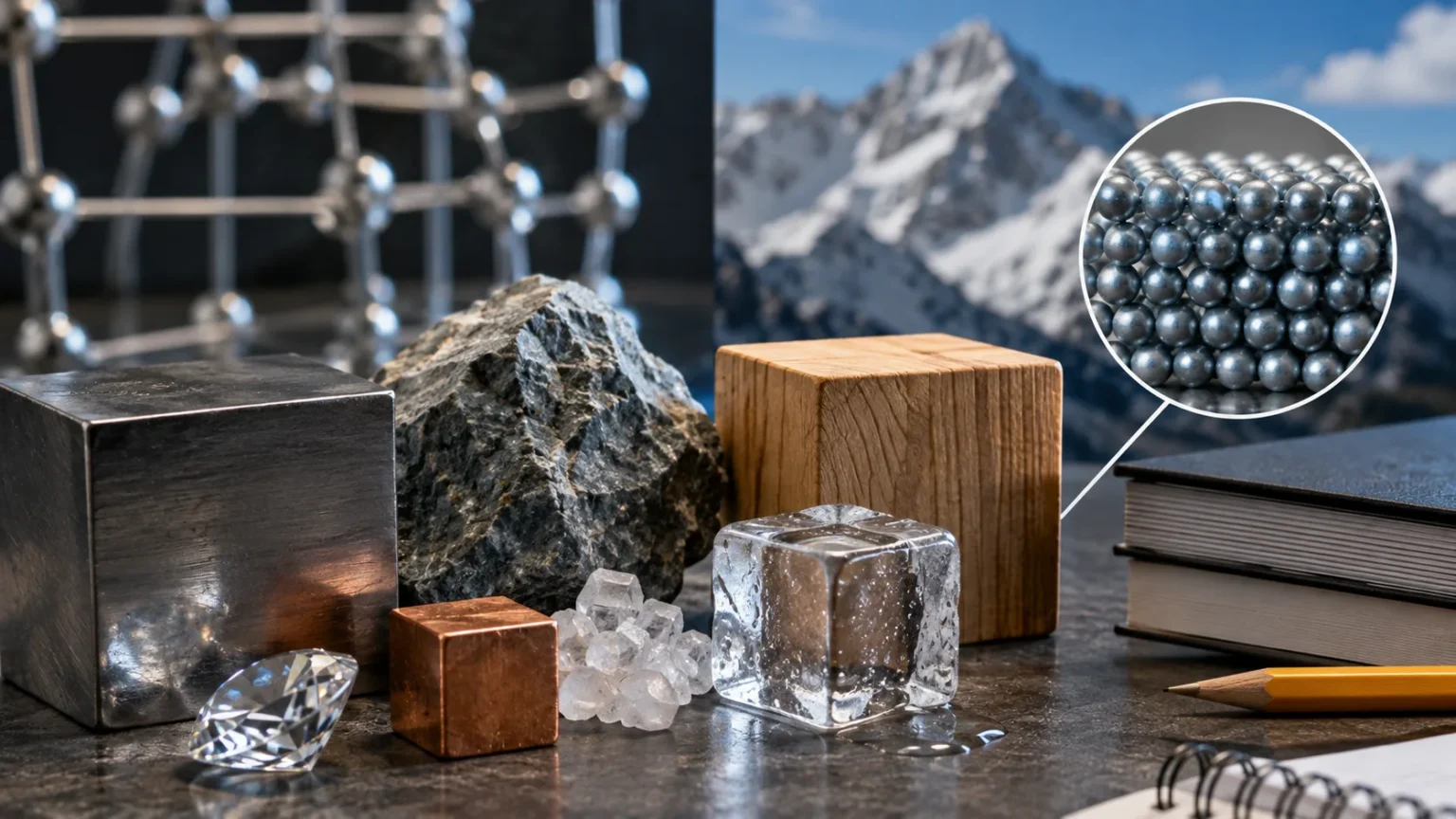
What Is a Solid? Properties & Easy Examples
A solid is one of the main states of matter, alongside liquids, gases, and plasma. In everyday life, solids include objects such as tables, rocks, pencils, ice cubes, coins, books, and smartphones. What makes these materials solids is that their particles are packed closely together and usually remain in relatively fixed positions. Because the particles cannot move freely past one another, a solid normally keeps its own shape and volume. This makes solids different from liquids, which flow and take the shape of their containers. Understanding what a solid is provides an important foundation for learning about matter, materials, chemistry, physics, engineering, and the objects we use every day.
Although most solids look stable and motionless, the particles inside them are not completely still. At the microscopic level, atoms, molecules, or ions continue to vibrate around their positions. The strength of the forces holding those particles together helps determine whether a material is hard, soft, flexible, brittle, elastic, or strong. Steel and rubber are both solids, for example, but they behave very differently because their structures and chemical compositions are different. Some solids form highly organized crystal structures, while others have particles arranged less regularly. These internal differences explain why solids can have such a wide range of physical properties despite belonging to the same state of matter.
Learning about solids is useful far beyond a classroom definition. Engineers study solid materials when designing bridges, vehicles, buildings, electronics, medical devices, and machinery. Scientists examine crystal structures to understand minerals, metals, salts, and advanced materials. Manufacturers need to know how solids respond to heat, pressure, stretching, and impact before using them in products. Even common experiences such as ice melting, glass breaking, wood bending, or metal expanding involve the behavior of solids. This guide explains what a solid is, its key properties, the way its particles are arranged, common types of solids, and easy examples that make the concept simple to understand.
What Is a Solid in Science?
A solid is a state of matter that normally has a definite shape and a definite volume. This means a solid does not automatically change its shape to match the container holding it. If you place a wooden block inside a bowl, the block remains the same shape rather than spreading across the bottom. Its volume also remains approximately constant under ordinary conditions. These characteristics exist because the particles inside a solid are positioned very close together. Strong attractive forces between those particles restrict their movement and prevent them from flowing freely. This stable internal structure gives solids many of the physical qualities we associate with everyday objects.
The particles in a solid may be atoms, molecules, or ions depending on the material. Metals such as copper contain atoms arranged within a metallic structure, while table salt contains positively and negatively charged ions arranged in a crystal lattice. Ice consists of water molecules held in an organized solid structure. Despite these chemical differences, all of these materials behave as solids under suitable temperature and pressure conditions. Their particles remain close together and mainly vibrate rather than traveling freely through the material. This microscopic behavior explains why a solid can resist changes in shape more effectively than a liquid or gas. Particle arrangement is therefore central to the scientific definition of a solid.
A solid can be extremely hard, but hardness is not required for a material to be classified as a solid. Rubber, wax, clay, fabric fibers, and soft plastics can all exist as solids even though they bend, stretch, or deform relatively easily. The important point is that they do not flow and fill a container in the same way a liquid does under normal conditions. Different solids respond differently to forces because the bonds and structures between their particles vary. Some return to their original shape after being stretched, while others permanently change shape. Scientists therefore describe solids using many properties beyond simply whether they feel hard when touched.
Temperature plays an important role in determining whether a substance exists as a solid. Water becomes solid ice when its temperature falls below its freezing point under ordinary atmospheric pressure. Many metals remain solid at room temperature because their melting points are much higher. Other substances, such as certain waxes or plastics, soften considerably when heated before eventually melting. The state of matter can therefore change when enough thermal energy is added or removed. A material that is a solid under one set of conditions may become a liquid under another. This is why scientific definitions consider both particle behavior and environmental conditions such as temperature and pressure.
Pressure can also influence whether matter exists as a solid, particularly under extreme conditions. Increasing pressure can force particles closer together and may encourage some materials to form solid phases at temperatures where they would otherwise remain liquid or gas. Most everyday discussions of solids focus on normal atmospheric pressure because that is the environment people experience most often. However, laboratories and planetary environments can involve very different pressures. Scientists study these conditions to understand materials deep inside planets, industrial processes, and unusual phases of matter. For basic science, remembering that solids have closely packed particles, a definite volume, and generally a definite shape provides a useful starting definition.
Main Properties of Solids
One of the most familiar properties of a solid is its fixed or definite shape. A stone placed on a table keeps essentially the same form instead of spreading outward like water. This happens because the particles within the stone are held together strongly enough to resist ordinary movement past one another. A force can still change the shape of some solids, particularly soft or flexible materials. Clay can be pressed into a new form, and a rubber band can be stretched. Even then, these materials remain solids because their particles do not behave like a freely flowing liquid. Fixed shape therefore describes normal solid behavior rather than absolute resistance to deformation.
Solids also generally have a definite volume. A metal cube measuring a certain volume does not suddenly expand to fill a large box simply because it has been placed inside one. Its particles are already closely packed, leaving relatively little empty space between them compared with gases. For this reason, most solids are difficult to compress significantly under ordinary pressure. Applying force may deform the material, but compressing its actual particle arrangement often requires much greater pressure. This low compressibility is an important physical property of solids. It helps explain why solid materials can support loads, form structural components, and maintain stable dimensions in everyday applications.
Density is another important property associated with solids, although density varies greatly between materials. Density describes how much mass is contained within a particular volume. Many solids are denser than liquids and gases because their particles are packed closely together. However, this is not a universal rule, as demonstrated by ice floating on liquid water. Some lightweight solids such as foam also contain many air spaces and have low overall density. Metals such as lead and gold are much denser than wood or plastic. Understanding density helps scientists and engineers predict whether materials will float, sink, support weight, or provide efficient strength for a particular application.
Rigidity describes a solid’s ability to resist changes in shape, but different solids show very different levels of rigidity. A steel beam is highly rigid compared with a silicone object, yet both are solids. Elastic solids can temporarily change shape and then return toward their original form after the force is removed. Brittle solids, such as certain ceramics and glass, may resist deformation until they suddenly crack or fracture. Ductile materials such as many metals can be drawn or stretched without immediately breaking. These differences are important because the word solid includes an enormous range of mechanical behaviors. Material structure determines how each solid responds when force is applied.
Most solids also expand slightly when heated and contract when cooled. Heating causes particles to vibrate more strongly, increasing the average spacing between them in many materials. The resulting expansion may be very small, but it matters in engineering and construction. Bridges, railway tracks, pipes, and buildings often include features that allow for thermal expansion without causing structural damage. Cooling generally reduces particle vibration and causes many solids to contract. There are exceptions and unusual behaviors among specific materials, but the general pattern is common. This property shows that solids are not perfectly unchanging objects, even though their shape and volume appear stable during normal everyday use.
How Particles Are Arranged in a Solid
Particles in a solid are packed much more closely together than particles in a gas and are generally more restricted than those in a liquid. Strong attractive forces hold atoms, molecules, or ions near particular positions. These particles still possess kinetic energy, so they vibrate continuously rather than remaining completely motionless. At higher temperatures, the vibrations become stronger as the particles gain thermal energy. At lower temperatures, their vibrations decrease. This microscopic motion cannot usually be seen directly, but it influences important properties such as thermal expansion and melting. The close particle arrangement explains why solids maintain stable shapes and resist compression under ordinary conditions.
In crystalline solids, particles are organized in repeating geometric patterns that extend through the material. This ordered arrangement is known as a crystal lattice or crystal structure. Table salt provides an easy example because its sodium and chloride ions form a regular three-dimensional pattern. Many metals and minerals are also crystalline solids. The structure may not be obvious when looking at an ordinary object, but microscopic analysis reveals the repeating arrangement. Crystal structure strongly influences physical properties such as strength, electrical conductivity, melting behavior, and the way a material breaks. Scientists therefore examine crystal arrangements when developing and selecting materials for technological applications.
Not every solid has a perfectly ordered crystal structure. Amorphous solids have particles arranged without the same long-range repeating pattern found in crystals. Common examples include many glasses, plastics, and resins. Their microscopic organization resembles a disordered arrangement rather than a regular lattice extending throughout the material. This difference influences how amorphous solids soften, break, and respond to heat. Some amorphous materials soften gradually across a temperature range instead of melting sharply at one precise point. They are still considered solids because their particles remain close together and do not move freely like those in a liquid under ordinary conditions.
The strength of the forces between particles also varies dramatically from one solid to another. Ionic solids such as salts are held together by electrical attractions between positively and negatively charged ions. Molecular solids may be held together by intermolecular forces between molecules. Metals have metallic bonding that allows electrons to move relatively freely through the structure, contributing to electrical conductivity and other characteristic properties. Covalent network solids contain extensive networks of strong chemical bonds. Diamond is a familiar example of a covalent network structure and is exceptionally hard. These different bonding arrangements help explain why solid materials can behave so differently despite sharing the same general state of matter.
Defects can also exist within the particle arrangement of a solid. A crystal may contain missing atoms, impurities, dislocations, or regions where the repeating pattern is imperfect. These imperfections are not always undesirable. In fact, engineers deliberately control defects and composition to change the properties of metals, semiconductors, and other useful materials. Adding carbon to iron, for example, contributes to the creation of steels with different characteristics. Heat treatment can also change microscopic structures and influence hardness or strength. The study of solid particles therefore goes far beyond the simple idea that they are packed together. Their exact organization determines how a material behaves in practical situations.
Types of Solids: Crystalline and Amorphous
Crystalline solids are materials whose particles follow a regular and repeating arrangement over relatively long distances. This structural order can produce recognizable crystal shapes when conditions allow the material to grow without obstruction. Salt crystals, quartz, many metals, and numerous minerals are familiar examples. A crystalline material often has a well-defined melting point because its organized structure breaks down within a relatively specific temperature range. The exact arrangement depends on the particles involved and the forces connecting them. Some crystals form cubic patterns, while others develop completely different geometric systems. Crystal structure is therefore an important way scientists classify and understand solid materials.
Crystalline solids can be divided into several categories according to the particles and bonds that hold them together. Ionic crystals contain oppositely charged ions and are often hard but brittle. Molecular crystals contain molecules held by intermolecular attractions and may have relatively low melting points compared with strongly bonded solids. Metallic crystals consist of metal atoms within a shared electron structure and often conduct heat and electricity well. Covalent network solids contain atoms connected through extensive networks of strong covalent bonds. Diamond and some forms of silicon-based materials fit this category. These classifications help explain why different crystalline substances have such varied mechanical, thermal, and electrical properties.
Amorphous solids lack the extensive repeating particle arrangement found in crystalline materials. Glass is one of the easiest examples to understand because its particles are arranged irregularly even though the material behaves as a solid. Many plastics are also amorphous or contain both amorphous and crystalline regions. Because their structure lacks long-range order, amorphous solids may soften gradually when heated rather than changing abruptly at one sharply defined melting temperature. This behavior is one reason different plastics can become flexible or moldable over a range of temperatures. Their disordered structure does not mean the particles are free to flow at room temperature, so they remain solid.
Some materials contain both crystalline and amorphous regions, which makes the distinction more complex than a simple two-category system. Certain polymers are described as semicrystalline because some sections of their long molecular chains form ordered regions while others remain disorganized. The proportion of each region can influence transparency, strength, flexibility, and resistance to heat. Manufacturers can sometimes adjust processing conditions to change how much crystallinity develops. Cooling rate, stretching, and chemical composition may all affect structure. This is particularly important in plastics and advanced engineering materials. Understanding whether a solid is crystalline, amorphous, or partly both helps predict how it will behave in real-world use.
The distinction between crystalline and amorphous solids is useful because internal structure often determines practical performance. Crystalline materials may provide predictable strength, melting behavior, or electrical properties that are valuable in engineering. Amorphous materials may offer advantages such as transparency, easy molding, or particular mechanical flexibility. Neither structure is automatically better than the other. Engineers select materials according to the needs of a product rather than simply choosing the most ordered structure. A window, smartphone screen, metal tool, plastic bottle, and electronic chip each require different characteristics. The broad variety of solid structures makes it possible to create materials suited to an enormous range of technologies and everyday objects.
Easy Examples of Solids in Everyday Life
A wooden table is an easy example of a solid because it keeps a stable shape and volume during normal use. The wood does not spread across the floor or change form to match the room around it. Its particles are held within a structured material made largely from complex biological polymers and plant tissues. Although wood feels rigid, it can still bend slightly, absorb moisture, expand, contract, or break under enough force. These changes do not stop it from being a solid. The table demonstrates that a solid can remain stable while still responding to environmental conditions. Furniture, doors, pencils, paper, and many construction materials provide similar everyday examples.
Ice is another useful example because it shows how the same chemical substance can exist in different states of matter. Liquid water flows and takes the shape of its container, while frozen water forms ice with a definite shape. When water freezes, its molecules organize into a solid structure and lose much of their ability to move past one another. Heating the ice provides energy that eventually disrupts this structure and causes melting. The resulting liquid contains the same water molecules even though their behavior has changed. This familiar transition helps students understand that a state of matter describes physical arrangement and motion rather than the chemical identity of a substance.
Metals provide many important examples of solids. Coins, cooking pans, tools, car bodies, electrical wires, bridges, and building frames often contain solid metals or alloys. Metals are particularly useful because many combine strength with the ability to be shaped, bent, rolled, or drawn into useful forms. They also often conduct heat and electricity efficiently. Different metals have different densities, melting points, hardness levels, and resistance to corrosion. Aluminum is relatively lightweight, while steel can provide high structural strength. Copper is widely used in electrical systems because of its conductivity. Their solid state and versatile properties make metals fundamental to modern infrastructure and technology.
Plastics demonstrate how varied solid materials can be. A rigid plastic storage box, flexible phone case, toothbrush handle, computer keyboard, and food container may all consist of different polymers designed for specific purposes. Some plastics are stiff, while others bend or stretch easily. They can be transparent, opaque, lightweight, heat resistant, or impact resistant depending on their chemistry and structure. Many are solids at room temperature even though they may soften substantially when heated. This ability to shape plastics through controlled heating is central to manufacturing processes such as injection molding. Their versatility explains why plastic solids appear in nearly every area of everyday life.
Rocks, bricks, glass, ceramics, books, phones, clothing fibers, and even many foods are also solids. A piece of chocolate is solid at typical room temperature but can melt when warmed sufficiently. Bread appears soft because it contains air spaces and flexible structures, yet it is still primarily treated as a solid material. A sponge can be compressed because of its porous structure but returns toward its original shape after pressure is removed. These examples show why softness does not automatically mean something is a liquid. Solids can be hard, soft, porous, elastic, brittle, flexible, transparent, or opaque while still maintaining the key characteristics associated with the solid state.
Solid vs Liquid vs Gas: What Is the Difference?
The clearest difference between a solid and a liquid is how each responds to its container. A solid normally maintains its own shape, while a liquid flows until it takes the shape of the portion of the container it occupies. Both states generally maintain a relatively definite volume under ordinary conditions. This means pouring water from a cup into a bowl changes its shape but not its basic amount of space very much. A wooden block behaves differently because its shape remains unchanged when moved between those containers. These differences arise from particle movement. Liquid particles can move past one another more easily than solid particles, allowing liquids to flow.
Gases behave even more differently because they have neither a fixed shape nor a fixed volume under ordinary conditions. A gas expands to fill the available space within a container. Its particles are usually far apart compared with those in solids and liquids and move rapidly in many directions. This large amount of empty space makes gases much easier to compress. Air inside a pump or compressed-gas cylinder can be forced into a smaller volume by increasing pressure. Solids, by contrast, resist compression strongly because their particles are already packed closely together. Particle spacing therefore provides a simple way to understand the major differences between the three common states of matter.
Particle motion also distinguishes solids, liquids, and gases. In a solid, particles mainly vibrate around relatively fixed positions. In a liquid, particles remain close together but move and slide around one another. In a gas, particles move freely across much larger distances and regularly collide with each other and with container walls. Adding thermal energy generally increases particle motion. If enough energy is added to a solid, it may melt into a liquid. Continued heating can cause the liquid to become a gas. Removing energy can reverse these changes through condensation and freezing under suitable conditions.
Density often differs between states as well. Solids and liquids usually have higher densities than gases because their particles are much closer together. However, density cannot be used as an absolute rule for identifying a state of matter. Ice provides a famous exception because solid water is less dense than liquid water, allowing ice to float. Different substances also have dramatically different densities even when they exist in the same state. A block of lead and a block of foam are both solids but have very different masses for the same volume. State of matter is therefore determined primarily by particle arrangement and behavior rather than density alone.
The boundaries between states can also become more complex under unusual conditions. Plasma forms when gas becomes highly energized and contains charged particles, while specialized states of matter appear under extreme temperatures or pressures. Materials such as gels, foams, and liquid crystals can display combinations of behaviors that do not fit perfectly into simple classroom categories. Nevertheless, the solid-liquid-gas model remains extremely useful for understanding everyday matter. Solids have stable structures, liquids flow while keeping approximately fixed volume, and gases expand to fill available space. These basic differences provide a foundation for studying more advanced concepts in physics, chemistry, and materials science.
How Solids Melt, Freeze and Change With Temperature
Melting occurs when a solid absorbs enough thermal energy for its particles to overcome some of the forces holding them in fixed positions. As the temperature rises, particles vibrate more strongly. At the melting point, the organized solid structure begins to break down and particles gain enough freedom to move past one another. The substance then becomes a liquid while keeping the same chemical identity unless a separate chemical reaction occurs. Ice melting into water is the most familiar example. Wax, metals, chocolate, plastics, and many other solids can also melt when heated sufficiently. Different substances require very different temperatures because their particle attractions and internal structures are different.
Freezing is the reverse process in which a liquid loses thermal energy and forms a solid. As particles slow down, attractive forces become more effective at holding them in relatively fixed positions. In crystalline materials, the particles may organize into repeating patterns as solidification occurs. Water freezing into ice is an everyday example, while molten metal cooling inside a mold demonstrates the same basic principle in manufacturing. The rate of cooling can influence the microscopic structure that develops in some materials. Fast and slow cooling may produce different crystal sizes or mechanical properties. This is why industrial heat treatment can strongly affect the final behavior of solid materials.
Sublimation is another phase change that involves solids but skips the liquid state. During sublimation, particles leave a solid and become gas directly under suitable conditions. Dry ice, which is solid carbon dioxide, provides a well-known example because it turns directly into carbon dioxide gas at ordinary atmospheric pressure. The reverse process is called deposition, in which gas changes directly into a solid. Frost forming from water vapor on a very cold surface demonstrates deposition. These processes show that solids do not always need to pass through a liquid stage when changing state. Temperature and pressure together determine which phase transitions are possible.
Heating can affect a solid even before it reaches its melting point. Most materials expand slightly as particle vibrations become stronger and average spacing increases. Some materials also become softer, more flexible, or less strong at elevated temperatures. Metals can lose mechanical strength when heated sufficiently, which is a major consideration in fire safety and structural engineering. Plastics may soften long before they fully melt, while certain ceramics remain stable at extremely high temperatures. Manufacturers choose materials partly according to how well they tolerate expected heat exposure. Understanding thermal behavior is therefore essential when designing engines, electronics, cookware, buildings, and industrial equipment.
Cooling also changes the behavior of many solids. Some materials become more brittle at low temperatures because their internal structures have less ability to deform under stress. Rubber can lose flexibility in extreme cold, while certain metals may fracture more easily depending on their composition and temperature. Thermal contraction can also create stress when different materials joined together shrink by different amounts. Engineers account for this when designing structures exposed to changing weather or operating temperatures. These examples demonstrate that the solid state is not a single unchanging condition. Temperature continuously influences particle motion and can affect dimensions, flexibility, strength, and eventually the state of matter itself.
Why Solids Matter in Science and Everyday Life
Solids make up most of the physical objects people rely on every day. Buildings require concrete, steel, wood, glass, and other structural materials that can maintain shape and support loads. Transportation systems depend on solid metals, polymers, ceramics, rubber, and composite materials. Homes contain solid furniture, appliances, tools, electronics, flooring, and countless smaller objects. The useful properties of these materials come from their internal structures and chemical composition. Engineers choose a material based on characteristics such as strength, weight, flexibility, durability, cost, conductivity, and resistance to heat. Understanding solids therefore has direct practical value in almost every area of modern life.
Electronics provide a particularly important example of solid-state science. Computer chips, smartphones, solar panels, sensors, and many modern devices depend on carefully engineered solid materials. Semiconductors such as silicon can control electrical current in ways that make digital electronics possible. Tiny changes in composition can dramatically alter the electrical properties of these materials. Manufacturers create microscopic structures containing billions of components on solid chips. These technologies would be impossible without detailed knowledge of crystal structures, impurities, electrical behavior, and material processing. The term solid-state electronics reflects how important solids are to the technology people use for communication, computing, entertainment, and scientific research.
Medicine also relies heavily on understanding solid materials. Artificial joints, dental fillings, implants, surgical tools, braces, prosthetics, and medical devices require materials that can withstand specific forces while interacting safely with the body. Some implants use titanium because it combines useful mechanical strength with favorable biological characteristics. Dental materials must resist repeated chewing forces and temperature changes while maintaining their shape. Pharmaceutical tablets are another example of carefully engineered solids whose structure affects how quickly ingredients dissolve. Material scientists and medical researchers therefore work together to develop solids with properties suited to healthcare. The state and structure of a material can directly influence safety and performance.
Environmental science also involves studying solids ranging from soil and minerals to plastics and industrial waste. The way solid materials break down affects ecosystems, recycling, pollution, and resource use. Metals can often be recovered and reused, while certain plastics present challenges because they degrade slowly or require specialized recycling processes. Construction industries increasingly study lower-impact materials that reduce energy use and waste. Scientists also examine solid minerals to understand Earth’s geological history and locate useful resources. Even tiny solid particles in the atmosphere can influence air quality and climate. Solids are therefore connected not only with manufactured products but also with major environmental and planetary processes.
Learning what a solid is ultimately introduces a much larger scientific idea: visible properties come from microscopic structure. A hard diamond, flexible rubber band, transparent window, conductive copper wire, and brittle ceramic plate all contain particles arranged and bonded in different ways. Their everyday behavior reflects those invisible differences. Once students understand this connection, concepts such as melting, elasticity, conductivity, density, and crystal structure become easier to explain. The simple definition of a solid as matter with a definite shape and volume is therefore only the beginning. Solids provide a practical window into how atoms and molecules combine to create the materials that shape the world around us.
Frequently Asked Questions About Solids
What is a solid in simple words?
A solid is a state of matter that normally keeps its own shape and volume. Its particles are packed closely together and mainly vibrate around fixed positions rather than moving freely.
What are five examples of solids?
Common examples of solids include a rock, wooden table, ice cube, metal spoon, and glass bottle. Books, phones, bricks, coins, pencils, and many plastics are also everyday solids.
What are the main properties of a solid?
Solids generally have a definite shape, definite volume, closely packed particles, and low compressibility. Their exact hardness, flexibility, density, strength, and conductivity depend on the material’s structure and composition.
What are the two main types of solids?
The two broad categories are crystalline solids and amorphous solids. Crystalline solids have an ordered repeating particle structure, while amorphous solids lack the same long-range repeating arrangement.
How is a solid different from a liquid?
A solid normally keeps its own shape, while a liquid flows and takes the shape of its container. Both usually maintain a relatively definite volume, but particles in a liquid can move past one another more freely than particles in a solid.