


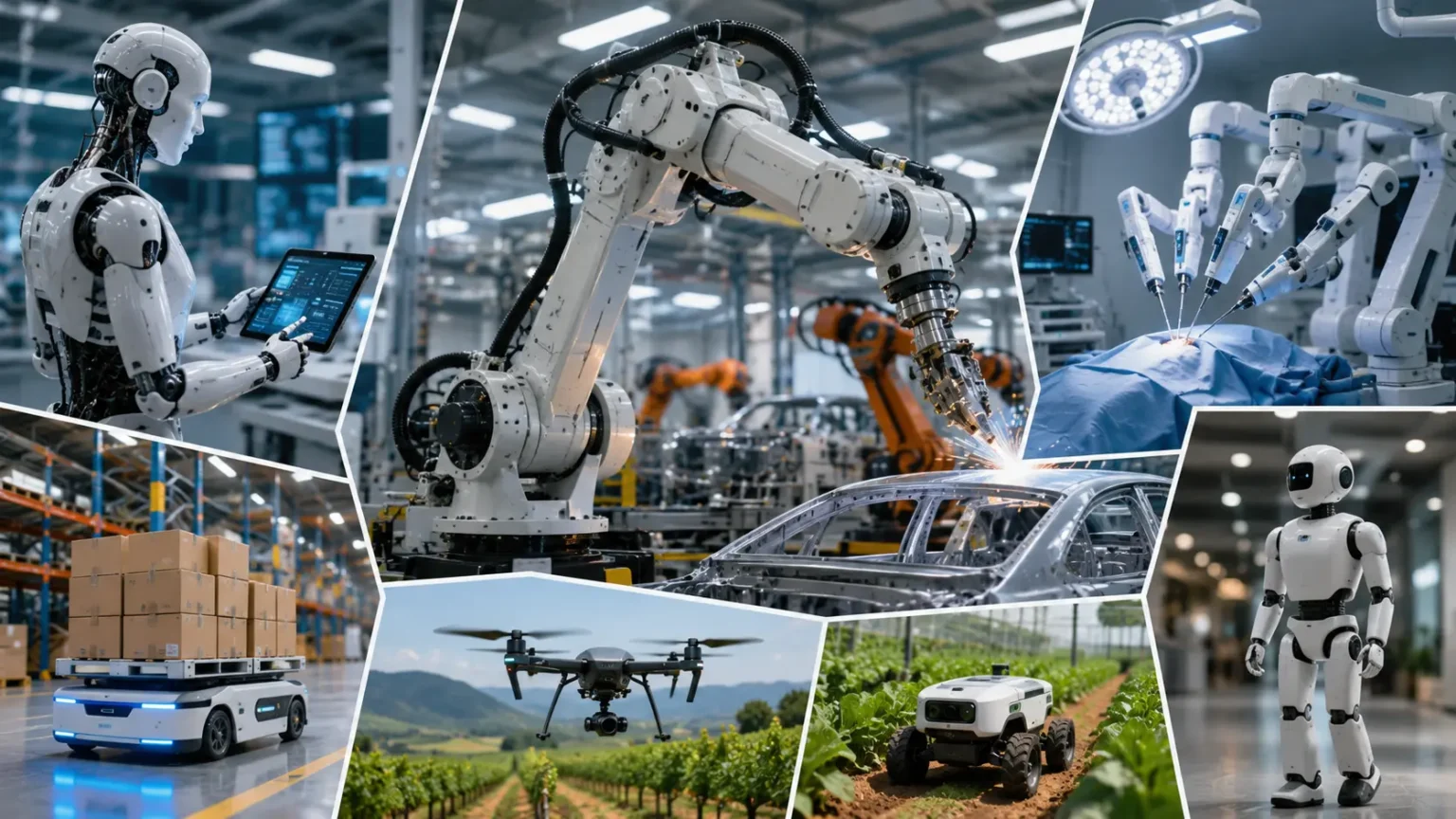
What Is Robotics? Types, Uses & Real-World Examples
Robotics is the field of science and engineering focused on designing, building, programming, and operating machines that can perform physical tasks. These machines, commonly called robots, can range from large industrial arms assembling vehicles to small autonomous devices navigating homes, warehouses, hospitals, farms, and laboratories. Modern robotics combines mechanical engineering, electronics, computer science, sensors, artificial intelligence, control systems, and software into working machines capable of interacting with the physical world. Some robots follow precisely programmed instructions, while others can sense changes in their surroundings and make limited decisions automatically. Robotics has become increasingly important because organizations use robots to improve productivity, safety, consistency, and access to difficult environments. Understanding how robotics works helps explain many technologies already transforming manufacturing, healthcare, transportation, logistics, agriculture, and everyday life.
What Is Robotics?
Robotics is an interdisciplinary branch of technology concerned with creating machines that can sense, move, manipulate objects, communicate, or perform tasks with varying levels of automation. The field includes everything involved in developing a robot, from mechanical design and electrical components to programming and system control. A robot typically receives information about its environment through sensors, processes that information using software or control systems, and then performs an action through motors or other actuators. Some machines operate according to fixed instructions, while more advanced robots can adjust their behavior based on sensor feedback. Robotics therefore brings the digital and physical worlds together. Instead of software merely processing information on a screen, robotic systems can use information to create physical actions in real environments.
The definition of a robot can vary because there is no single shape or function that every robot must share. Many people imagine a human-shaped machine when they hear the word robotics, but most practical robots look nothing like people. Industrial robots may resemble mechanical arms, warehouse robots may look like low mobile platforms, and underwater robots may resemble compact submarines. A robotic system is generally distinguished by its ability to perform physical actions under some degree of programmable control. Sensors, processing capabilities, actuators, and mechanical structures usually work together to produce those actions. The more autonomous the system becomes, the more it may need to interpret its environment before determining what to do next.
Robotics overlaps with automation, but the two terms are not exactly interchangeable. Automation refers broadly to using technology to perform processes with reduced human intervention, and many automated processes exist entirely within software. Robotics specifically involves machines that interact physically with the world. A software program automatically moving data between databases is automation, but it is not normally considered a robot. A robotic arm automatically moving components on an assembly line is both robotics and automation. This distinction matters because modern workplaces often combine robotic equipment with software automation, artificial intelligence, sensors, and digital management systems. Together, these technologies can automate complex workflows that previously required substantial manual labor.
Robotics has developed rapidly because improvements in computing, sensors, batteries, machine learning, cameras, motors, and manufacturing techniques have made sophisticated machines more practical. Earlier industrial robots were usually large machines performing carefully programmed repetitive movements inside controlled environments. Modern systems can sometimes detect objects, navigate changing spaces, collaborate more closely with people, or adapt their actions based on sensor information. Autonomous mobile robots can navigate warehouse floors, while agricultural robots can identify plants or move through fields. Medical robotic systems can help surgeons perform highly controlled procedures. These developments demonstrate how robotics has expanded beyond repetitive factory automation. The field increasingly involves machines that operate in dynamic environments rather than isolated production cells.
At its core, robotics attempts to answer a practical question: how can a machine perform a useful physical task reliably? The solution may require mechanical strength, precise movement, environmental awareness, intelligent software, or a combination of all four. Designers must also consider cost, energy consumption, safety, maintenance, communication, reliability, and the environment in which the robot will operate. A robot built for a clean manufacturing facility has very different requirements from one designed for underwater exploration or disaster response. There is therefore no universal robotic architecture suitable for every problem. Successful robotics involves matching the machine’s capabilities to the specific task, operating conditions, and people who will interact with it.
How Does Robotics Work?
Most robotic systems contain several major components that work together to sense the environment, process information, and create movement. Sensors gather information such as distance, position, temperature, pressure, speed, orientation, force, sound, or visual data. A controller or onboard computer processes this information according to programmed instructions or decision-making algorithms. Actuators then convert electrical, hydraulic, or pneumatic energy into physical movement. Mechanical structures such as joints, wheels, arms, tracks, or grippers determine how the robot interacts with the environment. Power systems provide the energy needed for computation and motion. Communication systems may also connect the robot with external computers, cloud platforms, operators, or other machines.
Sensors play a crucial role because a robot cannot respond intelligently to its surroundings without some way of observing them. Cameras can help robots recognize objects, inspect products, follow visual markers, or estimate their position. Proximity sensors can detect nearby obstacles, while force sensors may measure how firmly a robotic arm is gripping or pushing against an object. Encoders can track the position and movement of motors or joints. Some mobile robots use lidar, radar, ultrasonic sensors, or combinations of technologies to understand surrounding spaces. Sensor information is rarely useful by itself, however. Software must interpret the incoming data and determine what action the machine should take based on its goals and operating rules.
Actuators are responsible for turning decisions into movement. Electric motors are common in modern robots because they provide precise control and can be integrated into many mechanical systems. Hydraulic actuators may be used when very high force is required, while pneumatic systems can provide rapid movement in certain industrial applications. The type of actuator affects speed, strength, accuracy, energy efficiency, maintenance, and overall system design. A small collaborative robot handling lightweight components needs different motion technology from a large robotic machine lifting heavy materials. Engineers must calculate forces, loads, movement ranges, and safety requirements before choosing actuators. Effective robotic motion depends on both mechanical design and precise control of those components.
Robot control systems determine how actuators should move based on commands, sensor readings, and desired outcomes. In a simple system, the robot might repeatedly follow a predefined sequence of movements with very little variation. More advanced systems use feedback loops that continuously compare what is happening with what should be happening. If a robotic joint has not reached the expected position, for example, the controller can adjust motor commands. Mobile robots may repeatedly update their estimated location while navigating toward a destination. This feedback-based approach makes robots more accurate and adaptable. Control engineering is therefore fundamental to robotics because even sophisticated artificial intelligence is ineffective if the physical machine cannot move safely and predictably.
Software provides another major layer of robotic intelligence and functionality. Programmers define how robots perform tasks, respond to sensors, communicate with other systems, and handle unusual situations. Traditional robots may rely heavily on deterministic rules, while newer robotic applications can incorporate machine learning, computer vision, planning algorithms, or natural language interfaces. Artificial intelligence can improve perception and decision-making, but it does not remove the need for conventional control systems. A robot still requires reliable low-level software to operate motors, monitor hardware, manage safety functions, and maintain stable behavior. Modern robotics therefore combines traditional engineering with increasingly advanced software. The most successful systems usually integrate both rather than depending entirely on one technological approach.
Main Types of Robots
Industrial robots are among the most established and widely used types of robots. They are commonly installed in factories to perform repetitive, precise, or physically demanding tasks such as welding, painting, material handling, assembly, packaging, and machine loading. Many industrial robots use articulated arms containing multiple joints that allow the end of the arm to move through a large working area. Different configurations include articulated robots, SCARA robots, Cartesian robots, delta robots, and other specialized designs. Traditional industrial systems often operate inside guarded work areas because their speed and power can create safety risks. Their primary advantages include consistency, repeatability, high production rates, and the ability to perform demanding tasks for extended periods.
Collaborative robots, commonly called cobots, are designed to work more closely with people than traditional industrial robots. Cobots often include force sensing, speed limitations, collision detection, and other safety-oriented features that can support shared workspaces when properly implemented. They are frequently used for tasks such as light assembly, inspection, packaging, machine tending, and repetitive handling. One reason cobots have attracted attention is that they can be easier to deploy for smaller production environments or workflows that require regular changes. However, calling a robot collaborative does not automatically make every application safe. Tools, workpieces, speed, surrounding machinery, and specific operating conditions still require risk assessment. Human-robot collaboration depends on the complete application rather than the robot alone.
Mobile robots are designed to move through an environment instead of remaining fixed in one location. Automated guided vehicles traditionally follow predefined paths using markers, magnetic strips, or other navigation infrastructure. Autonomous mobile robots use sensors and software to navigate more flexibly, allowing them to plan routes and respond to obstacles. Warehouses, factories, hospitals, hotels, and other facilities increasingly use mobile robots to transport materials or supplies. Outdoor mobile robots can operate on wheels, tracks, or specialized platforms depending on terrain. Navigation requires the machine to understand its position and surrounding environment well enough to move safely. Technologies such as mapping, localization, obstacle detection, and route planning are therefore central to mobile robotics.
Humanoid robots are designed with physical characteristics inspired by the human body, often including a torso, arms, legs, or a human-like face. Researchers develop humanoid robots partly because human environments are already designed around human size, reach, movement, stairs, tools, and workspaces. A sufficiently capable humanoid could theoretically operate equipment or move through environments without requiring major infrastructure changes. In practice, balancing, walking, manipulating objects, and operating safely around people remain technically difficult challenges. Some humanoid systems are developed for research, customer interaction, entertainment, logistics, or experimental industrial use. Public interest in humanoid robots is high, but many real-world robotic applications continue to use simpler specialized designs because purpose-built machines can be more efficient.
Service robots form another broad category and are generally designed to perform useful tasks outside traditional industrial manufacturing. Examples include robotic vacuum cleaners, hospital delivery robots, inspection robots, agricultural robots, cleaning machines, security platforms, and hospitality robots. Service robotics can be divided into professional and consumer applications depending on where and how the machines are used. Some systems operate almost autonomously, while others remain under close human control. The category continues to grow as sensors, batteries, computing, and navigation technologies become more affordable. Unlike factory robots working in carefully controlled spaces, service robots often need to handle unpredictable environments. That requirement makes perception, navigation, interaction, and safety particularly important.
Industrial and Manufacturing Uses of Robotics
Manufacturing is one of the areas where robotics has had the greatest economic and technological impact. Automobile factories are well known for using large robotic arms to weld vehicle bodies, apply coatings, move heavy components, and support assembly operations. Robots are attractive in these applications because production requires thousands of similar movements to be completed with high consistency. Once properly programmed and maintained, robotic systems can repeat the same motion continuously while maintaining relatively stable quality. They can also operate in environments involving heat, fumes, sharp materials, or physically demanding loads. Human employees remain essential for maintenance, quality control, engineering, supervision, problem solving, and tasks requiring flexibility. Robotics usually changes how work is organized rather than simply eliminating every human role.
Material handling is another major application of industrial robotics. Robots can move components between machines, load raw materials, unload finished parts, stack products, or arrange packages on pallets. These tasks are often physically repetitive and can create ergonomic challenges for human workers when heavy objects must be moved frequently. Robotic palletizing systems can handle cases or containers according to programmed patterns, while robotic arms equipped with specialized grippers can manipulate objects with different shapes. Machine-tending robots can load parts into CNC machines and remove them after processing. Integrating these systems with conveyors, sensors, and production software can create highly automated manufacturing cells. The economic value depends on factors such as production volume, task complexity, labor requirements, and uptime.
Robots are also widely used for welding because the task benefits from repeatability and consistent movement. A robotic welding system can follow programmed paths while controlling speed, angle, and other process variables according to production requirements. Automotive manufacturing uses robotic welding extensively, but the technology also appears in metal fabrication and other industries. Painting is another application where robots can improve consistency while reducing direct worker exposure to chemicals and fumes. Specialized robotic systems may operate inside controlled booths where precise movement and spraying patterns are important. These applications demonstrate one traditional strength of robotics: performing repetitive industrial processes in environments that may be unpleasant or hazardous for people. Automation can improve both productivity and workplace safety when designed responsibly.
Quality inspection increasingly combines robotics with machine vision. Cameras and other sensors can examine manufactured products for dimensions, surface defects, missing components, incorrect assembly, or other quality issues. A robot may position the camera around a component, or the inspection system may remain fixed while products move through the production line. Artificial intelligence can assist with identifying visual defects that are difficult to describe through simple rules. However, inspection systems must be trained and validated carefully because false positives and missed defects can create production problems. Human quality specialists continue to play an important role in defining standards and reviewing unusual cases. Robotics makes inspection faster and more consistent, but quality decisions still depend on appropriate engineering and process controls.
Flexible manufacturing is becoming increasingly important as companies produce more product variations and shorter production runs. Traditional industrial automation works extremely well when the same task is repeated millions of times, but reconfiguring rigid equipment can be expensive. Modern robotic systems increasingly support programmable tools, computer vision, modular workstations, and faster changeovers. This flexibility can help manufacturers adjust production without rebuilding an entire line. Cobots and mobile robots are particularly relevant where production layouts change or humans and machines must share tasks. Digital twins and simulation tools can also help engineers test robotic workflows before physical installation. As manufacturing becomes more data-driven, robotics is increasingly integrated with smart factories, industrial networks, sensors, and production management systems.
Healthcare and Medical Robotics
Healthcare robotics includes systems that assist with surgery, rehabilitation, logistics, diagnostics, patient support, and medical research. Surgical robots are among the most recognizable examples because they allow surgeons to control specialized instruments through highly precise mechanical systems. These platforms do not typically perform surgery independently; trained clinicians remain responsible for controlling procedures and making medical decisions. Robotic systems can provide stable instrument movement, enhanced visualization, and access through relatively small incisions for certain procedures. The suitability of robotic surgery depends on the operation, available expertise, equipment, patient circumstances, and healthcare facility. Robotics should therefore be viewed as a tool that can expand clinical capabilities rather than a replacement for professional medical judgment.
Rehabilitation robotics helps patients practice movements following injuries, neurological conditions, or other health problems. Robotic devices can support repetitive movement exercises involving the arms, hands, legs, or walking. Some systems measure movement and adjust assistance according to patient performance, allowing therapists to collect useful information during rehabilitation. Robotic exoskeletons may help certain individuals stand or practice walking under professional supervision. These devices remain specialized tools rather than universal solutions, and outcomes depend on the patient’s condition and treatment goals. Physiotherapists and other rehabilitation professionals determine how technology fits into a broader therapy program. Robotics can increase repetition and consistency, but human clinical expertise remains essential for interpreting progress and adapting care.
Hospitals are also experimenting with mobile service robots that transport medications, linens, laboratory samples, meals, or equipment between departments. These tasks can require staff members to spend significant time walking through large healthcare facilities. A reliable mobile robot can reduce some routine transportation demands and allow workers to concentrate on tasks requiring human skills. Hospital robots must navigate hallways safely around patients, visitors, beds, carts, and constantly changing obstacles. They may also need to use elevators or connect with building systems. Infection control and cleaning requirements create additional design considerations. Healthcare environments therefore present a demanding real-world robotics challenge because safety, reliability, privacy, and operational continuity are extremely important.
Pharmacy automation provides another practical example of robotics in healthcare. Robotic systems can help store, retrieve, count, label, or organize medications under controlled processes. Automation may reduce some repetitive tasks and support inventory management, although pharmacists and pharmacy technicians remain responsible for professional oversight and medication safety. Laboratories similarly use robotic equipment to move samples, prepare materials, dispense liquids, or automate repeated testing steps. These systems are especially useful when thousands of highly standardized operations must be performed accurately. Laboratory robotics became increasingly important as diagnostic testing and biotechnology workflows expanded. By combining robotics with laboratory information systems, healthcare organizations can streamline complex processes while maintaining records needed for traceability and quality assurance.
Medical robotics also includes emerging technologies such as robotic prosthetics, assistive devices, telepresence robots, and experimental microscale systems. Advanced prosthetic limbs can use sensors and electronic control to provide more responsive movement than purely mechanical devices. Assistive robots may help people with limited mobility complete certain household or daily activities. Telepresence systems can allow healthcare professionals to communicate with patients from another location while navigating a clinical environment remotely. Research laboratories are also exploring very small robotic platforms for specialized medical applications, although many remain experimental. These developments show that healthcare robotics extends far beyond operating rooms. Future progress will depend not only on technical performance but also on affordability, regulation, clinical evidence, accessibility, and trust.
Robotics in Warehouses and Logistics
Warehousing has become one of the fastest-growing areas for practical mobile robotics because modern distribution centers must move enormous numbers of products efficiently. Autonomous mobile robots can transport shelves, containers, pallets, or individual items between storage locations and workers. Instead of employees walking long distances to retrieve every product, robots can bring materials closer to packing or picking stations. This can reduce travel time and improve workflow efficiency. Sensors help the robots navigate around people, equipment, and obstacles while software coordinates routes across the facility. Warehouse management systems can assign tasks based on inventory location and order priorities. The result is a highly coordinated environment in which software and physical machines work together continuously.
Robotic picking is another major logistics challenge because grasping random objects is much harder than moving standardized containers. Products vary in shape, weight, material, packaging, transparency, and orientation. A robot needs vision systems or other sensors to identify an item and calculate how to grasp it successfully. Specialized grippers may use suction, fingers, soft materials, or combinations of mechanisms depending on the application. Machine learning has improved object recognition and grasp planning, but human-level manipulation remains difficult in highly unstructured situations. Many warehouses therefore use robots for carefully selected categories of products while workers handle unusual items. Hybrid workflows allow businesses to gain efficiency without expecting robots to solve every possible handling problem.
Sorting systems are widely used in parcel delivery and e-commerce fulfillment centers. Conveyors move packages through the facility while scanners read barcodes or other identifiers. Robotic or automated systems then direct each package toward the correct destination, container, or delivery route. High-speed sortation is particularly valuable because logistics networks may process enormous volumes during busy shopping periods. Robots can also help unload or load trailers, although dealing with randomly stacked packages remains technically demanding. Computer vision and improved gripping systems continue to expand what machines can handle. The logistics industry demonstrates how robotics often succeeds by breaking a complicated workflow into smaller tasks that can each be automated effectively.
Last-mile delivery robots represent another visible example of logistics robotics. Small autonomous vehicles have been tested or deployed in some communities to transport groceries, meals, or packages over relatively short distances. These machines must recognize sidewalks, pedestrians, crossings, obstacles, and changing environmental conditions. Operating safely outside a controlled warehouse is substantially more complicated than moving through a mapped indoor facility. Regulations, weather, vandalism, accessibility, and public acceptance can all affect whether delivery robots are practical. A technically capable machine may still struggle if local infrastructure or legal rules are unsuitable. Last-mile robotics therefore highlights how successful deployment depends on social and regulatory conditions in addition to engineering performance.
Drones can also be considered part of the broader robotics landscape when they operate autonomously or semi-autonomously. Logistics companies have explored drones for urgent medical deliveries, remote-area transportation, inventory inspection, and small-package delivery. Flying robots offer unique advantages because they can travel over difficult terrain and avoid road congestion. However, flight time, battery capacity, weather, payload limitations, airspace regulations, and safety requirements restrict many applications. Warehouse drones can perform inventory scanning without carrying packages, which may be easier to implement than urban delivery. As drone technology develops, it will likely complement ground robots rather than replace them. Different robotic platforms are most effective when matched to environments where their mobility provides a clear advantage.
Robotics in Agriculture and Food Production
Agriculture increasingly uses robotics to address labor-intensive tasks, improve precision, and collect detailed information about crops. Autonomous tractors and agricultural vehicles can follow planned routes while performing operations such as tilling, planting, spraying, or monitoring fields. GPS, cameras, machine vision, and other sensors help these systems understand their position and surroundings. Precision agriculture aims to apply resources more accurately rather than treating every part of a field identically. Robotic equipment may therefore help farmers reduce waste while targeting water, fertilizer, or crop protection where needed. Agricultural robotics operates in challenging conditions because fields contain dust, mud, uneven terrain, changing weather, and living plants. Machines designed for farms must therefore be rugged as well as intelligent.
Robotic harvesting is a particularly difficult challenge because fruits and vegetables vary naturally in size, color, shape, position, and ripeness. A harvesting robot may use cameras and artificial intelligence to identify suitable produce before guiding a robotic arm or specialized tool toward it. The machine must avoid damaging the crop while working quickly enough to be economically useful. Soft fruits are especially challenging because excessive gripping force can cause bruising. Researchers and companies have developed systems for crops such as strawberries, apples, tomatoes, and other produce, but performance varies by crop and operating environment. Harvesting robotics illustrates how machine vision and manipulation must work together. Identifying an object correctly is only the first step; the robot must also interact with it safely.
Weed management is another promising agricultural use. Vision-guided robots can travel through fields and distinguish crops from unwanted plants. Once a weed is identified, the system may mechanically remove it, apply a targeted treatment, or use another method depending on the design. Precise identification can potentially reduce the amount of herbicide applied compared with treating an entire field uniformly. Similar technologies may monitor plant health, detect diseases, count crops, or identify areas suffering from water stress. These systems generate valuable agricultural data in addition to performing physical tasks. Farmers can combine robotic observations with weather information, soil sensors, and yield data. The result is an increasingly information-driven approach to managing crops.
Dairy farms provide another established example of agricultural robotics. Robotic milking systems allow cows to enter a milking station voluntarily, where sensors identify the animal and automated equipment performs parts of the milking process. The system can collect information about milk production and animal behavior while reducing some repetitive manual tasks. Automatic feeding equipment and barn-cleaning robots may also be used in livestock operations. These systems demonstrate that agricultural robotics is not limited to crop fields. However, animal welfare, hygiene, maintenance, and careful management remain essential. Robots can automate specific processes, but farmers still need to monitor animal health and the wider farm environment.
Food processing facilities also use robots extensively after agricultural products leave the farm. Robotic systems can cut, sort, package, palletize, inspect, and move food products through production facilities. Handling food presents special challenges because products may be delicate, irregularly shaped, wet, slippery, or easily contaminated. Equipment therefore needs hygienic designs that can tolerate appropriate cleaning procedures. Machine vision can help identify defective products or guide robots as items move along conveyors. Flexible robotic grippers are making it easier to handle foods that traditional rigid grippers would damage. As labor availability and food safety requirements continue to influence the industry, robotics is likely to play an expanding role across both agriculture and food production.
Real-World Examples of Robotics
One of the most familiar real-world examples of robotics is the robotic arm used on automotive production lines. These machines perform tasks such as spot welding, painting, adhesive application, assembly, and component handling. Their movements can be programmed with extremely high repeatability, allowing manufacturers to maintain consistent production processes across thousands of vehicles. Multiple robots may work within the same production cell, with each machine assigned a specific sequence of actions. Sensors and safety systems coordinate their operation and prevent dangerous interactions. Human technicians monitor equipment, maintain robots, troubleshoot faults, and manage production quality. This combination of human expertise and robotic repeatability represents one of the longest-established examples of successful industrial automation.
Robotic vacuum cleaners provide an everyday consumer example that demonstrates several fundamental robotics concepts. The device moves physically through an environment, uses sensors to detect obstacles and surfaces, and follows software instructions to clean an area. More advanced models can build maps, identify rooms, avoid specific objects, and return automatically to charging stations. Although these capabilities are less dramatic than humanoid robotics, they show how useful autonomy can emerge from relatively focused functions. The robot does not need general human intelligence to perform its task effectively. Instead, it needs reliable navigation, adequate suction, obstacle detection, battery management, and a suitable cleaning strategy. Purpose-specific robots often succeed precisely because their responsibilities are clearly defined.
Mars rovers provide another striking example of robotics operating where direct human work would be extremely difficult. Planetary rovers combine mobility systems, cameras, scientific instruments, robotic mechanisms, communication equipment, and autonomous navigation capabilities. Because signals between Earth and Mars take time to travel, operators cannot control every movement as though driving a remote-controlled vehicle in real time. Rovers therefore need some ability to evaluate terrain and execute planned actions without immediate human input. Their instruments collect images and scientific measurements that researchers analyze on Earth. Space robotics allows humanity to explore environments that are distant, hazardous, or inaccessible. Similar principles are used for robotic exploration of oceans, volcanoes, nuclear facilities, and disaster zones.
Warehouse mobile robots offer another large-scale example that many consumers never directly see. Hundreds or thousands of robots can operate inside a single distribution facility, transporting goods between storage and processing areas. Central software coordinates assignments while each robot uses onboard sensors to move safely. The machines constantly exchange information with warehouse systems so inventory and order workflows remain synchronized. This form of robotics demonstrates how the value of a robot often comes from being part of a larger digital ecosystem. One mobile platform alone may provide limited benefit, but a coordinated fleet can transform material movement across an entire facility. Fleet management software therefore becomes nearly as important as the physical robots themselves.
Surgical robotic systems demonstrate how robots can augment human precision rather than operate independently. A surgeon controls specialized instruments through an interface while the robotic mechanism translates those commands into carefully controlled movements. The system can provide stable motion and enhanced access during certain minimally invasive procedures. The physician remains responsible for planning and conducting the operation, making this fundamentally different from the popular idea of an autonomous robot performing surgery alone. Similar human-in-the-loop models appear across aviation, defense, underwater exploration, construction, and hazardous-material handling. Robotics does not always mean removing people from a task completely. In many valuable applications, the robot extends human capabilities while the person continues to provide judgment, experience, and oversight.
Robotics, Artificial Intelligence, and Automation
Artificial intelligence and robotics are closely related, but neither field requires the other in every application. A traditional factory robot can repeat programmed movements accurately without using modern AI. Likewise, an AI chatbot can analyze language without controlling a physical machine. When AI and robotics are combined, however, robots can gain more sophisticated capabilities for perception, planning, prediction, and interaction. Computer vision can help a machine identify objects, while machine learning can assist with classifying sensor information or recognizing patterns. Natural language models may allow users to communicate with certain robots more intuitively. The combination is especially useful when a robot must operate in environments that cannot be fully described in advance.
Computer vision has become one of the most important AI technologies in robotics because many physical tasks require understanding visual information. A warehouse robot may need to distinguish packages, an agricultural robot may identify crops, and an inspection robot may look for cracks or manufacturing defects. Cameras capture images, while software analyzes those images to identify relevant objects, boundaries, movement, or patterns. Depth cameras can provide information about distance, helping robots estimate three-dimensional positions. Vision systems must remain reliable under changing lighting, reflections, dirt, shadows, and unusual object orientations. Humans handle those variations effortlessly, but machines often require substantial engineering. Improving visual perception is therefore essential for making robots more flexible outside highly controlled environments.
Machine learning can also improve robotic decision-making by helping systems learn patterns from data rather than relying entirely on manually written rules. For example, a robot might learn how different objects should be grasped based on previous examples. Autonomous systems may use learned models to recognize terrain or predict how surrounding objects are likely to move. Reinforcement learning is another research approach in which an agent learns behaviors by receiving feedback associated with different actions. Training can occur partly in simulation so researchers do not need to risk physical hardware during every experiment. However, transferring behavior from simulation to the real world can be difficult because physical environments contain unpredictable details. Reliable robotic AI therefore usually combines learning with engineering constraints and safety systems.
Generative AI and language models are beginning to influence human-robot interaction as well. Instead of requiring users to specify every action through specialized programming interfaces, language-based systems may translate natural instructions into structured tasks. A person could potentially describe an objective while software breaks it into smaller robotic actions. However, language models can misunderstand instructions or generate incorrect outputs, which creates serious challenges when their decisions control physical machines. Safety-critical actions require verification, constraints, and reliable control mechanisms rather than trusting unrestricted generated commands. Robotics makes AI errors more consequential because mistakes can affect physical objects and people. As a result, developers must carefully separate flexible high-level reasoning from safety-critical low-level control.
Automation provides the broader framework within which many robotic systems operate. A modern production facility may combine robots, programmable controllers, cameras, industrial networks, inventory software, AI systems, and human workers. Warehouses similarly integrate mobile robots with order management, barcode scanning, scheduling, and transportation software. The greatest productivity gains often come from redesigning the complete workflow rather than adding a robot to an inefficient process. Companies must determine which tasks should be automated, which should remain human-led, and where cooperation between both provides the best result. Robotics is therefore increasingly part of digital transformation strategies rather than an isolated engineering project. The future of automation will likely involve coordinated systems combining physical robotics with intelligent software.
Benefits and Challenges of Robotics
One of the biggest benefits of robotics is consistency. A properly designed robot can repeat a task thousands of times without fatigue affecting its movement in the same way it affects human workers. This is valuable for welding, assembly, inspection, packaging, and other processes where repeatability contributes to quality. Robots can also operate for long periods when maintenance, material supply, and production schedules permit. Greater consistency can reduce defects and help companies standardize production. However, robotic systems still experience failures, calibration problems, tool wear, and software issues. They require maintenance and monitoring like any other industrial equipment. Automation should therefore be evaluated based on total operational reliability rather than the assumption that robots never make mistakes.
Safety is another important advantage when robots perform tasks involving dangerous environments or physically demanding work. Machines can enter areas with radiation, extreme temperatures, unstable structures, toxic materials, or other hazards where exposing people would be risky. Industrial robots can lift heavy components, handle hot materials, and perform repetitive movements that might otherwise contribute to worker injuries. Disaster-response robots can inspect buildings before rescue teams enter them. Remote-controlled underwater robots can operate at depths that are difficult for divers. Nevertheless, robots introduce their own safety risks, particularly when powerful moving machinery operates near humans. Good engineering therefore requires barriers, sensors, emergency systems, procedures, training, and application-specific risk assessment.
Cost is one of the main challenges limiting robotic adoption. Purchasing a robot is only part of the total investment because organizations may also need tooling, integration, sensors, software, safety equipment, programming, employee training, and facility modifications. Maintenance and future upgrades add further expenses. Automation can be highly economical for repetitive high-volume processes but less attractive when production changes constantly or task volumes are low. Smaller businesses may find collaborative or modular robotics more accessible because these systems can sometimes be deployed with less infrastructure. However, each business needs to calculate whether the expected productivity, safety, or quality improvements justify the investment. Robotics is most effective when it solves a clearly defined operational problem.
Technical complexity presents another challenge because real-world environments are unpredictable. A robot working inside a carefully organized factory can be programmed around known positions and standardized components. A robot operating in a home, farm, street, or construction site must deal with constantly changing objects and conditions. Humans can easily recognize that a chair has moved or a pathway is blocked, while a machine must detect and interpret the change correctly. Weather, dirt, lighting, wireless connectivity, sensor failures, and unexpected human behavior can further complicate operation. Increasing robot autonomy therefore requires advances not only in AI but also in mechanical reliability and systems engineering. Real-world robustness often matters more than impressive performance during a controlled demonstration.
Workforce impact is another major consideration as robotics becomes more widespread. Automation can reduce the need for certain repetitive tasks while increasing demand for robotics technicians, software developers, maintenance specialists, integration engineers, data analysts, and other technical roles. Some jobs may change substantially instead of disappearing completely, with workers supervising automated systems or concentrating on tasks requiring judgment and interpersonal skills. Businesses adopting robotics need training strategies that help employees work safely and effectively with new technologies. Policymakers and educational institutions also face questions about workforce development. The long-term impact will vary by industry and region. Robotics offers major productivity benefits, but successful adoption should consider people and organizational change alongside technical performance.
The Future of Robotics
The future of robotics is likely to involve greater autonomy, improved perception, more flexible manipulation, and closer cooperation between humans and machines. Robots are gradually moving from highly controlled industrial settings into warehouses, hospitals, farms, laboratories, public spaces, and homes. Each expansion introduces new challenges because unpredictable environments require machines to understand more about the world around them. Better cameras, lidar, force sensors, processors, and AI models are helping robots handle increasingly complicated situations. At the same time, improvements in motors, batteries, materials, and mechanical design are making machines more capable physically. Progress will probably occur through thousands of specialized improvements rather than one sudden breakthrough that creates universally intelligent robots.
Humanoid robotics is likely to remain an especially visible area of development because several technology companies and research groups are working on machines designed for human environments. A humanoid form potentially allows a robot to use stairs, tools, shelves, doors, workstations, and other infrastructure created for people. The challenge is that the human body is extraordinarily capable, combining balance, dexterity, strength, vision, touch, and adaptability. Replicating even a portion of those capabilities reliably is difficult and expensive. Early commercial humanoid applications are therefore likely to focus on structured tasks where environmental variation can be controlled. Whether humanoid robots become widespread will depend on reliability, cost, safety, maintenance, and whether they outperform simpler specialized machines economically.
Soft robotics represents another promising area because traditional robots are usually made from rigid links and joints. Soft robotic systems use flexible materials or compliant mechanisms that can deform when interacting with objects. This can be advantageous when handling delicate foods, fragile products, biological tissues, or irregular shapes. Soft grippers, for example, can conform around objects without applying the concentrated pressure produced by rigid mechanical fingers. Researchers are also exploring soft robotics for medical devices, wearable systems, and biologically inspired machines. Control can be challenging because flexible structures do not move as predictably as rigid mechanisms. Nevertheless, soft robotics could expand automation into tasks that traditional mechanical designs handle poorly.
Swarm robotics is another research direction inspired partly by collective behavior observed in insects and other biological systems. Instead of relying on one complex machine, a swarm may use many relatively simple robots that coordinate their actions. Potential applications include environmental monitoring, exploration, agriculture, search operations, and large-scale inspection. The advantage is that the overall system may continue operating even if individual robots fail. Coordinating large numbers of machines, however, creates challenges involving communication, navigation, collision avoidance, and task allocation. Swarm robotics remains more experimental than many industrial applications, but it demonstrates how future robotic systems may operate collectively. Intelligence can sometimes emerge from coordination among machines rather than residing entirely inside one robot.
Ultimately, robotics will probably become increasingly ordinary rather than remaining a technology people notice only in science fiction. Robots already manufacture products, move packages, clean floors, explore planets, assist surgeons, inspect infrastructure, and support agricultural operations. Future machines will likely perform more tasks while becoming less visually remarkable because they will be integrated into everyday systems and workplaces. The most successful robots may not resemble humans or appear dramatically intelligent. They will simply perform useful physical tasks reliably, safely, and economically. Robotics will continue to evolve alongside artificial intelligence, automation, sensors, and computing. Understanding the field today provides valuable insight into how machines will increasingly interact with the physical world tomorrow.
FAQs About Robotics
What is robotics in simple words?
Robotics is the field of creating and controlling machines that can perform physical tasks automatically or with limited human assistance. It combines mechanical engineering, electronics, sensors, computers, programming, and control systems.
What are the main types of robots?
Common types include industrial robots, collaborative robots, autonomous mobile robots, service robots, humanoid robots, medical robots, agricultural robots, drones, and specialized exploration robots. The categories often overlap because a single robot can belong to more than one group.
What is the difference between robotics and automation?
Automation is the broader concept of using technology to perform processes with reduced human intervention. Robotics is a type of automation involving physical machines that sense, move, manipulate objects, or interact with their surroundings.
Does every robot use artificial intelligence?
No. Many robots perform useful tasks using traditional programming, sensors, and control systems without modern artificial intelligence. AI becomes especially valuable when robots need advanced vision, learning, natural language interaction, or decision-making in changing environments.
What are some real-world examples of robotics?
Real-world examples include robotic arms in automotive factories, warehouse mobile robots, robotic vacuum cleaners, surgical robotic systems, agricultural harvesting robots, Mars rovers, inspection drones, and automated laboratory equipment. These examples show that modern robotics extends far beyond humanoid machines.