


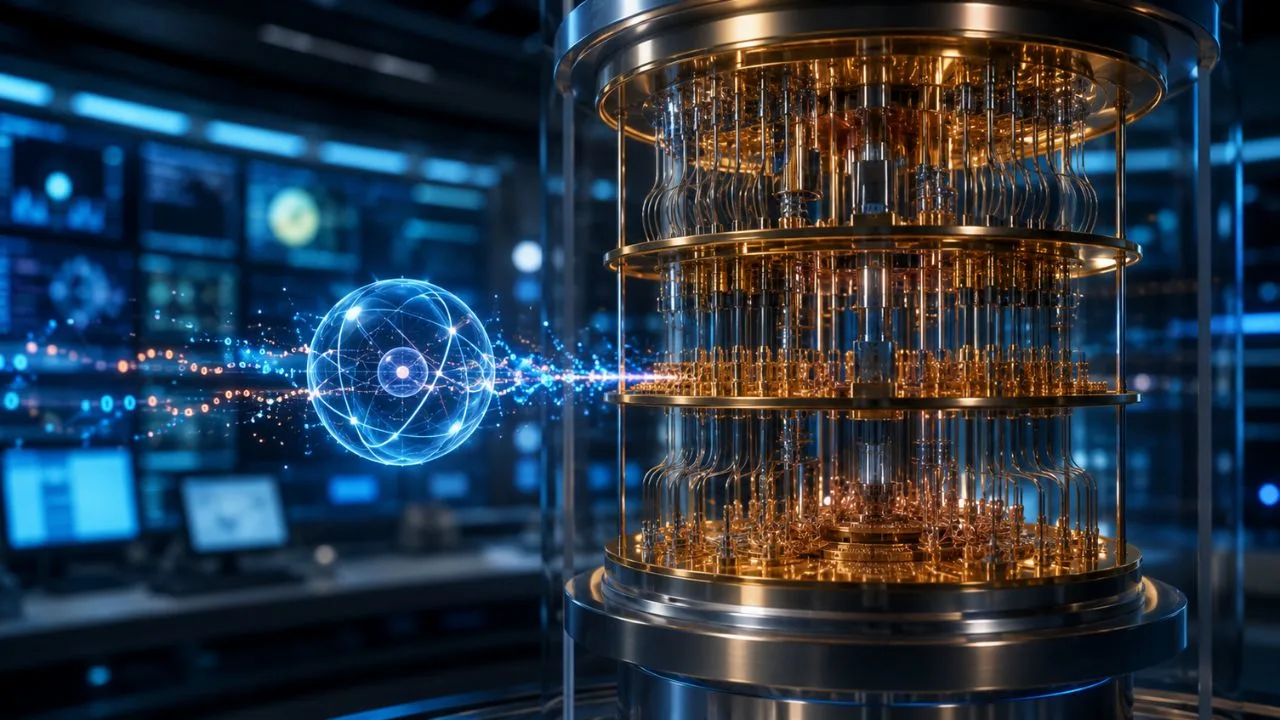
Quantum computing is one of the most exciting and misunderstood areas of modern technology. It uses ideas from quantum physics to process information in a different way from normal computers. Instead of relying only on regular bits, quantum computers use quantum bits known as qubits. Understanding how quantum computing works begins with learning what makes these qubits special.
A quantum computer is not simply a much faster version of a laptop. It is a different type of machine designed to handle certain problems in a new way. It uses superposition, entanglement, interference, and measurement to perform calculations. These ideas may sound difficult, but they become clearer when we explore them one step at a time.
Quantum computers are expected to support research in chemistry, materials, optimization, medicine, and cryptography. However, they will not replace ordinary computers for every task. Classical computers remain better for browsing websites, writing documents, watching videos, and running most everyday software. Quantum systems are mainly being developed for specialized problems that are difficult for classical machines.
This guide explains quantum computing in simple language without hiding its real complexity. You will learn how qubits store information, how quantum gates change them, and how quantum algorithms produce useful answers. You will also understand why quantum computers make errors, what they can do today, and what must improve before they become widely useful.
What Is Quantum Computing?
Quantum computing is a method of processing information using the rules of quantum mechanics. Quantum mechanics explains how very small objects, such as atoms, electrons, and particles of light, behave. These objects do not always follow the everyday rules we see in larger objects. Quantum computers attempt to control those unusual behaviors and use them for calculation.
A normal computer stores information as bits that have a value of either zero or one. Every image, video, application, and website is eventually represented through large patterns of these two values. A quantum computer uses qubits instead of ordinary bits. A qubit can be controlled in ways that allow more complex information to be represented before it is measured.
Quantum computing does not mean that every possible answer instantly appears at the same time. A useful quantum program must carefully shape the probabilities of different outcomes. It increases the chance of measuring a helpful answer while reducing the chance of measuring an unwanted one. This is why quantum algorithm design requires more than simply adding extra qubits.
Researchers are developing quantum computers because some problems become extremely difficult as their size grows. A classical computer may need to examine too many possible combinations or simulate a system with too many interacting parts. A carefully designed quantum algorithm may handle the structure of certain problems more efficiently. The advantage depends on the problem, algorithm, hardware, and required accuracy.
How Is Quantum Computing Different From Classical Computing?
Classical computers use electrical switches called transistors to process bits. A bit represents a clear zero or one at any particular moment. Classical logic gates combine these bits to perform calculations and follow instructions. Billions of fast transistors allow modern computers to run complex applications, store information, and connect people across the world.
Quantum computers use physical quantum systems to represent qubits. Depending on the hardware, a qubit may be created from an ion, atom, photon, electron spin, or tiny superconducting circuit. Engineers control these systems with carefully timed signals. The exact signals may involve microwaves, lasers, magnetic fields, or other methods suited to the hardware.
The two types of computers also handle errors differently. Classical bits are stable enough that errors can often be detected and corrected using copies of information. Qubits are more fragile and cannot simply be copied in the same way. Quantum error correction therefore requires carefully arranged groups of physical qubits to protect useful logical information.
Quantum and classical computers are likely to work together rather than compete in every area. A classical computer can prepare data, control the quantum processor, and study its results. The quantum processor can perform the part of a calculation suited to quantum operations. This combined approach is often called hybrid quantum computing and is central to many current systems.
How Do Qubits Work?
A qubit is the basic unit of information in a quantum computer. Like a classical bit, it can produce a measured result of zero or one. Before measurement, however, its state can contain a quantum combination of both possibilities. This combination gives quantum algorithms a richer way to represent and change information during a calculation.
The state of one qubit can be pictured as a point on an imaginary sphere. Different points represent different combinations of zero and one, including information about their relative phase. Quantum gates move the state around this space in controlled ways. When the qubit is measured, the result becomes either zero or one according to the state’s probabilities.
This does not mean that a qubit reveals both answers when it is read. Measurement produces only one classical result. To understand the probability pattern, a quantum circuit is usually run many times. Each run produces a result, and the collection of results shows which outcomes appear most often.
When more qubits are added, the mathematical description grows very quickly. Two qubits require four amplitudes, while three require eight. In general, a system of several qubits can represent a large state space. Quantum algorithms try to control this space without directly reading all of its hidden information.
What Is Superposition?
Superposition is the ability of a quantum system to exist in a combination of possible states before measurement. For a qubit, those possibilities are commonly described using zero and one. A quantum gate can place a qubit into a balanced or unbalanced superposition. The final measurement still returns only one ordinary value.
A common explanation says that a qubit is zero and one at the same time. This phrase is useful as a starting point, but it can also be misleading. A superposition is not simply two normal values stored side by side. It is a quantum state with amplitudes and phase relationships that can interact during a calculation.
Imagine several paths that waves can follow. When those waves meet, they may strengthen or cancel one another. A quantum algorithm uses the amplitudes connected with different computational paths in a similar mathematical way. The goal is not merely to create many possibilities but to control how those possibilities later combine.
Superposition allows a quantum circuit to explore a large mathematical state. However, superposition alone does not guarantee a useful speed advantage. The algorithm must use gates that create the correct interference pattern. Without that structure, measurement may return a random-looking result that offers little useful information.
What Is Quantum Entanglement?
Quantum entanglement occurs when qubits become connected in a way that cannot be fully described separately. The state of the entire group becomes more important than the state of each individual qubit. Measurements of entangled qubits can show strong relationships. These relationships are created by the shared quantum state rather than normal stored instructions.
Entanglement does not allow useful messages to travel faster than light. It creates correlations that become visible when measurement results are later compared. Quantum algorithms use these correlations to represent relationships between different parts of a problem. This can be especially useful when many variables influence one another.
A two-qubit gate can create entanglement when one qubit is already in superposition. For example, a controlled operation can connect the possible values of one qubit with those of another. After this process, the qubits may no longer have independent descriptions. Changing later operations can affect the probability pattern of the entire system.
Not every quantum algorithm requires the largest possible amount of entanglement. Too much uncontrolled entanglement can also make a system difficult to understand or simulate. Researchers study where entanglement creates useful computational power. They also examine how noise damages it before a calculation has been completed.
What Is Quantum Interference?
Quantum interference is the process through which probability amplitudes strengthen or cancel one another. It is one of the most important parts of understanding how quantum computing works. Superposition creates different possible computational paths. Interference helps the algorithm make useful paths more likely and unhelpful paths less likely.
The idea is similar to waves meeting in water. Two waves can combine to create a larger wave when their peaks match. They can also cancel when a peak meets a dip. Quantum amplitudes follow mathematical rules that allow similar constructive and destructive effects within a circuit.
A successful quantum algorithm is designed around these effects. Its gates change both the size and phase of amplitudes. As the calculation continues, unwanted outcomes may cancel while desired outcomes grow. When the qubits are measured, the useful answers then have a greater chance of appearing.
This explains why a quantum computer does not simply test every answer and show the best one. The possible paths cannot all be directly read. Instead, the algorithm must arrange interference so that measurement provides helpful evidence. Designing that arrangement is one of the central challenges of quantum programming.
How Do Quantum Gates Work?
Quantum gates are controlled operations that change the states of qubits. They play a role similar to logic gates in ordinary computers, but their behavior follows quantum rules. A gate may rotate one qubit, change its phase, or connect several qubits. A sequence of gates forms the main working part of a quantum circuit.
Some gates act on a single qubit. The X gate changes zero to one and one to zero, making it somewhat similar to a classical NOT operation. The Hadamard gate can create a balanced superposition from a known starting state. Phase gates change relationships that later affect interference, even when immediate measurement probabilities appear unchanged.
Other gates work on two or more qubits. A controlled-NOT gate, often called CNOT, applies an operation to one qubit depending on another qubit’s state. When used after a superposition operation, it can produce entanglement. Two-qubit gates are therefore essential for many powerful quantum circuits.
Quantum gates must preserve the rules of quantum mechanics. Before measurement, ideal gate operations are reversible and described by special mathematical transformations. Real gates are never perfectly accurate because hardware is affected by noise and control errors. Engineers therefore measure gate quality and try to reduce mistakes throughout the circuit.
How Does a Quantum Circuit Run?
A quantum calculation usually begins by preparing each qubit in a known state. Most circuits start with qubits set to zero. The system may then apply gates that create superposition, phase differences, and entanglement. These operations encode the problem and guide the qubits through a planned computational process.
The next stage applies the main algorithmic operations. Some circuits repeat a pattern many times, while others use a carefully chosen sequence only once per run. The circuit may also interact with a classical computer that updates parameters. This hybrid loop is common in experiments on current quantum hardware.
At the end of the circuit, selected qubits are measured. Measurement converts quantum information into classical zeros and ones. Because quantum outcomes are probabilistic, the same circuit is usually repeated many times. These repeated runs are often called shots, and their results form a distribution.
A classical program then analyzes the distribution. It may select the most common answer, estimate an average value, or update the next circuit. The complete process can involve many rounds of quantum execution and classical calculation. A useful result therefore comes from the full workflow, not only from the quantum chip.
How Do Quantum Algorithms Find Answers?
A quantum algorithm is a set of instructions designed for quantum hardware. It prepares qubits, applies gates, controls interference, and measures selected information. The algorithm must use a problem’s structure in a meaningful way. Simply moving an ordinary program onto a quantum computer does not usually make it faster.
Quantum algorithms often begin by representing a problem in qubit states. This process is known as encoding. The algorithm then transforms those states so important patterns affect measurement probabilities. A classical computer may interpret the results and decide whether another quantum calculation is required.
Some famous algorithms offer major theoretical speed improvements for specific tasks. Shor’s algorithm can factor large integers more efficiently than known classical methods on a sufficiently powerful fault-tolerant quantum computer. Grover’s algorithm can reduce the number of steps needed to search an unstructured space. These advantages do not apply equally to every computing problem.
Many current algorithms use quantum and classical processing together. A classical optimizer changes parameters inside a quantum circuit, and the quantum device estimates a value. The loop repeats while searching for a better result. Researchers study these methods for chemistry, optimization, machine learning, and other fields, although practical advantage remains difficult to prove.
A Simple Example of Quantum Computation
Imagine that we prepare one qubit in the zero state. We then apply a Hadamard gate, placing it into a balanced superposition. If we immediately measure the qubit many times, we should receive roughly equal numbers of zero and one results. This simple circuit behaves like a quantum random-number generator.
Now imagine adding a second qubit, also beginning at zero. We apply a Hadamard gate to the first qubit and then a CNOT gate connecting the first and second. The resulting pair becomes entangled. Repeated measurement may return zero-zero and one-one, while the mixed results become unlikely in an ideal circuit.
The useful feature is not that the computer produced two random bits. The important part is the strong relationship between the results. The qubits were controlled as one joint quantum system. More advanced algorithms build much larger and more carefully arranged relationships to represent difficult problems.
Real hardware will also produce some unwanted results. Noise may cause zero-one or one-zero to appear even when the ideal circuit predicts only matching pairs. Developers study these errors to understand the quality of a device. They may use mitigation methods or redesign the circuit to improve reliability.
Why Must Quantum Computers Repeat Calculations?
A quantum measurement provides a sampled result rather than a complete view of the quantum state. One run of a circuit may therefore offer too little information. Repeating the circuit helps estimate the probabilities behind different outcomes. The number of repetitions needed depends on the algorithm and the desired level of confidence.
Suppose an ideal circuit produces zero 70 percent of the time and one 30 percent of the time. One measurement cannot reveal that distribution. After many runs, the results may begin to approach those percentages. The classical system can then estimate the probability pattern and use it in a larger calculation.
Repetition also helps researchers separate useful signals from hardware noise. A rare result may be a real part of the algorithm or an error caused by the device. More samples can make patterns easier to study. However, extra runs require time and may increase the cost of accessing quantum hardware.
Some quantum algorithms are designed to reduce the amount of measurement needed. Others use methods that estimate properties without reconstructing the entire quantum state. Efficient measurement is an important research area because large experiments can require many circuit executions. Better sampling methods may make future quantum applications more practical.
How Are Quantum Computers Built?
There is no single design used for every quantum computer. Research groups are developing several hardware approaches, each with different strengths and weaknesses. These include superconducting circuits, trapped ions, neutral atoms, photons, semiconductor spins, and other systems. Each approach must create, control, connect, and measure reliable qubits.
Superconducting quantum processors use tiny electrical circuits cooled to extremely low temperatures. At these temperatures, the circuits can display useful quantum behavior. Microwave signals control their states and perform gates. This approach can support fast operations, but the qubits remain sensitive to noise and require complex cooling equipment.
Trapped-ion systems use charged atoms held in place by electromagnetic fields. Lasers prepare, control, and measure the ions. These qubits can maintain quantum information for relatively long periods and support accurate operations. However, increasing the size and speed of the system presents major engineering challenges.
Photonic systems use particles of light to carry and process quantum information. Other designs use neutral atoms arranged with lasers or electron spins controlled inside solid materials. Researchers do not yet know which platform will dominate every use case. Future systems may even combine different hardware types for computing, storage, and communication.
Why Are Quantum Computers Kept So Cold?
Some quantum computers must operate at temperatures close to absolute zero. This extreme cooling reduces thermal movement and helps superconducting circuits maintain controlled quantum states. A specialized refrigerator creates several cooling stages. The quantum processor sits in the coldest area, while control equipment connects it to warmer external systems.
Heat is a form of unwanted environmental energy. Even small disturbances can affect fragile qubits and create errors. Cooling does not remove every source of noise, but it can make certain quantum hardware possible. Engineers must also block vibration, electrical interference, radiation, and other disturbances.
Not every type of quantum computer needs the same cooling system. Trapped ions can operate in highly controlled vacuum equipment with laser systems. Photonic processors may have different temperature requirements depending on their components. The physical needs therefore depend on how each platform stores and manipulates quantum information.
The large cooling equipment seen around a quantum processor is not itself the computer’s thinking unit. Much of it supports the tiny chip and keeps its environment stable. Classical electronics generate control signals and collect measurement data. A working quantum system is therefore an entire stack of hardware, software, control, and cooling technology.
What Is Quantum Decoherence?
Decoherence happens when a quantum system loses the delicate relationships needed for computation. Qubits are affected by unwanted contact with their surroundings. Heat, vibration, electromagnetic noise, material defects, and inaccurate control signals can all cause problems. As coherence is lost, the quantum state becomes less useful for the intended algorithm.
A qubit does not need to be physically destroyed for decoherence to occur. Small changes in its energy or phase may be enough to damage a calculation. Quantum circuits must therefore complete important operations before errors become too large. Longer and more complicated circuits are generally harder to run reliably.
Researchers measure different coherence times to understand how long qubits preserve useful information. They also measure gate errors, readout errors, and unwanted interactions between nearby qubits. Improving only one measurement is not enough. A practical machine needs high-quality performance across the entire computing system.
Decoherence is one reason present-day quantum devices cannot simply run unlimited circuits. Developers try to shorten programs, improve gate control, and use error-mitigation techniques. Hardware teams improve materials, shielding, calibration, and manufacturing. Long-term progress depends on better physical qubits and stronger methods for protecting information.
Why Do Quantum Computers Make So Many Errors?
Quantum states are extremely sensitive to their environment. A small disturbance can change a qubit before the intended operation is complete. Control signals may also rotate a qubit slightly too far or not far enough. Measurement equipment can sometimes report the wrong classical result.
Errors can build up as more gates are added to a circuit. Even when every gate is highly accurate, a long sequence can still produce an unreliable final answer. Two-qubit gates are often more difficult than one-qubit gates. Large algorithms therefore require much better error management than small demonstrations.
Current systems are sometimes described as noisy quantum computers. They contain enough qubits to explore useful ideas but not enough reliable resources for every large-scale algorithm. Researchers often redesign circuits to use fewer gates. They may also compare results across several noise levels to estimate a cleaner answer.
The main long-term solution is quantum error correction. Instead of trusting one physical qubit, a system stores a logical qubit across many physical qubits. Carefully designed checks reveal certain errors without directly reading the protected information. This process is difficult and requires significant hardware overhead.
How Does Quantum Error Correction Work?
Quantum error correction protects information by spreading it across a group of connected physical qubits. The system repeatedly checks patterns that can reveal whether an error has occurred. These checks are designed to avoid directly measuring the hidden logical value. A control system then interprets the results and selects an appropriate correction.
A logical qubit is the protected unit used by a fault-tolerant quantum program. It may require many physical qubits, depending on their quality and the error-correcting code. Better physical qubits reduce the number needed for protection. However, large useful algorithms may still require a very large total system.
Error correction must operate continuously during computation. Gates on logical qubits must also be performed without allowing errors to spread dangerously. This requirement is known as fault tolerance. A fault-tolerant computer should complete long calculations even when individual components occasionally make mistakes.
The challenge is not merely to build a processor with the highest qubit count. Researchers need low error rates, fast control, reliable measurements, useful connectivity, and effective decoding. The classical system must interpret correction data quickly enough to guide the quantum machine. Progress must therefore occur across hardware, software, mathematics, and engineering.
What Problems Can Quantum Computers Solve?
Quantum computers are expected to be most useful for problems with structures that match quantum methods. One major area is the simulation of molecules and materials. Nature itself follows quantum mechanics, making some chemical systems difficult to model accurately on classical computers. Quantum processors may eventually represent those systems more naturally.
Possible applications include studying catalysts, batteries, fertilizers, medicines, and new materials. Researchers hope quantum simulation will help explain how electrons behave inside complex molecules. Better understanding could support the design of useful substances. However, large commercially valuable simulations will require more reliable and capable machines than most current devices.
Optimization is another widely discussed area. Businesses regularly face problems involving schedules, routes, supply chains, investments, and resource allocation. Quantum methods may improve some of these tasks, especially when used with classical algorithms. Yet researchers must still prove where they deliver meaningful improvements over powerful classical optimization tools.
Quantum computers may also support certain tasks in cryptography, mathematics, and scientific modeling. They could help study interacting quantum systems that are difficult to reproduce in a laboratory. Not every difficult problem has a useful quantum solution. The strongest applications will come from matching the right algorithm with the right problem.
Quantum Computing in Chemistry
Molecules are made from quantum particles whose interactions can become extremely complicated. Classical computers can accurately model small systems, but the required resources can grow quickly. Quantum computing may provide new ways to represent molecular states. This makes chemistry one of the most natural areas for quantum research.
A quantum chemistry algorithm can prepare an estimated molecular state and measure properties such as energy. A classical optimizer may then adjust circuit settings to improve the estimate. This creates a hybrid process in which both computing types contribute. Current experiments are usually limited by noise, circuit size, and measurement cost.
Future systems may help scientists study chemical reactions before performing expensive laboratory experiments. They could support research into better industrial catalysts or more effective energy-storage materials. A useful quantum calculation would still require scientific knowledge and classical models. The quantum computer would become one tool within a larger research process.
Claims about new medicines or revolutionary batteries should be treated carefully. Quantum computing has not yet solved every major chemistry challenge. Research demonstrations often use simplified systems or hybrid approximations. The long-term promise is meaningful, but practical value must be tested against the best available classical methods.
Quantum Computing in Cybersecurity
Quantum computing matters to cybersecurity because certain future machines could threaten widely used public-key encryption. Shor’s algorithm could factor large integers and solve related mathematical problems efficiently on a fault-tolerant quantum computer. These tasks support the security of several traditional encryption systems. Present devices are not yet capable of breaking widely used encryption at practical scale.
Governments and technology organizations are therefore preparing post-quantum cryptography. These are classical encryption methods designed to resist attacks from both quantum and classical computers. They do not normally require a quantum device. Organizations can begin moving toward these standards before a cryptographically powerful quantum computer exists.
Quantum technology can also support new forms of secure communication. Quantum key distribution uses the behavior of quantum states to reveal certain forms of interception. However, it does not solve every cybersecurity problem. Devices, networks, software, identities, and users still need protection from ordinary attacks.
Quantum computing and quantum cryptography are related but different areas. One focuses on using quantum systems for computation, while the other may use them to protect communication. Strong cybersecurity planning must consider both future quantum threats and present-day risks. Waiting until a large quantum computer arrives could make security transitions more difficult.
Quantum Computing and Artificial Intelligence
Quantum computing is sometimes presented as a guaranteed way to make artificial intelligence much faster. The real situation is more uncertain. Researchers are studying quantum methods for optimization, sampling, linear algebra, and machine learning. Some theoretical approaches may provide benefits under particular assumptions.
Current AI systems depend heavily on powerful classical processors, large datasets, and highly developed software. Quantum computers do not currently replace the graphics processors used to train most large AI models. Moving data into a quantum state can also be difficult. Any speed improvement must include the cost of preparing inputs and reading outputs.
Hybrid systems may eventually assign specific mathematical tasks to quantum processors. A classical AI program could prepare the problem, call a quantum routine, and interpret its result. This would resemble the way modern computers use specialized accelerators. The quantum component would need to provide enough benefit to justify its extra complexity.
It is therefore better to view quantum machine learning as an active research field. Some promising ideas may become valuable, while others may not outperform improved classical techniques. Clear evidence requires fair comparisons on useful problems. Marketing claims should not be treated as proof of practical quantum advantage.
What Can Quantum Computers Not Do?
Quantum computers cannot instantly solve every difficult problem. Computational complexity still applies, and many tasks may remain hard even with quantum hardware. A quantum algorithm needs a known method for using superposition, entanglement, and interference effectively. Without such a method, the machine offers no automatic shortcut.
They also cannot return every possible result from a superposition. Measurement reveals limited classical information. An algorithm must increase the probability of useful outcomes before measurement. This restriction prevents quantum computing from behaving like a magical database that reveals all answers simultaneously.
Quantum computers are not ideal replacements for phones, gaming computers, office laptops, or web servers. Classical machines perform these tasks efficiently and reliably. A quantum processor also depends on classical systems for control and analysis. Replacing every classical machine would provide little benefit and create unnecessary difficulty.
Finally, quantum computers cannot remove the need for careful problem definition. Poor data, incorrect assumptions, or an unsuitable model will still produce weak results. Scientists and engineers must decide what question to ask and how to measure success. Quantum hardware is a tool, not an independent source of perfect answers.
Are Quantum Computers Faster Than Normal Computers?
Quantum computers can theoretically be much faster for certain carefully selected problems. The size of the improvement depends on the algorithm. Some algorithms may provide an exponential advantage, while others offer a smaller speedup. Many everyday tasks have no known reason to run better on quantum hardware.
Speed must also be measured fairly. A quantum processor may complete its internal circuit quickly, but preparation, repeated sampling, error correction, and classical analysis also take time. A complete comparison should include the full workflow. It should also compare against the best modern classical algorithm, not an outdated method.
Researchers use terms such as quantum advantage when a quantum device performs a task beyond a practical classical approach. Demonstrating an advantage on an experimental benchmark does not automatically create commercial value. The task may be specially designed for the quantum machine. Useful advantage requires solving a meaningful problem at a better cost, speed, or quality.
Classical computing also continues to improve. Better algorithms, specialized chips, parallel processing, and efficient approximations can change the comparison. Quantum researchers must therefore aim at a moving target. The most convincing success will come when independent users repeatedly obtain better results on real problems.
How Do People Program Quantum Computers?
Quantum programmers describe operations through quantum circuits or specialized programming tools. They select qubits, apply gates, define measurements, and send the circuit to a simulator or processor. Popular frameworks allow developers to write programs using familiar classical languages. The framework translates those instructions into operations supported by the chosen hardware.
A quantum simulator runs the circuit model on a classical computer. Simulators are useful for learning, testing, and debugging small programs. However, the memory needed to simulate a general quantum state grows quickly with the number of qubits. Large quantum systems can therefore become very difficult to reproduce exactly on classical hardware.
Real processors may have limited qubit connections and a restricted set of native gates. Software tools transform a general circuit into a version the machine can execute. This process is known as compilation or transpilation. A good compiler tries to reduce circuit depth, avoid weak connections, and limit additional errors.
Cloud platforms allow users to access quantum devices without owning the hardware. A developer can create a circuit, choose an available target, and submit a job remotely. The provider runs the experiment and returns measurement results. This model makes quantum computing available to students, researchers, and businesses in different locations.
What Is Hybrid Quantum Computing?
Hybrid quantum computing combines quantum processors with classical computers. The classical system manages tasks that it can perform reliably and efficiently. The quantum processor handles a selected calculation that may benefit from quantum effects. Results then return to the classical program for analysis or another round.
Many near-term algorithms use adjustable quantum circuits. A classical optimizer chooses a set of parameters, and the quantum processor measures a value. The optimizer uses that result to choose improved parameters. This loop continues until the system meets a stopping condition or stops improving.
Hybrid computing is useful because current quantum devices have limited size and reliability. Developers can keep circuits shorter and allow classical machines to complete the surrounding work. This does not guarantee an advantage, but it creates a practical testing method. It also reflects how future quantum accelerators may fit into larger computing systems.
A hybrid workflow can run locally, through a research laboratory, or through a cloud service. The user may not need to understand every physical detail of the processor. However, good results still require awareness of errors, sampling, hardware limits, and algorithm design. Quantum computing does not remove the need for strong classical computing skills.
What Is the Current State of Quantum Computing?
Quantum computers are real and can be accessed through laboratories and cloud platforms. Researchers use them to test algorithms, study hardware, and perform experimental simulations. However, present systems remain limited by noise and scale. They cannot yet complete every large fault-tolerant calculation discussed in quantum theory.
Current progress should be judged through several measurements, not only the number of qubits. Gate accuracy, connectivity, circuit depth, coherence, measurement quality, and error-correction performance all matter. A smaller system with better operations can outperform a larger but noisier one. Useful performance depends on how the entire system works together.
Researchers have reported quantum advantage on selected experimental tasks. They have also used quantum processors to study small molecules and quantum materials. These demonstrations are important scientific steps. However, many expected applications remain years away, and their commercial value has not yet been fully established.
The field is moving from basic demonstrations toward error-corrected computing and combined quantum-classical systems. Companies and research institutions are developing hardware, programming tools, standards, and training resources. Progress is real, but timelines remain uncertain. Readers should separate demonstrated results from predictions about future machines.
What Is the Future of Quantum Computing?
The long-term goal is to build fault-tolerant quantum computers with reliable logical qubits. Such machines could run deep circuits without errors destroying the answer. Achieving this goal requires better physical qubits, control systems, correction codes, software, and manufacturing. It may also require entirely new engineering methods.
Early useful systems may focus on a limited number of valuable scientific tasks. They could work as specialized accelerators inside high-performance computing centers. Classical supercomputers would manage data and simulation, while quantum processors handle selected difficult components. This combined design is more realistic than replacing every computer.
The workforce will also need new skills. Quantum projects bring together physics, computer science, mathematics, chemistry, engineering, and business knowledge. Not every worker will need to build qubits. Many people may focus on software, applications, security, education, standards, or integration.
The future will probably include both progress and disappointment. Some proposed uses will prove valuable, while others will be handled better by classical technology. The most important changes may arrive gradually rather than through one sudden breakthrough. Careful testing will determine where quantum computing creates genuine value.
How to Start Learning Quantum Computing
Begin with the differences between bits and qubits. Learn what superposition, measurement, interference, and entanglement mean. You do not need advanced physics to understand the basic ideas. Simple circuit exercises can make the concepts clearer than memorizing difficult definitions.
Next, build a foundation in basic mathematics. Algebra, probability, complex numbers, vectors, and matrices are especially helpful. These tools describe quantum states and gates. You can begin conceptually and add more mathematical detail as your confidence grows.
Try a quantum simulator before using real hardware. Build a one-qubit circuit, apply a Hadamard gate, and examine repeated measurements. Then create a two-qubit entangled state. These small experiments show how circuit design changes probability patterns.
After learning the basics, study a programming framework and beginner algorithms. Explore how circuits are compiled for real hardware and how noise changes results. Compare ideal simulations with device outputs. This practical approach can turn quantum computing from an abstract idea into a learnable technical subject.
Frequently Asked Questions
How does quantum computing work in simple words?
Quantum computing uses qubits, quantum gates, and measurement to process information. Algorithms control probability amplitudes so useful answers are more likely to appear. The circuit is normally repeated many times before a classical computer analyzes the results.
Is a qubit both zero and one?
A qubit can exist in a superposition involving zero and one before measurement. This is a quantum state, not two normal stored values. When measured, the qubit produces either zero or one according to its probabilities.
Can quantum computers solve every problem faster?
No. Quantum computers may improve specific problems that have suitable algorithms. Ordinary computers remain better for most daily tasks, and many difficult problems have no known major quantum speed advantage.
Are quantum computers available today?
Yes. Universities, laboratories, and technology companies operate real quantum processors. Some are available through cloud platforms, but present machines remain noisy and cannot yet run every large fault-tolerant algorithm.
Will quantum computers replace normal computers?
Quantum computers are more likely to work alongside classical computers. Classical systems will manage everyday processing, control, and analysis. Quantum processors may act as specialized tools for selected scientific or mathematical tasks.
Why are quantum computers difficult to build?
Qubits are fragile and easily affected by heat, noise, vibration, and imperfect controls. Large systems require accurate gates, reliable measurement, strong cooling or isolation, and advanced error correction.
What is quantum entanglement used for?
Entanglement creates strong quantum relationships between qubits. Algorithms can use these relationships to represent connected variables and build useful interference patterns. Entanglement is important, but it does not send usable information faster than light.
Can quantum computers break encryption?
A sufficiently large fault-tolerant quantum computer could threaten certain traditional public-key systems. Current devices cannot perform this attack at a practical scale. Organizations are already adopting post-quantum encryption methods to prepare.
Conclusion
Understanding how quantum computing works requires looking beyond the idea of a faster normal computer. Quantum machines use qubits, superposition, entanglement, interference, gates, and measurement. These tools allow algorithms to represent and transform information in ways that classical computers cannot directly copy.
The power of quantum computing comes from controlling probability amplitudes rather than simply testing every answer. A well-designed circuit strengthens useful outcomes and reduces unwanted ones. Repeated measurements then provide data that a classical system can interpret. The quantum processor and classical computer usually operate as parts of one larger workflow.
Today’s quantum computers remain limited by noise, decoherence, imperfect gates, and measurement errors. Researchers are working toward logical qubits and fault-tolerant systems that can complete much longer calculations. Until then, practical applications must be tested carefully against strong classical alternatives.
Quantum computing has genuine potential in chemistry, materials, cryptography, optimization, and scientific simulation. It will not solve every problem or replace every classical machine. Its future value will depend on reliable hardware, useful algorithms, fair performance comparisons, and applications that solve real human problems.