


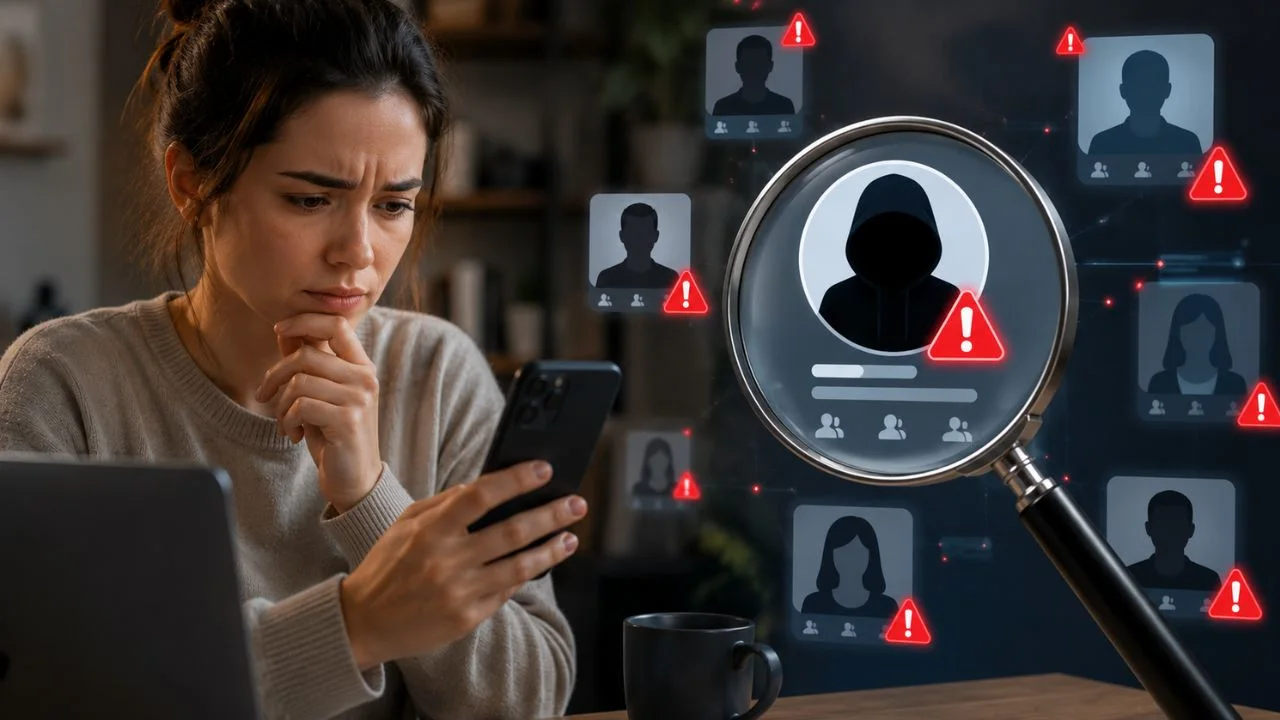
A new follower, connection request, or direct message can appear completely genuine at first. The account may use a realistic photograph, familiar name, professional biography, and posts copied from a real person. However, these details can be stolen, generated, or carefully arranged to create a false identity.
Fake social media accounts are created for many purposes. Some spread spam or manipulate engagement, while others impersonate friends, celebrities, companies, recruiters, government agencies, or romantic interests. The person operating the profile may want money, passwords, financial information, private photographs, access to an account, or greater influence over an online conversation.
Scammers are increasingly using social platforms because profiles reveal useful details about people’s jobs, families, interests, locations, and relationships. In 2025, nearly 30% of people who reported losing money to a scam said it started on social media, with reported losses reaching approximately $2.1 billion.
Fortunately, most fake accounts reveal warning signs when you examine the complete profile rather than trusting one photograph or message. This guide explains how to identify fake social media accounts by checking usernames, profile pictures, account history, engagement, messages, verification badges, business information, and common scam behavior.
What Is a Fake Social Media Account?
A fake social media account is a profile that misrepresents the identity, organization, purpose, or person behind it. It may impersonate a real individual, invent a fictional identity, pretend to represent a company, or use automated behavior to appear like a genuine user.
Some fake profiles are designed for financial fraud, phishing, romance scams, fake job offers, investment schemes, or counterfeit sales. Others are used to distribute misinformation, inflate follower counts, post repetitive promotions, harass people, or manipulate conversations across a platform.
Not every anonymous, incomplete, or recently created account is fake. A genuine person may use a nickname, avoid uploading a photograph, maintain a private profile, or have only a few connections. LinkedIn specifically advises users to consider several signals together because an incomplete profile alone does not prove deception.
The purpose of checking an account is therefore not to judge someone based on one unusual detail. It is to identify a pattern of inconsistencies, unverifiable claims, copied material, suspicious communication, or pressure that suggests the profile is not operating honestly.
Why Fake Social Media Profiles Are Becoming More Convincing
Creating a believable fake profile no longer requires advanced design skills. A scammer can copy public photographs, rewrite a biography, imitate a company’s branding, and fill an account with stolen posts. A profile may look established even though none of its content belongs to the person controlling it.
Artificial intelligence has made this problem more complex. Fraudsters can create synthetic profile photographs, realistic identity documents, cloned voices, and convincing videos that appear to show public figures, business executives, or family members. The FBI reported that AI-related complaints caused nearly $893 million in reported losses during 2025.
Video calls and voice messages are also no longer perfect proof of identity. The FBI has warned that criminals use AI-powered voice and video cloning to impersonate trusted individuals and persuade people to reveal information or authorize fraudulent transactions.
These developments do not mean that every polished account is fraudulent. They mean that identity should be verified through several independent signals, such as an official website, known contact information, consistent history, trusted mutual connections, and confirmation through a separate communication channel.
1. Inspect the Username Carefully
Begin with the account’s exact username rather than the large display name shown above the profile. Impersonators frequently copy a real person’s display name while making a small change to the unique handle because the genuine username is already taken.
Look for additional underscores, periods, repeated letters, missing characters, substituted numbers, or words such as “official,” “support,” “team,” and “private.” A fake account might replace the letter “o” with the number zero or add an unnoticed character to a well-known brand name.
The username should also fit the identity being presented. A profile claiming to be a respected company executive may be suspicious when its handle contains random numbers or unrelated promotional language. However, an unusual username by itself is not enough to prove fraud.
Compare the handle with the username linked from the person’s official website, verified company page, previous messages, or other trusted profiles. Do not use links sent by the questionable account as your only source of verification because those links may lead to additional fake pages.
2. Examine the Profile Photograph
A professional profile photograph can make an account appear trustworthy, but images are among the easiest profile elements to steal. Scammers commonly copy photographs from public accounts, company websites, dating profiles, stock-photo collections, and news articles.
Look at whether the photograph matches the person’s stated age, profession, location, and posting history. A profile may use different faces across older posts, display military photographs under an unrelated name, or show a corporate headshot that belongs to someone working at another company.
Use a reverse image search when the account is making important claims or developing a personal relationship. Google Lens can find similar images and websites on which the photograph appears, while the FTC recommends reverse image searches when investigating possible romance scams.
Finding the same picture elsewhere does not automatically prove fraud because people reuse their own photographs across platforms. The stronger warning appears when the image is connected to several unrelated names, countries, professions, dating profiles, or known scam reports.
3. Look for AI-Generated Image Warning Signs
Some fake accounts use photographs that do not belong to any real person. AI-generated portraits can appear highly realistic, particularly when viewed as small circular profile images. You should therefore avoid relying on obvious visual mistakes as your only detection method.
Potential inconsistencies may include irregular earrings, distorted glasses, unusual background objects, mismatched reflections, unrealistic hair edges, or details that change between photographs. However, image-generation technology continues to improve, and genuine photographs can also contain editing artifacts or unusual lighting.
A profile should be evaluated through its complete identity history rather than through image inspection alone. Check whether the person appears naturally in group photographs, tagged posts, public events, videos, professional listings, and conversations with long-standing contacts.
Treat unexpected voice notes and video messages with similar caution when money or sensitive information is involved. The FTC warns that scammers can clone a person’s voice using a short audio clip gathered from content posted online, so verification should happen through a known phone number or another trusted channel.
4. Read the Biography for Inconsistencies
A fake account’s biography often contains impressive claims designed to establish trust quickly. It may describe the person as a doctor, soldier, investor, executive, recruiter, celebrity representative, government official, or successful entrepreneur without providing verifiable details.
Check whether the job title, employer, education, location, and linked website agree with one another. LinkedIn identifies unrealistic career timelines, inconsistent dates, celebrity or stock photographs, and unverifiable claims of being an executive as possible fake-profile signals.
Search the person’s name with the claimed employer, profession, city, or organization. A real employee may not appear prominently online, but senior executives, licensed professionals, recognized speakers, and official company representatives should normally have some consistent evidence supporting their claims.
Be careful when the biography uses authority to discourage questions. A genuine professional should not become aggressive because you want to verify their identity, qualifications, employer, or offer before sharing information or making a payment.
5. Review the Account’s Posting History
A genuine account usually develops a history over time. Posts may reflect changing interests, relationships, places, events, conversations, and personal experiences. A fake profile often has a thinner or less natural timeline despite claiming to represent a long-established person or business.
Look for accounts that published dozens of posts within a few days to create the appearance of age. Repeated photographs, copied captions, sudden changes in language, or content covering several unrelated identities can suggest that material has been collected from elsewhere.
Examine older comments and tagged posts, not just the newest uploads. Genuine accounts often contain natural interactions with friends, colleagues, relatives, or customers. Fake profiles may receive only generic comments, emoji responses, promotional replies, or engagement from other suspicious accounts.
A new account is not automatically fraudulent, and an old account is not automatically safe. Scammers may purchase established profiles or take control of real accounts, so account age should remain one part of a wider authenticity check.
6. Check the Followers and Following List
Follower counts can create an illusion of credibility, but they are easy to manipulate. Fake accounts may buy followers, participate in engagement exchanges, or connect with thousands of random users to make their profiles appear active and popular.
Look at the quality and relevance of the audience rather than the total number. An account claiming to operate a local business may be questionable when most followers are unrelated profiles from distant countries with empty biographies, random usernames, and no genuine activity.
An extreme follower-to-following ratio can be a warning, but it is not proof. New creators often follow many accounts, while established public figures may follow relatively few people. The surrounding context matters more than a single numerical pattern.
Review mutual connections carefully. Scammers sometimes follow your friends before contacting you so the account appears familiar. Contact a trusted mutual connection directly to ask whether they genuinely know the person rather than assuming the connection itself confirms authenticity.
7. Evaluate the Quality of Engagement
Fake accounts often produce engagement that looks active at first but lacks substance. Posts may receive dozens of comments containing only emojis, one-word compliments, repeated phrases, or unrelated promotional messages from profiles with similarly questionable histories.
Compare the comments with the content. Genuine engagement usually reflects what was actually posted, while automated comments might say “Amazing photo” beneath a written announcement or “Great information” on an unrelated personal image.
Sudden engagement spikes can also deserve attention. A small account may receive thousands of likes while generating almost no meaningful comments, shares, or conversation. This pattern may suggest purchased engagement, although a post can also receive legitimate exposure through recommendations.
Do not assume that low engagement proves an account is fake. Many real users have private, inactive, or small profiles. Engagement becomes useful when it is examined together with identity inconsistencies, copied content, suspicious messages, and unverifiable claims.
8. Notice How the Account Communicates
The way an account speaks may reveal more than its profile. Scammers often begin with friendly conversation, compliments, sympathy, or professional interest before shifting toward an urgent request, financial opportunity, private communication, or sensitive question.
Be cautious when someone quickly asks you to leave the platform for WhatsApp, Telegram, email, text messaging, or an encrypted application. The FBI identifies rapid attempts to move conversations away from dating or social platforms as a common romance-scam warning sign.
Watch for sudden changes in writing style, grammar, time zone, or knowledge. A person may repeatedly forget details from previous conversations, provide vague answers to direct questions, or appear unfamiliar with the company, city, school, or profession mentioned in the profile.
Do not dismiss a person solely because their language is imperfect or inconsistent. Genuine users may speak several languages, use translation tools, or share an account with a team. The concern is the broader pattern of contradiction, avoidance, pressure, and deception.
9. Be Suspicious of Unexpected Links
Fake accounts frequently send links described as security alerts, voting pages, account-verification forms, investment platforms, competition entries, discount stores, job applications, or private photographs. The real purpose may be stealing passwords, payment details, or personal information.
Phishing messages commonly create a story designed to make people click before checking. They may claim that an account is suspended, a payment has failed, suspicious activity was detected, or immediate confirmation is required.
Do not open the link simply because the message comes from someone you know. A real account may have been compromised and used to contact friends. Reach the supposed sender through a separate channel and ask whether they intentionally sent the message.
When a message claims to represent a business, bank, platform, or government agency, open the official application or type the known website address yourself. Do not call phone numbers or use login links provided by the suspicious account.
10. Watch for Requests for Money or Personal Information
An account becomes significantly more suspicious when it asks for money, cryptocurrency, gift cards, account details, identification documents, security codes, or private financial information. The request may be disguised as an emergency, investment, fee, prize, loan, donation, or business opportunity.
Scammers often create urgency because careful verification works against them. They may claim that an opportunity expires today, a family member has been arrested, a delivery requires immediate payment, or an account will be closed unless you respond.
Never share a one-time verification code with another person. A scammer may already have your username and password and need only the code to complete an account takeover. Legitimate support staff should not request your password or ask you to transfer funds to secure an account.
If a person claims to be a friend, relative, colleague, or executive requesting money, contact them through a phone number you already know. Do not rely on the profile’s voice, video, photograph, or explanation when the request involves an urgent financial decision.
11. Recognize Fake Investment Accounts
Investment scammers may present themselves as traders, financial coaches, successful entrepreneurs, celebrities, or ordinary users sharing impressive results. They often publish screenshots of account balances, luxury lifestyles, testimonials, and supposed withdrawals to create credibility.
An unexpected social media message offering investment advice is a major warning sign. The FTC states that unsolicited investment messages on social media almost always lead to scams, often directing victims to fake platforms that display fabricated profits.
The account may initially allow a small withdrawal to build trust before demanding larger deposits. Later, the platform may claim that taxes, unlocking charges, security fees, or additional investments are required before the victim can access the displayed balance.
Do not treat screenshots, group-chat testimonials, or celebrity videos as proof. The FBI has reported that scammers use AI-generated videos and voices of trusted figures to promote fraudulent investment opportunities through professional-looking social media content.
12. Identify Romance and Catfishing Profiles
A romance scammer creates a false identity to develop affection and trust before asking for money or financial assistance. The relationship may progress unusually quickly, with early declarations of love, marriage plans, private conversations, and promises to meet in person.
The person often has a repeated reason for being unavailable. They may claim to work overseas, serve in the military, manage a construction project, travel constantly, or experience an emergency whenever an in-person meeting is arranged.
Requests for money may involve medical treatment, travel tickets, legal expenses, frozen accounts, customs fees, business problems, or investment opportunities. In 2025, nearly 60% of people reporting financial losses to romance scams said the scam started on social media.
Move slowly, ask detailed questions, search the profile photograph, and discuss the relationship with someone you trust. A person you have never met should not require your money, banking information, cryptocurrency, gift cards, or access to your accounts.
13. Spot Fake Job Recruiters
A fake recruiter may use a convincing professional profile, company logo, and job description to collect personal information or demand payment. The offer might promise unusually high income, remote work, flexible hours, or immediate hiring without a meaningful interview.
Check whether the recruiter works for the company listed in the profile. Search for the person through the company’s official website or contact its human resources department using independently verified information. Do not rely on an email address or telephone number supplied by the recruiter.
Legitimate employers do not normally ask applicants to pay for interviews, background checks, training, equipment, software, or guaranteed placement. Be suspicious of employers who send a check and instruct you to purchase equipment or return part of the money.
LinkedIn identifies unrealistic job offers, immediate requests to move communication off-platform, and demands for sensitive or financial information as suspicious profile behavior.
14. Verify Celebrity and Influencer Accounts
Celebrity impersonators often follow fans, send private messages, offer exclusive memberships, promise prizes, or request donations. The account may claim to be a private profile used personally by the celebrity rather than the public account managed by a team.
A famous person is unlikely to contact a random follower to request gift cards, cryptocurrency, banking details, or a fee for releasing a prize. The FTC warns that celebrity impersonators commonly ask fans for money by pretending to support charities, prizes, or personal causes.
Search for the person’s official website and compare the social profiles linked from it. Review usernames carefully because an impersonator may copy the photograph, biography, content, and display name while changing only one character in the handle.
Remember that a fan, parody, commentary, or tribute account is not necessarily deceptive when it clearly identifies itself. X requires compliant parody and fan accounts to distinguish themselves with labels such as “parody,” “fake,” “fan,” or “commentary” in the account name and biography.
15. Understand What a Verification Badge Means
A verification badge can be a useful authenticity signal, but its meaning differs across platforms. Some badges identify notable public figures, while others are available through paid identity-validation subscriptions. You should understand the platform’s current verification system before drawing conclusions.
Instagram explains that traditional verified badges confirm the authentic presence of notable people or brands, while Meta Verified is a paid subscription that validates an eligible account and includes impersonation protection and other benefits.
A badge does not guarantee that every claim, product, investment, or message from the account is trustworthy. Verified accounts can publish misleading content, become compromised, or be imitated by another profile using a fake badge inside its photograph.
An unverified account is not automatically fake either. Many genuine small businesses, professionals, creators, and private individuals do not qualify for or purchase verification. Use the badge as one supporting clue rather than the final decision.
16. Verify Business and Customer-Support Accounts
Fake business accounts commonly imitate banks, delivery services, retailers, software companies, cryptocurrency platforms, and social media support teams. They may reply to public complaints and invite the customer to continue through direct messages.
Compare the username with the account linked from the company’s official website. Check when the profile was created, whether its older posts are consistent, and whether the company lists the same telephone number, email address, and support process elsewhere.
A real customer-support representative should not ask for your full password, payment card PIN, one-time authentication code, remote-access permission, or cryptocurrency transfer. Business impersonators often use unexpected messages and harmful links to create urgency.
When uncertain, end the conversation and open the official company application or website independently. Start a new support request through the verified contact page rather than continuing with the profile that approached you.
17. Distinguish a Fake Account From a Compromised Account
Sometimes the suspicious message comes from a real account belonging to someone you know. Criminals may steal login credentials, take control of the profile, and use the trusted identity to send scams to friends, relatives, customers, or colleagues.
Warning signs include an unexpected investment offer, urgent request for money, strange link, change in writing style, or message asking for a verification code. The account’s legitimate history can make these requests more convincing than messages from a newly created profile.
Contact the account owner through another method, such as a known phone number or in-person conversation. Do not ask whether the request is real within the same compromised account because the attacker may be the person responding.
The FTC warns that criminals can hack real profiles, pretend to be the account owner, and target that person’s friends. A genuine-looking history therefore reduces suspicion but does not eliminate the possibility of account takeover.
18. Use Independent Verification
Independent verification means confirming an identity without using information controlled by the questionable profile. Search for the person or company through trusted sources, official directories, known websites, public records, or contact information you already possess.
For a company representative, call the organization through the number on its official website, a friend or relative, use a saved contact method. For a professional, confirm their employment, qualifications, or license through the relevant organization or authority.
You can also ask a question that a copied profile would not easily answer. However, avoid sharing the correct answer inside the question, and remember that a scammer may have gathered personal information from public posts or a compromised account.
Verification becomes especially important before sending money, sharing documents, starting a romantic relationship, accepting a job, purchasing a product, or following investment advice. A genuine person or organization should understand why you need to confirm a high-risk request.
19. Report and Block Fake Accounts
Report the account through the platform’s built-in tools before blocking it. Include the most accurate reason, such as impersonation, scam, spam, fake identity, or hacked account. Screenshots and links may help when the platform provides space for additional evidence.
Facebook allows users to report profiles or Pages that pretend to represent themselves, someone they know, or a public figure. Impersonation reports can also be submitted in certain situations without having a Facebook account.
TikTok users can open the profile, select the sharing menu, choose Report, select Report account, and identify the account as pretending to be someone. LinkedIn provides similar reporting options for impersonation and profiles that do not represent real people.
X provides a dedicated impersonation-reporting process for individuals, brands, and organizations. Blocking the account after collecting necessary evidence prevents additional messages, although you should also warn affected friends, customers, or colleagues through a trusted channel.
20. What to Do If You Interacted With a Fake Account
Stop communicating with the profile and do not send additional money in the hope of recovering previous payments. Scammers may return as supposed investigators, recovery experts, lawyers, or platform representatives and demand another fee.
Save screenshots of the profile, username, messages, payment instructions, transaction records, email addresses, phone numbers, and links. The FBI advises fraud victims to document contact methods, dates, payment details, destination accounts, and a complete description of the interaction.
If you sent money, contact the bank, card issuer, payment application, gift-card company, or cryptocurrency service immediately. Explain that the transaction resulted from fraud and ask whether it can be stopped, reversed, frozen, or traced.
Report the profile to the social platform and the appropriate national fraud or cybercrime authority. In the United States, fraud can be reported to the FTC, while cyber-enabled crime can be submitted to the FBI’s Internet Crime Complaint Center. People outside the United States should use their relevant local authorities.
What to Do If You Shared a Password
Change the exposed password immediately through the platform’s official application or website. Use a trusted device when possible and create a completely new password rather than making a minor variation of the compromised one.
Change the password anywhere else you reused it. Begin with your primary email account because it may allow an attacker to reset passwords for social media, shopping, cloud storage, banking, and other important services.
Review active sessions, connected applications, recovery email addresses, phone numbers, forwarding rules, and recent login activity. Sign out of unfamiliar devices and remove any authorization you do not recognize.
Enable two-factor authentication and store recovery codes securely. The FTC recommends strong, unique passwords and two-factor authentication to protect accounts from hackers and scammers.
How to Protect Yourself From Fake Profiles
Limit the amount of personal information visible publicly. Details about relatives, workplaces, birthdays, travel, pets, and daily routines can help scammers create convincing stories, answer security questions, or target people close to you.
Adjust privacy settings so strangers cannot automatically view every post, friend list, email address, and telephone number. Review old content periodically and remove information that no longer needs to remain public.
Use unique passwords and multifactor authentication on social media and email accounts. Install software updates promptly because updates often include security fixes that reduce the risk of account compromise and malicious software.
Develop a family or workplace verification method for urgent requests. A private question, agreed phrase, or requirement to confirm financial instructions through a second channel can reduce the effectiveness of impersonation, hacked-account, and AI voice-cloning scams.
Common Mistakes When Checking Account Authenticity
The first mistake is trusting a profile only because it contains many posts, followers, or mutual connections. These signals can be copied, purchased, or created through networks of fake accounts, and a genuine established account can still be compromised.
The second mistake is treating a verification badge as complete proof. Verification may confirm that a platform validated an identity, but it does not guarantee that every message, business opportunity, investment, or external link is safe.
The third mistake is attempting to expose or threaten the suspected scammer. Public confrontation may cause the person to delete evidence, target you through another profile, or escalate harassment. Save evidence, report the account, and stop contact.
The final mistake is feeling embarrassed after being deceived. Fake profiles are deliberately designed to exploit trust, urgency, loneliness, authority, and financial pressure. Acting quickly after discovering the scam can improve the possibility of securing accounts and limiting financial damage.
Quick Fake Social Media Account Checklist
Check whether the exact username matches the person or company’s established profiles. Review the photograph through a reverse image search and compare the account’s name, biography, employment, location, and posting history for inconsistencies.
Examine the timeline, followers, comments, tagged posts, and mutual connections. Look for copied content, unnatural engagement, sudden bursts of activity, unrelated audiences, and older posts that appear to represent different people.
Pay close attention to behavior. Requests to move off-platform immediately, click unexpected links, provide passwords, share security codes, send money, buy gift cards, transfer cryptocurrency, or make a rushed decision are serious warnings.
Verify the person through a separate, trusted source before taking action. When several warning signs appear together, report and block the account rather than continuing the conversation in an attempt to prove that it is fake.
Final Thoughts on Identifying Fake Social Media Accounts
No single profile detail can prove that an account is real or fake. Photographs can be stolen, followers can be purchased, biographies can be copied, badges have different meanings, and genuine accounts can be taken over by criminals.
The safest approach is to combine identity checks with behavioral evidence. Review the username, profile image, account history, professional claims, engagement, messages, links, payment requests, and willingness to complete independent verification.
Be especially careful when a new online contact creates emotional urgency or offers an unexpected financial opportunity. Romance, investment, job, shopping, customer-support, and impersonation scams frequently depend on making the target act before checking the story.
Slowing down is one of the strongest protections available. Confirm important requests through trusted contact details, discuss suspicious situations with someone you know, and never let a social media profile pressure you into sending money or sensitive information.
Frequently Asked Questions
1. What is the easiest way to identify a fake social media account?
Check the username, profile photograph, account history, biography, and messages together. A reverse image search and independent verification through an official website or known contact can reveal many impersonation profiles.
2. Does a low follower count mean an account is fake?
No. Genuine users may be new, private, or inactive. A low follower count becomes more concerning when combined with copied images, inconsistent information, suspicious messages, and requests for money or personal data.
3. Can a verified social media account still be unsafe?
Yes. Verification does not guarantee that every claim, link, product, or investment is trustworthy, and verified accounts can sometimes be compromised. Always evaluate the actual request before taking action.
4. How can I check whether a profile picture is stolen?
Save or capture the profile image and search it with Google Lens or another reputable reverse image tool. Multiple results using different names or identities can indicate that the picture was copied.
5. What should I do when someone creates a fake account using my identity?
Save screenshots and profile links, report the account for impersonation, warn your contacts through your genuine account, and strengthen your privacy and login security. Report threats or financial fraud to the relevant authorities.