

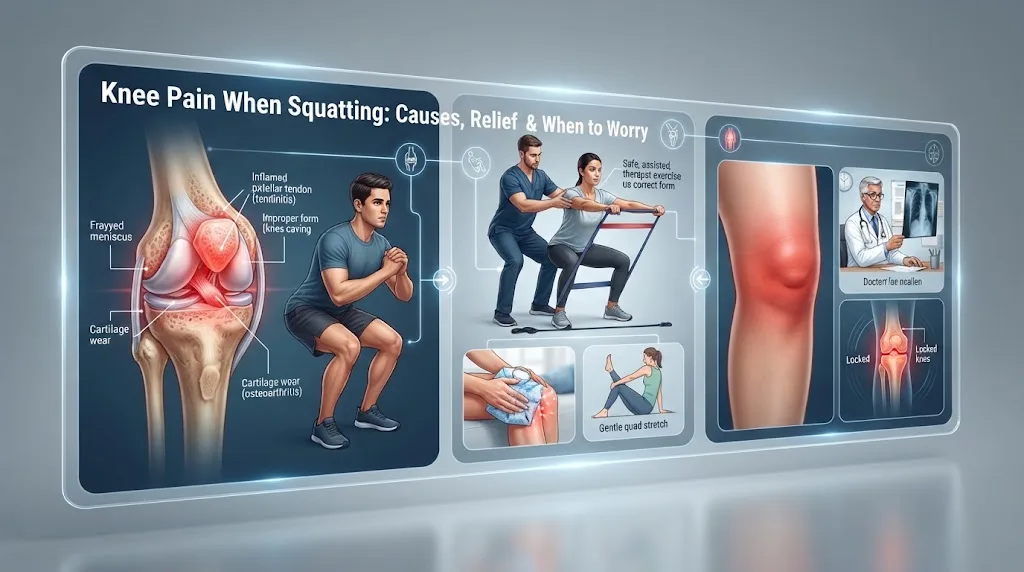
Knee pain when squatting is common because the movement places significant load through the knee joint, kneecap, tendons, and surrounding muscles. Pain can appear in the front, inside, outside, or back of the knee depending on the underlying cause. For some people, discomfort develops only during deep squats, while others feel pain even with shallow bending.
Squatting requires coordination between the hips, knees, ankles, and core. If one area lacks strength or mobility, the knee may absorb more stress than it can comfortably tolerate. Sudden increases in exercise volume, poor technique, previous injuries, or repetitive loading can also irritate tissues that were previously pain-free.
Not every painful squat means there is serious joint damage. Mild overuse problems often improve with temporary activity changes, better movement control, and gradual strengthening. However, swelling, locking, instability, severe pain, or symptoms following a significant injury can indicate a problem that deserves assessment from a qualified healthcare professional.
Patellofemoral Pain Syndrome
Patellofemoral pain syndrome is one of the most common causes of pain at the front of the knee during squats. It involves irritation around the kneecap and the joint surface beneath it, especially during movements that increase pressure through the patellofemoral joint. People may also notice discomfort when climbing stairs, running, or sitting with bent knees for long periods.
The condition is often influenced by several factors rather than one clear injury. Weakness or reduced control around the hips and thighs, training errors, reduced ankle mobility, and sudden increases in activity can all contribute. Squatting itself is not necessarily harmful, but repeatedly loading an irritated knee beyond its current tolerance may keep symptoms active.
Relief usually focuses on temporarily reducing painful loading while maintaining as much comfortable activity as possible. Strengthening the quadriceps, glutes, and hip muscles can improve how forces are distributed during squats. Gradually rebuilding squat depth and resistance is often more helpful than avoiding knee bending completely for long periods.
Patellar Tendon Irritation
The patellar tendon connects the kneecap to the shinbone and helps transfer force when you straighten the knee. Repetitive jumping, running, heavy squatting, or sudden increases in training can overload this tendon. Pain is commonly felt just below the kneecap and may become more noticeable during squats, jumps, stairs, or activities requiring powerful knee extension.
Patellar tendon pain often develops gradually rather than after one dramatic injury. Athletes involved in basketball, volleyball, running, and strength training may be more likely to experience it because of repeated high-force loading. Continuing to increase training intensity while symptoms worsen can make the tendon increasingly sensitive and reduce its ability to tolerate exercise.
Treatment usually involves adjusting load rather than stopping all activity. Isometric and progressive resistance exercises may help rebuild tendon capacity when performed at an appropriate level. Heavy squats, jumping, and sprinting can then be reintroduced gradually once the tendon tolerates lower-level strengthening without a significant increase in pain.
Meniscus Irritation or Injury
The menisci are cartilage structures that help distribute pressure and improve stability inside the knee. A meniscus can become irritated by repeated deep bending or injured during twisting movements, especially when the foot is planted. Pain may occur along the inner or outer joint line and can become more noticeable during deep squats or rotational movements.
Some meniscus problems produce swelling, clicking, or a feeling that the knee catches during movement. A significant tear may cause locking, where the knee becomes difficult to fully straighten or bend. However, clicking alone is not always a sign of serious damage, especially when it occurs without pain, swelling, or loss of function.
If symptoms are mild and there is no locking or significant instability, conservative management may include activity modification and strengthening. More persistent symptoms, repeated swelling, or mechanical locking deserve clinical evaluation. A healthcare professional can assess whether the problem is likely related to the meniscus or another structure inside the knee.
Osteoarthritis and Squatting Pain
Knee osteoarthritis develops when changes occur within the joint over time, including cartilage wear and other structural adaptations. People may notice pain, stiffness, swelling, or reduced movement, particularly after prolonged activity or inactivity. Squatting can become uncomfortable because deeper knee flexion increases pressure through parts of the joint that may already be sensitive.
Osteoarthritis does not automatically mean you should stop squatting. Appropriate strength training can help support the joint, maintain function, and improve confidence with daily movements. The key is adjusting squat depth, load, and volume so the exercise remains challenging without causing a large or lasting increase in symptoms.
Some people benefit from box squats, supported squats, or reduced-depth variations while building strength. Gradually increasing movement range as tolerance improves can make squatting feel more manageable. If pain becomes severe, swelling is frequent, or function is progressively declining, medical assessment can help guide treatment and rule out other possible causes.
Poor Squat Technique and Movement Control
Technique can influence how stress is distributed through the knees, hips, and ankles during a squat. Knees moving inward excessively, heels lifting, losing trunk control, or shifting unevenly to one side may increase strain for some people. However, there is no single perfect squat position that works identically for every body shape and training goal.
Foot stance, hip anatomy, ankle mobility, and limb proportions all influence how a comfortable squat looks. Forcing everyone into the same stance or knee position can sometimes create unnecessary discomfort. A useful approach is to find a position that allows balanced pressure through the feet, controlled knee movement, and a comfortable depth without sharp pain.
Core control also contributes to squat stability because the trunk helps transfer force between the upper and lower body. If you are also dealing with side abdominal discomfort from training, understanding an oblique strain can be useful before returning to heavy compound exercises. Pain in one region may change movement mechanics and increase compensatory stress elsewhere.
Tight Ankles and Limited Mobility
Limited ankle dorsiflexion can change squat mechanics because the shin needs to move forward as the body lowers. If the ankle cannot move comfortably, the heels may lift or the body may compensate by leaning forward, widening the stance, or reducing depth. These changes are not always harmful, but they can increase stress on sensitive areas in some people.
Calf tightness, previous ankle injuries, or joint stiffness can reduce available ankle motion. Gentle calf stretching, ankle mobility drills, and gradual loaded movements may improve comfort over time. Raising the heels slightly during squats can also help some people maintain balance and depth while they work on ankle mobility.
Mobility exercises should not be forced aggressively, especially if they create sharp pain at the front or back of the ankle. Small, consistent improvements are usually more useful than intense stretching. If ankle movement remains very restricted after a previous injury, a physical therapist can assess whether joint stiffness or another mechanical issue is contributing.
Weak Hips and Quadriceps
The quadriceps are major muscles used during squatting because they control knee bending and help straighten the leg as you stand. If they are weak or poorly conditioned, the knee may become more sensitive when squat volume increases. Building quadriceps strength can improve the joint’s ability to tolerate everyday movements, stairs, running, and resistance training.
Hip muscles also influence leg control during squatting. Weakness or poor coordination around the glutes can contribute to excessive inward movement of the knees in some people. Exercises such as step-ups, split squats, bridges, lateral band walks, and controlled single-leg movements can help improve strength and coordination when progressed gradually.
Strength training should be matched to your current tolerance rather than based on an ideal program. If a particular exercise causes sharp pain, reduce the load, range, or difficulty and try a more comfortable variation. Progress becomes easier when the goal is consistent improvement rather than forcing through painful repetitions.
How to Relieve Knee Pain When Squatting
The first step is usually reducing the specific activity that clearly aggravates the knee rather than stopping all movement. You may temporarily use shallower squats, lighter resistance, fewer repetitions, or slower training sessions. Keeping the knee active within a tolerable range can help maintain strength and confidence while irritated tissues begin to settle.
Cold packs may provide temporary comfort if the knee feels sore or swollen after activity. Apply a wrapped cold pack for short periods and avoid placing ice directly on the skin. Some people prefer warmth when stiffness is the main issue, particularly before gentle mobility or strengthening exercises.
Pain-relieving medication may be appropriate for some people, but individual health conditions, allergies, and other medicines can affect what is safe. It is better to check with a pharmacist or healthcare professional if you are unsure. Medication may reduce symptoms, but it does not replace correcting training errors or rebuilding strength when those factors are contributing.
Knee-Friendly Squat Modifications
Box squats are useful because the box provides a clear depth target and can reduce uncertainty during the movement. Choose a height that allows you to squat without sharp pain and gradually lower it as your confidence improves. The goal is not to force greater depth immediately but to expose the knee to manageable amounts of load.
Supported squats are another option. Holding a stable surface, suspension trainer, or rail can reduce balance demands and make it easier to control knee and hip movement. Support can be gradually reduced once strength improves, making this variation useful for people returning to squats after pain or a period of reduced activity.
Heel-elevated squats can help when limited ankle mobility makes regular squatting uncomfortable. Placing the heels on a small stable wedge allows the knees to move forward more easily and often creates a more upright torso. Start with light resistance and monitor how the knee responds during the session and over the following day.
Exercises That May Help Knee Pain
Wall sits can provide a simple way to strengthen the quadriceps without repeated knee movement. Choose a knee angle that feels manageable and hold the position for a comfortable period rather than dropping into the deepest possible position. Gradually increasing hold time or resistance can build strength without immediately returning to full squats.
Step-ups and split squats can also strengthen the legs while allowing you to control the amount of knee flexion. Start with a low step or short range and increase difficulty gradually. These exercises also challenge hip stability and single-leg control, which can be helpful when squatting discomfort is connected with weakness or movement asymmetry.
Glute bridges and lateral hip exercises can complement knee-focused strengthening. Although they do not directly load the knee heavily, they help strengthen muscles that support lower-body movement. A balanced program should eventually include knee-dominant and hip-dominant exercises rather than relying only on stretches or avoiding loaded movement entirely.
When Knee Pain During Squats Is Normal
Mild muscular effort or temporary discomfort during rehabilitation is not always harmful. A small amount of pain that remains stable, feels manageable, and settles soon after exercise may be acceptable in some recovery programs. The response over the next several hours and the following day is often more useful than judging the exercise from one repetition alone.
Pain should not continuously increase as you complete each set. If discomfort becomes sharper, movement quality changes significantly, or the knee feels worse for a prolonged period afterward, the exercise may currently be too difficult. Adjusting depth, weight, repetitions, or frequency can often make the movement more tolerable.
Learning the difference between discomfort from effort and symptoms suggesting irritation takes time. Keeping notes on pain level, squat depth, resistance, and next-day symptoms can reveal useful patterns. This allows you to progress based on how your knee actually responds rather than making large training changes based on a single good or bad workout.
When to Worry About Knee Pain
Seek medical attention after a significant injury if you cannot bear weight, the knee looks deformed, or swelling develops rapidly. A loud pop followed by instability or major loss of function can indicate ligament or other internal joint injury. These situations deserve assessment rather than repeated attempts to test the knee through squatting or running.
Locking is another symptom that should not be ignored. If the knee becomes physically stuck and cannot fully straighten or bend, a mechanical problem may be present. Recurrent giving way, persistent swelling, or a progressive loss of movement can also justify an evaluation by a sports medicine professional, physical therapist, or other qualified clinician.
Medical review is also appropriate when pain continues for several weeks despite sensible activity changes and strengthening. Fever, redness, unusual warmth, or severe unexplained swelling require more urgent attention because they can suggest conditions beyond a typical overuse problem. Persistent night pain or unexplained symptoms should also be discussed with a healthcare professional.
Conclusion
Knee pain when squatting can come from several sources, including patellofemoral irritation, patellar tendon overload, meniscus problems, arthritis, limited ankle mobility, or weakness around the hips and thighs. The location and behavior of the pain often provide clues, but symptoms can overlap. A painful squat does not automatically mean the knee is seriously damaged.
Relief often starts with reducing painful loading, adjusting squat depth, and gradually rebuilding strength. Box squats, supported variations, heel elevation, quadriceps exercises, and hip strengthening can help many people return to comfortable movement. Progress should be gradual, with the knee’s response during and after exercise guiding how quickly difficulty increases.
More serious symptoms should not be managed through exercise alone. Rapid swelling, locking, repeated giving way, inability to bear weight, severe pain after trauma, or persistent unexplained symptoms deserve medical evaluation. When red flags are absent, a combination of load management, strength, mobility, and sensible technique changes can often make squatting more comfortable again.
FAQs
Why does my knee hurt only when I squat?
Squatting increases pressure through the kneecap, tendons, and joint surfaces. Pain may appear only during squats when one of these tissues is irritated or when strength, mobility, or training load exceeds your current tolerance.
Should I stop squatting if my knee hurts?
You may not need to stop completely. Reduce depth, weight, or volume and use a comfortable variation. Stop and seek evaluation if pain is severe, worsening, or accompanied by swelling, locking, or instability.
Are squats bad for your knees?
Squats are not inherently bad for healthy knees. When performed at an appropriate load and range, they can strengthen the legs and improve function. Problems usually arise when tissues are overloaded beyond their current capacity.
Can weak glutes cause knee pain when squatting?
Weak or poorly coordinated hip muscles can contribute to movement patterns that increase knee stress in some people. Strengthening the glutes, quadriceps, and other lower-body muscles may improve squat control and comfort.
When should I see a doctor for knee pain?
Seek medical care for severe pain, major swelling, locking, repeated giving way, inability to bear weight, or symptoms after significant trauma. Persistent pain that does not improve with reasonable activity changes also deserves evaluation.