

How to Pack a Diaper Bag for Travel: A Complete Parent-Friendly Guide
Learning how to pack a diaper bag for travel can make the difference between a stressful journey and one that feels much more manageable. Traveling with a baby means preparing for diaper changes, feeding, spills, naps, unexpected delays, temperature changes, and occasional messes, often while working with limited space. The best diaper bag is not necessarily the one packed with the most items. It is the one organized around what your baby is most likely to need during the journey.
A well-packed travel diaper bag should keep essential items within easy reach without becoming so heavy that it is uncomfortable to carry through airports, train stations, or sightseeing areas. Parents often make the mistake of packing for every possible situation, only to discover that the bag is difficult to organize when something is urgently needed. A smarter approach is to prioritize high-use essentials, organize them into categories, and carry a reasonable backup supply for delays or accidents.
The exact contents will depend on your baby’s age, feeding routine, length of travel, destination, and transportation method. A newborn may require more frequent diapers, burp cloths, and feeding supplies, while an older baby may need snacks, toys, and additional entertainment. Air travel also introduces considerations such as security screening, while road trips allow parents to keep extra supplies in the vehicle instead of carrying everything in one bag.
The goal of this guide is to help you build a practical travel diaper bag checklist without unnecessary clutter. You will learn how many diapers to bring, how to organize wipes and changing supplies, what feeding essentials to pack, how to prepare for airport security, and which emergency extras are worth carrying. With a little planning, your diaper bag can become a compact travel station that helps you handle most everyday baby needs wherever the journey takes you.
Start With the Right Diaper Bag for Travel
Choosing the right bag is the first step because even the best packing strategy becomes frustrating when the bag itself is difficult to use. Look for a diaper bag with several compartments, a wide opening, comfortable straps, and enough room for essential supplies without becoming oversized. Backpack-style diaper bags are particularly practical for travel because they leave both hands free for carrying a baby, pushing a stroller, or handling luggage.
Compartments make a significant difference when you are trying to find something quickly. A bag with separate areas for diapers, bottles, clothing, wipes, and personal belongings reduces the amount of digging required during a messy diaper change or hungry moment. Exterior pockets are useful for items such as wipes, tissues, hand sanitizer, or a water bottle, while secure interior pockets can hold passports, travel documents, and other valuables.
Consider the bag’s material as well. Travel often means placing your diaper bag on airport floors, changing stations, car seats, and restaurant surfaces, so an easy-to-clean exterior is practical. A waterproof or water-resistant lining is also useful because bottles can leak and wet clothing may need to be stored temporarily. Durability matters more than fashionable details when the bag will be carried frequently and exposed to demanding travel conditions.
Before buying or selecting a bag, also check how it fits alongside your other luggage. If flying, confirm your airline’s current cabin baggage policy because rules concerning diaper bags, personal items, and carry-ons vary between carriers. A bag that fits beneath the seat can be especially useful because it keeps your baby’s essentials accessible during the flight rather than stored in an overhead compartment.
How Many Diapers Should You Pack for Travel?
Diapers should form the foundation of your baby travel bag because running out is one of the most inconvenient problems a parent can face away from home. A practical approach is to estimate how many diapers your baby normally uses during the length of the journey and then add several extras. Babies do not always follow their usual schedule while traveling, and delays can extend a trip far beyond the original plan.
For a short outing, a few diapers may be sufficient, while a flight or longer road trip requires a larger supply. Rather than using a rigid universal number, think in terms of your baby’s normal changing frequency. If your baby usually needs a diaper every two to three hours, calculate the likely number for the journey and add enough backups to cover delays, leaks, or unexpected changes.
Do not necessarily place an entire vacation’s diaper supply inside the diaper bag. If you are staying away for several days, keep the travel-day quantity in your diaper bag and place the remaining supply in checked luggage, a suitcase, or another larger bag. For road trips, additional diapers can stay in the trunk while only the immediate supply remains within reach.
It can also help to divide diapers into small groups inside the bag rather than stacking them randomly. Keep several together near the changing mat and another small backup group in a different compartment. This organization makes it easy to see how many you have left and reduces the chance of discovering too late that your usable diaper supply has run low.
Pack Plenty of Baby Wipes
Baby wipes are one of the most versatile items you can carry while traveling. They are obviously useful during diaper changes, but they can also clean sticky hands, wipe food from a high chair, handle minor spills, clean surfaces, and freshen up your baby when proper washing facilities are not immediately available. A generous supply is therefore useful even if you expect only a few diaper changes.
Travel-size wipe packs can save space, but make sure the amount is realistic for the journey. A nearly empty packet may seem lighter during packing but becomes frustrating if a travel delay leaves you without enough wipes. For longer journeys, a fuller soft pack usually provides a better balance between capacity and space efficiency than a bulky plastic dispenser.
Place wipes somewhere that can be reached with one hand. During a diaper change, you may already have one hand holding your baby safely, so opening several compartments to find wipes makes the process unnecessarily difficult. Many parents prefer an outer pocket or the upper section of the diaper bag where the packet can be pulled out immediately.
Keeping a small additional pack can also be useful as a backup. If the primary pack dries out, becomes contaminated, or gets left behind in a changing room, you will still have another option. This small amount of redundancy is one of the simplest ways to make your diaper bag packing strategy more reliable during unpredictable travel days.
Bring a Portable Changing Mat
A portable changing mat creates a cleaner and more predictable surface for diaper changes when you are away from home. Public changing stations vary greatly in cleanliness and availability, while some locations may not have a changing table at all. A foldable mat gives you a protective barrier and allows you to create a temporary changing area more easily when circumstances are less than ideal.
Choose a mat that folds compactly and has an easy-to-clean surface. Thick padded models can be comfortable but may take up too much valuable space inside a travel diaper bag. For travel, a lightweight waterproof changing mat usually offers enough protection while remaining easy to fold and store alongside diapers and wipes.
Place the changing mat together with your diaper supplies so everything needed for a basic change can be removed at once. Some parents create a small changing pouch containing two or three diapers, wipes, disposable bags, and diaper cream. This prevents the entire diaper bag from needing to be carried into a small airplane or public restroom.
After each use, wipe the mat clean before returning it to the bag whenever possible. If the surface becomes heavily soiled, store it separately until it can be cleaned properly. Maintaining a clean changing setup is particularly useful during travel because babies and caregivers encounter many unfamiliar surfaces throughout the day.
Add Diaper Rash Cream and Changing Essentials
Diaper rash cream can be especially useful during travel because babies may spend longer periods sitting in car seats, strollers, or airplane seats than they do at home. Their normal changing schedule may also become disrupted by boarding, traffic, security lines, or sleeping. Packing the cream your baby normally uses can help you maintain a familiar diaper-care routine throughout the journey.
Choose a travel-sized container when possible so you are not using unnecessary bag space. If you are flying, remember that creams and gels may be subject to airport security requirements depending on the quantity and country. Check the current rules for your departure airport before leaving home rather than assuming that every destination follows identical liquid restrictions.
Disposable diaper sacks or resealable bags are another extremely useful addition. They can hold used diapers when a bin is not immediately available and separate wet or dirty clothing from clean items. A few lightweight bags occupy almost no space but can prevent smells, moisture, and mess from spreading throughout your diaper bag.
You may also want to include tissues and hand sanitizer, particularly for situations where handwashing facilities are unavailable. Proper handwashing remains preferable after diaper changes whenever possible, especially when dealing with diarrhea or illness. CDC guidance specifically emphasizes careful hand hygiene following diaper changes, making clean-up supplies an important part of travel preparation.
Pack at Least One Complete Change of Clothes
Babies have an impressive ability to need fresh clothing at the least convenient moment. Diaper leaks, spit-up, dropped food, spilled bottles, and motion sickness can all turn a clean outfit into an unusable one within seconds. Packing at least one complete change of clothes is therefore one of the most important rules when learning how to pack a diaper bag for travel.
For longer travel days, two changes may be more practical, particularly for newborns or babies who frequently spit up. Choose lightweight clothing that folds compactly and works well with the expected temperature. Instead of packing bulky matching outfits, prioritize simple pieces that are easy to put on inside a restroom, vehicle, or airplane seat area.
Place the spare outfit inside a resealable or waterproof bag. This serves two purposes: the clean clothes remain protected from leaking bottles or other spills, and the same bag can later hold the dirty outfit. Rolling clothes rather than folding them can also make them more compact and easier to fit into small compartments.
Do not forget socks or another small layer if your baby may need them. Cabin temperatures, air-conditioned airports, and changing weather can make babies uncomfortable even when the destination itself is warm. A lightweight layer gives you more flexibility without taking up much space in the diaper bag.
Pack Feeding Supplies Based on Your Baby’s Routine
Feeding is one area where the diaper bag should closely reflect your baby’s normal routine. A breastfed baby, formula-fed baby, and older baby eating solids will each require a different packing strategy. Rather than adding every feeding product you own, focus on the supplies needed during the journey plus a reasonable amount of backup for unexpected delays.
For bottle feeding, bring clean bottles, the required milk or formula supplies, and anything you normally use to prepare or serve feeds safely. If powdered formula requires water, consider where safe water will come from and how bottles will be cleaned during longer journeys. International travel may require additional planning because water quality and sanitation practices can vary between destinations.
For breastfeeding parents, the diaper bag may include nursing covers if preferred, breast pads, burp cloths, expressed milk, pumping equipment, or cooling supplies depending on the journey. In the United States, expressed breast milk and related feeding accessories can be carried through TSA checkpoints under special rules that differ from the standard liquids limit. Travelers should declare these items for separate screening.
Older babies may need snacks, feeding spoons, bibs, or small containers of appropriate food. Familiar snacks can be helpful because travel environments may not always offer suitable food when your child becomes hungry. CDC guidance also suggests bringing familiar snacks for children when traveling, particularly when available food may be unsuitable or unappealing.
Pack Formula Carefully for Air Travel
Formula feeding during air travel requires a little extra preparation because parents need enough food for the expected journey without becoming overwhelmed by unnecessary equipment. Calculate approximately how many feeds your baby is likely to need between leaving home and reaching your accommodation. Then carry extra formula for potential delays, diversions, missed connections, or extended airport waiting times.
If using powdered formula, keep portions organized so feeds can be prepared without measuring powder in a crowded environment. However, food safety remains important, so follow the preparation instructions associated with the formula you use. Ready-to-feed formula can sometimes simplify travel because it does not require mixing with water, although it may be heavier and more expensive to carry.
For flights departing through U.S. security, formula and other medically necessary infant feeding liquids are generally treated differently from ordinary carry-on liquids. Current TSA-related guidance allows breast milk and liquid formula in quantities above the usual 3.4-ounce container limit, although travelers should inform security personnel and expect separate screening procedures.
Airport and airline rules can change, particularly outside the United States, so always review requirements shortly before departure. Do not assume that rules experienced on a previous trip will apply everywhere. Checking both security screening requirements and airline baggage policies beforehand can prevent unnecessary delays when traveling with infant feeding supplies.
Add Burp Cloths and Bibs Without Overpacking
Burp cloths are small but extremely useful when traveling with a baby. They can handle spit-up, bottle drips, drool, and minor spills without requiring you to use wipes for everything. For a short journey, one or two may be enough, while babies who frequently spit up may require several during a longer trip.
Choose lightweight and absorbent cloths that fold or roll easily. Bulky decorative burp cloths may take up unnecessary room inside a travel diaper bag. Multi-purpose muslin cloths can be especially practical because they can function as burp cloths, light covers, temporary clean surfaces, or general clean-up cloths depending on the situation.
A bib is equally useful once your baby is eating solids or tends to drool heavily. Silicone bibs are easy to wipe clean but can take up more space, while fabric or disposable bibs pack flatter. Select the option that best suits the type of travel and the amount of washing you expect to be able to do.
Keep feeding cloths in a clean pouch until needed, then move dirty ones into the same waterproof bag used for soiled clothes. Separating clean and used fabric prevents milk, food, and moisture from spreading through the rest of the diaper bag. This simple system can make unpacking after the journey considerably easier.
Include Safe Snacks for Older Babies and Toddlers
Once your baby is eating solid foods, snacks can become one of the most useful tools in the travel bag. Hunger often appears at inconvenient moments such as boarding lines, road traffic, or lengthy security procedures. Carrying familiar, age-appropriate foods means you are not completely dependent on finding suitable baby food wherever you happen to be.
Choose snacks your child already eats safely rather than introducing unfamiliar food during the journey. Travel can already disrupt routines, so familiar tastes and textures often make feeding easier. Consider foods that are relatively easy to serve and unlikely to create a major mess inside an airplane, train, or car.
Pack snacks inside secure containers or resealable bags to prevent crumbs and spills throughout the diaper bag. A small reusable spoon can also be helpful if you bring puree or other soft foods. Bibs and wipes should remain close to the snack compartment because they will probably be needed immediately afterward.
Always follow age-appropriate feeding and choking-safety practices. A moving vehicle or turbulent flight can create additional complications, so supervise your child carefully while eating. Food can help keep babies comfortable during travel, but convenience should never take priority over safe feeding.
Pack Water and Cleaning Supplies Thoughtfully
Travel frequently exposes baby bottles, pacifiers, toys, and feeding equipment to unfamiliar surfaces. Keeping these items clean can become more challenging when you are moving between airports, restaurants, hotels, and vehicles. For longer travel, consider what you will need to safely clean the feeding equipment your baby uses regularly.
Potable water is important when cleaning bottles, pacifiers, teething rings, or toys that have fallen onto potentially contaminated surfaces. This consideration becomes particularly important when traveling internationally to destinations where tap water may not be safe for drinking. CDC guidance advises using potable water for cleaning baby feeding items and objects that may go into a child’s mouth.
You do not need to carry an entire bottle-washing setup inside the diaper bag for a short journey. Instead, determine what must be cleaned during transit and what can wait until you reach your accommodation. Disposable or pre-sterilized options may reduce the amount of washing required during particularly complicated journeys.
For longer stays, pack additional cleaning supplies in your main luggage rather than carrying them all throughout the travel day. The diaper bag should contain the items needed between departure and arrival, while your suitcase can hold larger bottle brushes, washing equipment, detergent, or additional feeding accessories.
Bring a Few Comfort Items for Sleep
Travel can be stimulating for babies because they encounter unfamiliar sounds, lights, people, and environments. A small familiar comfort item can help create a sense of routine during naps or quiet periods. Depending on your baby’s age and safe-sleep requirements, this might include a pacifier or another familiar item used while awake or settling.
Avoid filling the diaper bag with multiple large toys or bulky sleep products. The goal is to carry a few high-value items that your baby already enjoys. One favorite toy and one backup are generally more useful than ten unfamiliar toys packed simply because there was space available.
Pacifiers should be stored in a clean case or resealable container. Bringing a spare can also be helpful because pacifiers have a habit of falling onto airport floors exactly when they are most needed. If one becomes dirty and proper cleaning is not immediately possible, having another clean option saves time and frustration.
Remember that travel convenience should not override safe sleep practices. Items used for comfort while your baby is awake may not be appropriate in an infant sleep space. Continue following the safe sleep guidance recommended for your baby’s age even when staying in hotels, rental properties, or other temporary accommodation.
Add Simple Baby Entertainment
Babies do not usually need complicated entertainment, but a few carefully selected toys can help during long waiting periods. Soft toys, teethers, board books, sensory toys, or lightweight rattles are easy to pack and can keep a baby occupied without taking up much room. Choose items based on your child’s age and developmental stage.
Avoid toys with numerous loose pieces because they are easy to lose under airplane seats or around public spaces. Loud electronic toys can also become inconvenient in quiet environments. Simple toys that can be cleaned easily are generally better suited to travel than large or complicated alternatives.
Rotating toys can make a small selection feel more interesting. Instead of presenting everything at once, keep one item hidden until your baby begins losing interest in the first. This strategy provides novelty without requiring you to fill the diaper bag with extra entertainment.
Keep toys in their own pouch so you can find them quickly. This also prevents items that frequently touch floors or public surfaces from mixing directly with clean clothing or feeding equipment. A small amount of organization can make a surprisingly large difference when you are repeatedly opening the bag throughout the day.
Carry Baby Medications and Health Essentials Carefully
If your baby uses prescribed medication, place it high on your travel priority list. Keep necessary medicine accessible rather than burying it inside checked luggage, especially if missing a dose could cause problems. Bring enough for the trip plus an appropriate backup amount when recommended, particularly if international travel or delays could make replacement difficult.
Parents sometimes pack a few routine health items as well, such as a thermometer or supplies recommended by their pediatrician. What belongs in the bag depends on your baby’s health history and destination. Avoid packing or administering medication simply because another parent recommends it, as dosing and suitability vary according to the child’s age, weight, condition, and medical history.
Store medicines safely and according to their temperature or storage requirements. Keep them away from loose food and place them where your child cannot reach them. Original packaging can also make identification easier, particularly during international travel or security screening.
If your baby has a medical condition, allergy, or specialized feeding requirement, discuss travel planning with the appropriate healthcare professional before departure. The diaper bag should then reflect your baby’s actual medical needs rather than a generic list created for healthy children.
Pack Hand Sanitizer and Hygiene Supplies
Traveling exposes families to many shared surfaces, including airport seating, security bins, public restrooms, elevators, restaurant tables, and transportation equipment. Keeping your hands clean is particularly important before feeding and after changing a diaper. Soap and water remain the preferred option when available, but hand sanitizer can be useful when proper washing facilities cannot be reached immediately.
Choose a portable sanitizer container and keep it in an exterior or easily accessible pocket. You should not need to dig underneath clothes and diapers every time you want to clean your hands. If flying, ensure the container complies with the applicable security requirements for the airport you are using.
Tissues can also be helpful for wiping noses, handling minor spills, or creating a temporary clean barrier. A small packet takes little space and can complement baby wipes rather than requiring you to use wipes for every situation.
Hygiene becomes particularly important when someone in the family is experiencing diarrhea or another gastrointestinal illness. CDC guidance emphasizes thorough handwashing after diaper changes because germs can spread easily from infants to caregivers and other family members.
Organize the Diaper Bag Into Zones
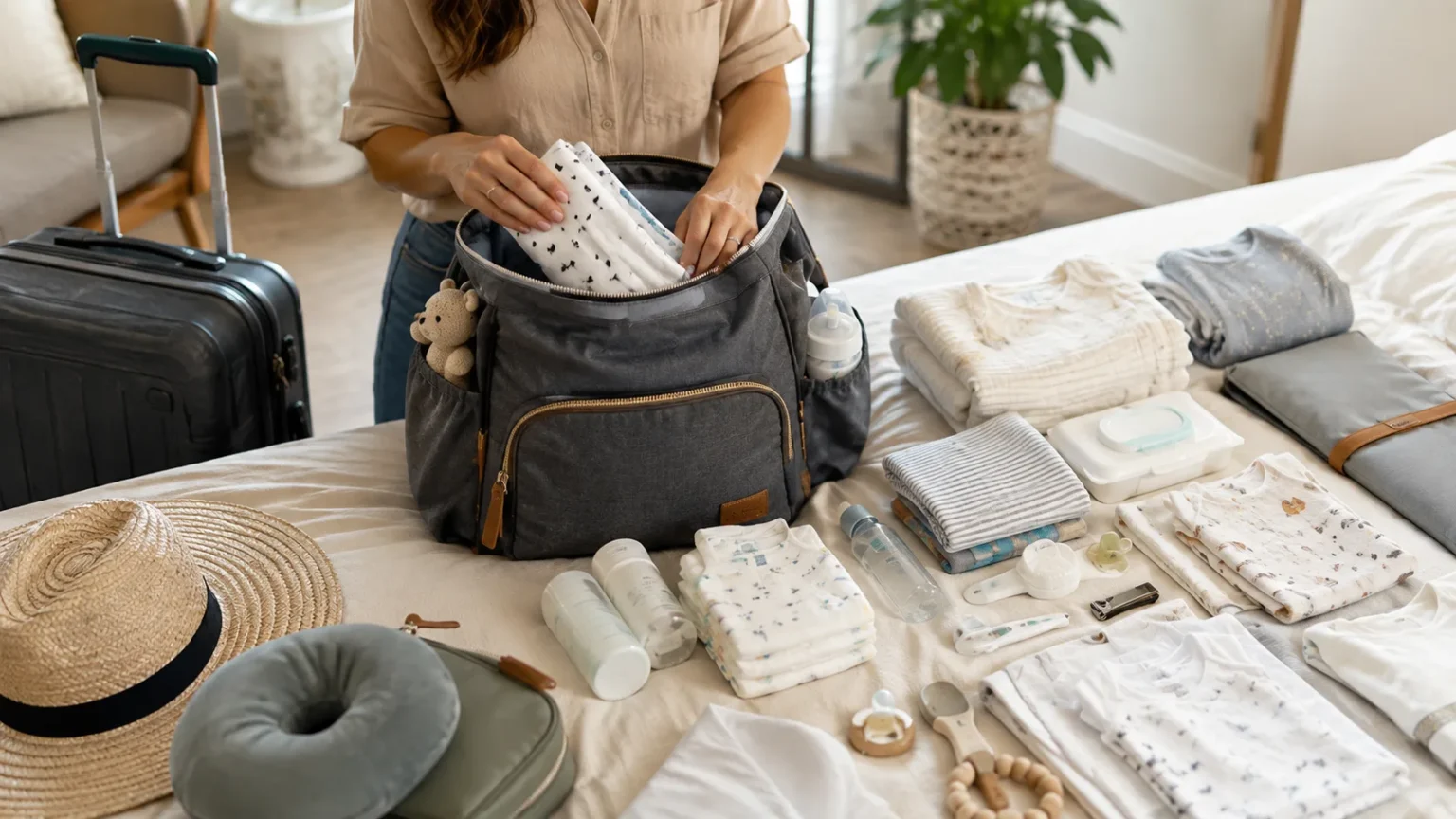
A diaper bag becomes much easier to use when every category has a predictable location. Think of the bag as several small zones rather than one large storage space. One area can contain diaper-changing supplies, another feeding equipment, another spare clothing, and another personal or travel documents.
Use lightweight pouches or reusable bags to create these zones if your diaper bag does not already have enough internal compartments. Labeling is unnecessary if the pouches look or feel different enough to recognize quickly. The objective is to be able to reach what you need without emptying half the bag onto an airport floor.
The changing pouch should be one of the easiest sections to remove. Include a few diapers, wipes, a portable mat, and disposal bags so you can take only that pouch into a restroom. Feeding supplies should also remain together so preparing a bottle or snack does not require searching through unrelated items.
Keep emergency items slightly deeper in the bag while placing frequently used supplies near the top. This creates a simple priority system based on how often each item is needed. Organization often saves more time during travel than carrying additional products ever will.
Use Pouches to Prevent Small Items From Getting Lost
Small items quickly disappear inside a large diaper bag. Pacifiers, medicine, bibs, spoons, charging cables, and travel documents can migrate between compartments until you can no longer remember where anything is located. Pouches prevent this problem by grouping similar items together.
Transparent pouches can be particularly useful because you can identify their contents without opening them. However, any lightweight organizer will work as long as it does not add unnecessary bulk. Reusable resealable bags are an inexpensive alternative and are especially useful for wet or messy items.
Avoid creating too many categories. Ten tiny pouches can make the bag just as confusing as having no organization at all. Three or four practical zones—changing, feeding, clothing, and miscellaneous essentials—will generally cover most needs.
After every trip, restock the pouches instead of rebuilding the diaper bag completely. This makes spontaneous outings easier because the core supplies remain prepared. You can then add journey-specific items such as extra formula, passports, or warmer clothing before departure.
Keep Emergency Supplies Within Reach
Travel delays are common enough that your diaper bag should contain some backup capacity. An extra diaper, additional feed, spare outfit, and small reserve of wipes can make a major difference if a one-hour journey unexpectedly turns into three hours. The goal is not to prepare for every disaster but to cover the most likely disruptions.
Consider the consequences of running out when deciding what deserves backup space. Running out of toys is inconvenient, while running out of diapers or feeding supplies can create a much bigger problem. Prioritize accordingly when space becomes limited.
For air travel, think beyond the scheduled flight time. Your baby’s supplies must cover transportation to the airport, check-in, security, boarding, the flight itself, baggage collection, and travel from the destination airport. Delays can occur at any stage of this process.
For road trips, you have more flexibility because bulkier backup supplies can stay elsewhere in the vehicle. Keep only immediate essentials in the diaper bag and store additional diapers, wipes, clothes, and food in an easily reachable backup container. This reduces the weight you carry during stops.
How to Pack a Diaper Bag for Flying
Flying with a baby becomes easier when the diaper bag is packed specifically for airport conditions. Place travel documents, essential feeding items, changing supplies, and at least one outfit where they can be accessed quickly. You may need them before boarding, during security screening, in the terminal, or while seated on the aircraft.
Avoid storing your baby’s most important supplies exclusively in checked luggage. Bags can be delayed, and access to checked luggage ends long before boarding. Items needed for feeding, diapering, medication, or immediate comfort should stay with you throughout the journey.
Feeding liquids require particular attention. In the United States, breast milk, liquid formula, and related cooling accessories receive special treatment under TSA screening rules and are not handled exactly like ordinary travel liquids. Travelers should inform officers and separate these items when requested for screening.
Airline baggage rules are separate from security rules, so check your carrier’s policy before arriving at the airport. Different airlines can have different allowances for diaper bags, strollers, car seats, breast pumps, and personal items. Confirming the current policy can help you avoid repacking at the check-in counter.
How to Pack a Diaper Bag for a Road Trip
Road trips give parents more storage flexibility, so there is usually no reason to force every baby supply into one diaper bag. Pack the diaper bag for individual stops and keep bulkier backup supplies somewhere accessible in the vehicle. This makes each restaurant, rest-area, or fuel stop easier because you only need to carry one manageable bag.
Create a separate vehicle backup container with additional diapers, wipes, clothing, feeding supplies, and other frequently replenished items. When the diaper bag becomes low, restock it from the vehicle rather than carrying the entire supply everywhere. This strategy also helps prevent the diaper bag from becoming unnecessarily heavy.
Keep temperature-sensitive items appropriately stored. Cars can become dangerously hot or cold, and some foods, medications, or feeding supplies may require controlled temperatures. Do not leave temperature-sensitive baby products in a parked vehicle unless their storage instructions specifically allow it.
Plan regular stops around feeding, diaper changes, and your baby’s comfort. A well-packed diaper bag makes those stops faster because everything needed is already organized. However, the bag should support safe travel routines rather than encouraging families to delay necessary breaks simply to reach a destination sooner.
What Not to Pack in a Travel Diaper Bag
One of the easiest ways to make a diaper bag uncomfortable is to pack too many “just in case” items. Several blankets, an excessive number of toys, full-size toiletries, an entire package of diapers, and multiple bulky outfits can quickly turn a practical bag into something difficult to carry.
Avoid duplicates unless running out would create a genuine problem. Two pacifiers make sense; six usually do not. Several spare diapers are essential, while enough diapers for an entire week belong in your luggage rather than the day bag.
Large containers should also be replaced with travel-sized alternatives whenever practical. Diaper cream, sanitizer, lotion, and other products generally do not need to be carried in their full household packaging during a short journey. Smaller quantities save both weight and space.
Finally, avoid packing items you have never used with your baby simply because they appeared on an online checklist. Every family has different routines. A useful diaper bag reflects what your baby actually needs, not the largest possible collection of baby travel products.
Create a Last-Minute Diaper Bag Check Before Leaving
Before leaving home, perform one quick check of the items that are difficult to replace during travel. Confirm that diapers, wipes, feeding supplies, medication, spare clothes, and travel documents are actually inside the bag rather than sitting on a counter.
Check feeding quantities again based on the total journey, not simply the scheduled flight or drive. Add a reasonable buffer for delays. It is better to carry one additional feed than to find yourself searching for appropriate formula or baby food in an unfamiliar terminal.
Make sure wet wipes have not dried out, medicines have not expired, and spare clothes still fit your baby. Bags that remain permanently packed can contain forgotten items that are no longer suitable several months later.
Finally, review your destination and transportation conditions. Weather, flight length, airport rules, feeding routines, and your baby’s age may require small adjustments. A five-minute review before departure can prevent many of the most common diaper bag problems later in the journey.
Final Thoughts on Packing a Diaper Bag for Travel
Knowing how to pack a diaper bag for travel is really about balancing preparation with simplicity. You need enough supplies to handle feeding, diaper changes, clothing accidents, hygiene, and delays, but carrying too much can make the bag harder to use when you actually need something.
Start with the essentials: diapers, wipes, a changing mat, diaper cream, disposal bags, feeding supplies, spare clothes, and basic hygiene items. Then add a few comfort products, snacks, medication when needed, and backup supplies according to the length and type of journey.
Organization matters almost as much as what you pack. Keep changing, feeding, clothing, and miscellaneous supplies in predictable sections so you can reach them quickly with one hand. Reserve the easiest pockets for items you expect to use repeatedly.
Most importantly, customize the bag around your own baby. A newborn, eight-month-old, and toddler will have different requirements, and no universal checklist can replace understanding your child’s normal routine. Pack around those real needs, add a sensible buffer for delays, and your diaper bag will be far more useful throughout the trip.
Frequently Asked Questions
How many diapers should I pack in a diaper bag for travel?
Estimate how many your baby normally uses during the journey and add several extras for delays, leaks, or unexpected changes. Keep additional vacation supplies in your main luggage.
What should always be in a travel diaper bag?
Diapers, wipes, a changing mat, disposal bags, spare clothes, feeding supplies, hygiene items, and any essential medication should form the core of your bag.
Can I bring baby formula or breast milk through airport security?
In the U.S., breast milk and infant formula can generally exceed normal carry-on liquid limits, but they may require separate screening. Check current airport rules before departure.
Should I take one or two changes of baby clothes?
One complete change is the minimum for most journeys. Two can be useful for newborns, long flights, or babies who frequently experience leaks, spit-up, or spills.
How do I keep a diaper bag organized while traveling?
Separate supplies into simple zones or pouches for changing, feeding, clothing, and other essentials. Keep frequently used items near the top or in exterior pockets.