


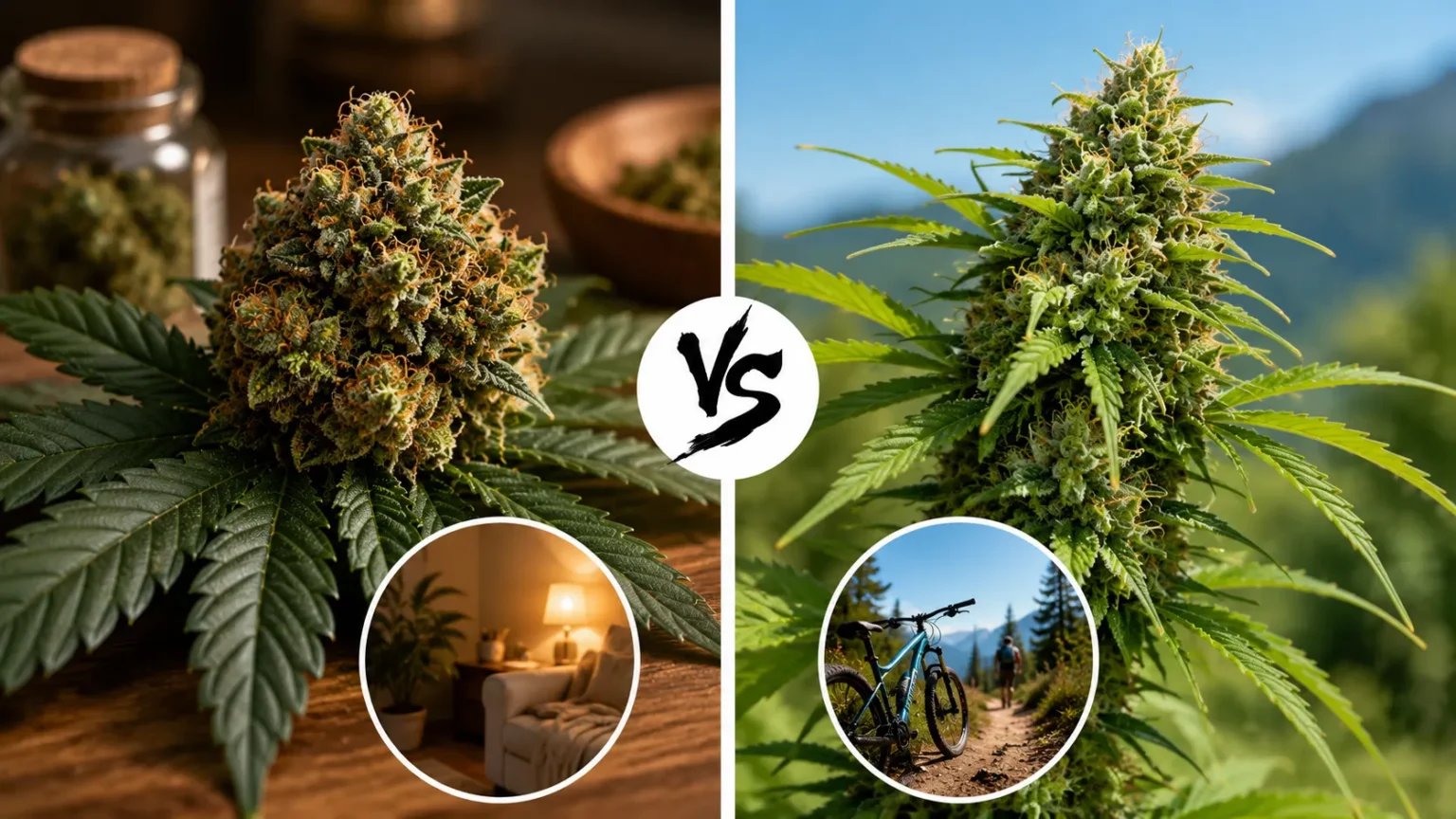
Indica vs Sativa: Key Differences Explained
If you have ever looked at cannabis products, you have probably seen them labeled indica, sativa, or hybrid. For decades, these categories have been used as a quick way to describe different cannabis varieties and the experiences people supposedly associate with them. Indica is commonly described as relaxing or sedating, while sativa is often marketed as uplifting or energizing. Although these descriptions are familiar, modern cannabis research suggests the real differences are considerably more complicated.
The biggest problem with the traditional indica vs sativa comparison is that these labels do not reliably tell you exactly how a cannabis product will affect you. Modern commercial cannabis has been extensively crossbred, and products carrying the same category can contain very different concentrations of THC, CBD, terpenes, and other plant compounds. Researchers have found that indica and sativa labels often fail to accurately represent a product’s complete genetic or chemical composition.
That does not make the labels completely meaningless. They still provide useful historical, botanical, and commercial context, and consumers frequently associate the categories with particular aromas or subjective experiences. However, predicting cannabis effects requires looking beyond a strain name. THC potency, CBD content, terpene profile, dose, method of consumption, individual tolerance, and personal biology may all influence the final experience.
Understanding these distinctions can help replace cannabis myths with more realistic expectations. Whether you are researching cannabis terminology, trying to understand why two products with the same label feel different, or simply curious about what “indica” and “sativa” actually mean, this guide explains their history, plant characteristics, cannabinoids, terpenes, potential effects, risks, and the limitations of modern strain classifications.
What Is Indica?
The term indica is traditionally associated with cannabis plants described as shorter, bushier, and broader-leaved than plants historically categorized as sativa. These physical characteristics developed partly because cannabis populations adapted to different climates and geographic regions over generations. Indica-type plants have traditionally been associated with regions where shorter growing seasons favored compact plants that matured relatively quickly.
In modern cannabis culture, indica has become strongly connected with relaxation. Product descriptions frequently use phrases such as calming, sleepy, body-focused, or nighttime-oriented when marketing an indica strain. This association is so widespread that some consumers automatically choose products labeled indica when they want to unwind or avoid feeling overly stimulated.
However, an indica label does not guarantee sedation. Two products sold as indica may have very different cannabinoid concentrations and terpene profiles, meaning their effects can differ substantially. A high-THC product may also feel very different from a lower-THC product even when both carry exactly the same indica classification.
This is why cannabis experts increasingly encourage people to consider the actual chemical profile instead of relying entirely on strain categories. The label can still provide a convenient starting point, but it should not be treated like a precise prediction of how the product will affect mood, alertness, perception, or physical sensations.
What Is Sativa?
Sativa traditionally describes cannabis plants associated with taller growth, narrower leaves, and longer flowering periods. Historically, these plants were linked with warmer environments and longer growing seasons. Botanical characteristics such as height and leaf shape helped distinguish different cannabis populations long before modern chemical testing became widely available.
Within contemporary cannabis marketing, sativa is commonly associated with an energetic, uplifting, cerebral, or daytime experience. Someone browsing products may see a sativa described as suitable for creativity, conversation, social activities, or staying active. These descriptions have become an established part of cannabis culture and influence how many consumers make purchasing decisions.
Research, however, does not support assuming that every sativa product will reliably produce stimulation or improved energy. Chemical composition varies considerably across cultivars, and modern crossbreeding has blurred many of the historical genetic distinctions between categories. Two sativa-labeled products can therefore contain noticeably different combinations of cannabinoids and aromatic compounds.
Individual responses also vary. A product that one person describes as energizing might make another feel anxious, tired, distracted, or relaxed. Factors such as THC dose, tolerance, previous cannabis exposure, metabolism, emotional state, and surroundings can influence the experience, making the word “sativa” an imperfect guide to expected effects.
Indica vs Sativa: What Is the Main Difference?
Traditionally, the main difference between indica and sativa involved plant appearance, geographic origin, and growing characteristics. Indica plants were generally described as compact and broad-leaved, while sativa plants were described as taller and narrow-leaved. These botanical distinctions later became connected with assumptions about different psychological and physical effects.
Modern cannabis markets use the terms differently. Instead of simply describing plant morphology, indica and sativa often function as experience-oriented marketing categories. Indica usually signals relaxation, while sativa implies energy or alertness. Hybrid products are positioned somewhere between these two categories, although the exact meaning varies considerably between cultivators and retailers.
Scientific analysis has challenged the idea that these labels consistently identify two chemically distinct types of cannabis. Commercial products frequently show extensive genetic overlap, and their chemical profiles do not always correspond neatly with the category displayed on the package. This makes simple comparisons such as “indica equals sedating” and “sativa equals energizing” unreliable.
A more informative comparison considers THC percentage, CBD percentage, terpene content, minor cannabinoids, serving size, and consumption method. These variables provide considerably more information about a particular product than plant-category terminology alone. In other words, the label can offer context, but the chemistry provides more meaningful detail.
Does Indica Really Make You Sleepy?
Indica has become so strongly associated with sleep that many people refer to it almost automatically as nighttime cannabis. Some users do report feeling sleepy, physically relaxed, or less active after using products sold as indica. Consumer surveys also show that people often expect and report relaxation when choosing indica-labeled cannabis.
However, scientists cannot conclude that indica itself automatically causes sleepiness. Commercial indica products can differ dramatically in THC concentration and other chemical compounds. The dose also matters: the effects experienced from a small amount of a particular product may differ substantially from those experienced after consuming a larger quantity.
THC can influence alertness, memory, coordination, mood, perception, and reaction time, but its effects vary between individuals. Some people become tired after using THC-containing cannabis, while others experience increased anxiety, racing thoughts, restlessness, or other effects that could actually interfere with sleep.
Using cannabis specifically to manage persistent insomnia is also different from occasionally feeling sleepy after cannabis use. Ongoing sleep difficulties can be connected with stress, mental health conditions, medications, sleep disorders, pain, lifestyle factors, or other medical problems. People with chronic insomnia should avoid assuming that an indica label automatically represents an evidence-based treatment.
Does Sativa Really Give You Energy?
Sativa products are frequently marketed as an option for people seeking an uplifting or energetic experience. Consumers sometimes describe feeling more talkative, mentally engaged, creative, or interested in activities after using products categorized as sativa. These expectations have helped reinforce the idea that sativa should always be reserved for daytime.
Yet there is no guarantee that a sativa strain will increase energy. Cannabis responses are highly individual, and THC can impair concentration, judgment, coordination, and short-term memory even when someone subjectively feels more stimulated. Feeling energized should therefore not be confused with being unimpaired or objectively more productive.
Dose can dramatically change the experience. A relatively small amount of a particular product might feel manageable to someone with existing tolerance, while a larger dose could lead to anxiety, dizziness, confusion, or significant intoxication. Product potency also varies, making strain labels an unreliable substitute for understanding THC content.
The surrounding environment matters as well. Expectations, mood, social setting, food intake, previous cannabis experience, and other substances can influence subjective effects. Someone using exactly the same product on two different occasions may even describe different experiences, illustrating why predicting effects from the word “sativa” alone is difficult.
Indica vs Sativa Plant Appearance
Classic descriptions portray indica plants as shorter and bushier, with relatively broad leaves and a compact structure. This growth pattern has historically been associated with cannabis populations adapted to particular environments. Cultivators have also valued these characteristics when growing plants in locations where limited space or shorter seasons make compact growth useful.
Traditional sativa plants are generally described as taller, with thinner leaves and a more open growth structure. Their flowering periods have historically been considered longer, particularly among populations adapted to warmer regions with extended growing seasons. Under favorable conditions, these plants may reach considerably greater heights than compact indica-type plants.
These visual differences are useful when discussing cannabis botany, but they do not reliably reveal the chemical content of a finished cannabis product. Looking at leaf width or plant height cannot tell someone precisely how much THC, CBD, myrcene, limonene, pinene, or another compound will be present after cultivation and processing.
Modern breeding complicates the situation even further. Decades of crossing different cannabis varieties have produced plants containing combinations of characteristics historically associated with both categories. A modern cultivar may have broad leaves but a chemical profile unlike what consumers traditionally expect from an indica, demonstrating the limitations of classifying cannabis by appearance alone.
Indica vs Sativa THC Content
One common misconception is that sativa automatically contains more THC, while indica contains more CBD. This is not a reliable rule. THC concentration varies from one cultivar and product to another regardless of whether a package says indica, sativa, or hybrid. High-potency and lower-potency products can exist within all of these categories.
THC, or delta-9-tetrahydrocannabinol, is the primary intoxicating cannabinoid associated with cannabis. It interacts with cannabinoid receptors in the brain and can alter mood, perception, memory, coordination, and thinking. As THC exposure increases, the likelihood of unpleasant or impairing effects can also increase, particularly among inexperienced users.
Because potency varies, looking at THC content can provide more useful information than assuming potency based on strain type. Two products with similar names could contain noticeably different THC percentages depending on cultivation, processing, testing, and product format. Concentrates and some manufactured cannabis products can contain far greater THC concentrations than traditional dried flower.
Higher THC does not automatically mean a better experience. Stronger products may increase the likelihood of anxiety, panic, impaired coordination, confusion, and other unwanted effects. The traditional indica-sativa framework provides little information about this risk unless it is considered together with the product’s actual cannabinoid content.
Indica vs Sativa CBD Content
CBD, or cannabidiol, is another widely recognized cannabinoid found in cannabis. Unlike THC, CBD does not generally produce the same intoxicating “high.” However, CBD is biologically active and should not automatically be treated as harmless simply because it is non-intoxicating.
Neither indica nor sativa guarantees a particular amount of CBD. Some cultivars are THC-dominant, others have more balanced THC-to-CBD ratios, and certain cannabis or hemp varieties have been selectively bred to contain high concentrations of CBD with relatively low THC. Chemical testing is therefore far more useful than the traditional category when CBD content matters.
CBD has received enormous attention for potential health applications, but consumer marketing sometimes goes far beyond established evidence. A purified prescription CBD medicine is used for specific seizure disorders, but that does not mean ordinary retail CBD products have been proven to treat every condition for which they are advertised.
CBD can also interact with medications and may cause side effects. This becomes particularly important when people use concentrated CBD products for medical reasons or combine them with prescription drugs. Anyone considering cannabis-derived products specifically for health treatment should distinguish evidence-based medical use from general wellness marketing.
What Are Cannabis Terpenes?
Terpenes are aromatic compounds found in cannabis and many other plants. They contribute to characteristic scents and flavors that people may describe as citrusy, earthy, pine-like, floral, spicy, or fruity. Cannabis can contain numerous terpenes, and the proportions vary considerably between cultivars.
Commonly discussed cannabis terpenes include myrcene, limonene, pinene, linalool, and beta-caryophyllene. These compounds are often used in product descriptions, with marketers sometimes associating individual terpenes with specific effects such as relaxation or alertness. However, many claims about predicting human experiences from individual terpenes remain more certain in marketing than in clinical evidence.
Interestingly, research suggests that some of the differences people associate with indica and sativa labels may correspond more closely with certain terpene patterns than with broad genetic separation between the categories. This helps explain why consumers may perceive meaningful aroma differences even when genetic studies show substantial overlap between labeled groups.
Terpenes therefore offer another useful piece of information, but they should not be treated as a perfect prediction system either. Cannabis contains hundreds of chemical compounds, and human responses are influenced by numerous variables. A terpene profile can help describe a product’s chemistry and aroma without guaranteeing precisely how someone will feel after using it.
What Is a Cannabis Chemovar?
Because traditional strain labels have limitations, researchers increasingly use the term chemovar, meaning a chemically characterized variety. Rather than simply calling a product indica or sativa, a chemovar-based approach classifies cannabis according to measurable chemical characteristics such as cannabinoids and sometimes additional compounds.
One common framework describes products according to their dominant cannabinoid profile. Type I cannabis is generally THC-dominant, Type II contains substantial amounts of both THC and CBD, and Type III is CBD-dominant with comparatively low THC. These chemical categories provide information directly connected to compounds known to influence cannabis effects.
This approach does not explain every possible difference between products. Minor cannabinoids, terpenes, volatile compounds, cultivation conditions, harvesting, curing, and storage can all influence the final chemical composition. Still, chemovar classification is generally more informative scientifically than assuming effects based solely on indica or sativa terminology.
For consumers trying to understand a regulated product, a laboratory-tested cannabinoid profile can therefore provide better information than a creative strain name. Knowing whether a product contains high THC, balanced THC and CBD, or predominantly CBD offers a clearer starting point for discussing potential intoxication and safety.
What Are Hybrid Cannabis Strains?
A hybrid generally refers to cannabis created by crossing varieties traditionally classified as indica and sativa. Because cannabis has been selectively bred for generations, a large portion of modern commercial cannabis has mixed ancestry. This makes hybridization one of the reasons simple indica-sativa classifications have become scientifically difficult to apply.
Retailers sometimes divide hybrids into indica-dominant, sativa-dominant, or balanced categories. These descriptions are intended to communicate which traditional traits or perceived effects are expected to be stronger. However, there is no universal scientific standard ensuring that one company’s “sativa-dominant hybrid” means exactly the same thing as another company’s product carrying that description.
Hybrid breeding can target many characteristics beyond subjective effects. Cultivators may select plants for aroma, cannabinoid concentration, flowering time, resistance to disease, yield, appearance, or environmental suitability. The resulting plant can therefore contain a complicated combination of traits inherited from multiple parent varieties.
For consumers, seeing the word hybrid should reinforce the importance of examining the actual product rather than relying exclusively on categories. THC and CBD concentration, terpene information, serving size, product format, and individual tolerance can tell you considerably more than simply knowing that a cultivar has mixed ancestry.
Indica vs Sativa Effects on the Brain
Cannabis effects on the brain are influenced primarily by psychoactive compounds such as THC, not by the word printed beside the strain name. THC interacts with cannabinoid receptors in brain regions involved in memory, coordination, pleasure, thinking, movement, and sensory perception. This is why intoxicating cannabis can affect several mental and physical abilities simultaneously.
Possible acute effects include altered perception, changes in mood, impaired short-term memory, slower reaction time, and reduced coordination. Some people experience pleasurable relaxation or euphoria, while others experience anxiety, fear, paranoia, confusion, or unpleasant changes in perception, particularly with higher THC exposure.
The traditional idea that sativa produces only a mental high while indica produces only a physical high oversimplifies how the brain and body respond to cannabinoids. Brain activity influences physical sensations and behavior, while individual physiology and product chemistry determine how pronounced particular effects become.
People should therefore avoid assuming that a familiar category makes impairment predictable. Someone can be significantly impaired after either an indica- or sativa-labeled THC product. Driving, operating machinery, or performing other safety-sensitive activities while impaired can create serious risks regardless of the strain classification.
Which Is Stronger: Indica or Sativa?
Neither indica nor sativa is automatically stronger. Potency depends much more directly on the concentration of THC and other active cannabinoids within a specific product. A high-THC indica can be substantially more intoxicating than a lower-THC sativa, while the opposite can also occur.
Product format further complicates potency comparisons. Dried cannabis flower, concentrates, vape products, oils, and edible products deliver cannabinoids differently. Two products that share the same strain name may therefore produce different experiences because the dose and route of administration are not equivalent.
Personal tolerance also affects what “strong” means. Someone who regularly uses THC may react differently from someone with little previous exposure. Body composition, metabolism, medications, food, alcohol consumption, health conditions, and sensitivity to psychoactive effects can create additional differences.
Instead of asking whether indica or sativa is stronger overall, the more useful question is how much THC and other active compounds are present in the specific product. Understanding dose and potency gives consumers a more realistic picture of potential intoxication than relying on traditional botanical labels.
Indica vs Sativa for Anxiety
Online discussions frequently recommend indica for anxiety because of its reputation for relaxation. While some individuals report feeling calmer after particular cannabis products, THC can also cause or worsen anxiety, particularly at higher doses or in people who are sensitive to its psychoactive effects. An indica label does not eliminate that possibility.
Sativa is sometimes described as more likely to create racing thoughts or nervousness because of its stimulating reputation. Again, this cannot reliably be predicted from the label. A person’s response depends on the actual chemical profile, dose, previous experience, mental state, and individual vulnerability.
CBD has attracted research interest for anxiety-related effects, but evidence from controlled formulations should not be generalized automatically to every retail CBD or cannabis product. Products may contain varying doses, inaccurate labeling, additional cannabinoids, or other ingredients that change their effects and risks.
People experiencing persistent or severe anxiety should consider appropriate professional evaluation rather than experimenting with increasingly potent cannabis products. Anxiety disorders have established treatment options, and cannabis can affect different people in very different ways. Self-treatment based only on indica or sativa marketing may therefore produce unpredictable results.
Indica vs Sativa for Pain
Cannabis and cannabinoids have also attracted significant interest for pain management. Some people report temporary pain relief after using cannabis, and certain cannabinoid-based medicines have been investigated or used within specific medical contexts. However, the effectiveness and appropriate formulation depend on the condition, product, dose, and individual patient.
Calling one strain “indica for pain” does not provide enough information to determine whether it will actually be useful. Products within the same category can contain significantly different levels of THC, CBD, and other compounds. The evidence supporting cannabis for one type of pain also may not apply to every other painful condition.
Potential benefits must be balanced against adverse effects such as intoxication, dizziness, impaired coordination, cognitive changes, and possible interactions with other medications. Long-term or frequent high-THC use introduces additional considerations that are not captured by the simple indica versus sativa distinction.
Anyone considering cannabis specifically to manage chronic pain should discuss options with an appropriate healthcare professional where medical cannabis is legally available. The aim should be understanding evidence, potential risks, medication interactions, and alternative treatments rather than selecting a strain exclusively because its label promises relaxation.
Indica vs Sativa for Sleep
The popular cannabis rule is “indica at night, sativa during the day,” which explains why many people specifically search for indica for sleep. Some THC-containing products may produce short-term sleepiness, and people often report using cannabis in an attempt to fall asleep more easily.
Sleep, however, involves more than sedation. Falling asleep quickly does not necessarily mean sleep quality, sleep architecture, next-day alertness, or long-term insomnia will improve. Frequent cannabis use can also produce tolerance and may change sleep patterns, while stopping regular use can temporarily disrupt sleep for some people.
A product’s cannabinoid content and dose are therefore more important than whether it carries an indica label. High THC can produce unwanted psychological effects in some users, including anxiety or racing thoughts, which may make sleeping more difficult rather than easier.
Persistent sleep problems deserve attention to their underlying causes. Stress, sleep apnea, restless legs, medications, pain, depression, anxiety, caffeine, irregular schedules, and many other factors can contribute to insomnia. Treating chronic sleep difficulties based solely on cannabis category labels can delay identification of a more appropriate solution.
Are Indica and Sativa Scientifically Different?
Historically, indica and sativa represented botanical distinctions, but applying those terms to modern commercial cannabis is scientifically complicated. Genetic research examining modern cannabis samples has found extensive overlap between products sold under the two labels, meaning the names do not neatly identify two separate genetic groups.
Chemical studies have reached similar conclusions. Researchers analyzing commercially available cannabis have found that products can be organized into meaningful chemical groups, but these groups do not consistently correspond with traditional indica, sativa, and hybrid labels. Cannabis chemistry is more diverse than the three-category retail system suggests.
Interestingly, certain terpene differences may contribute to why particular products receive one label rather than another. Aroma and sensory characteristics can influence how growers and consumers categorize cultivars. This means the labels can sometimes correlate with specific traits without representing completely distinct biological categories.
The most accurate conclusion is therefore not that indica and sativa have absolutely no meaning. Rather, their meaning has changed and become inconsistent through historical naming, crossbreeding, consumer expectations, and commercial marketing. For predicting effects, objective chemical information is generally more useful.
Why Cannabis Strain Names Can Be Misleading
Cannabis products are frequently sold under memorable strain names, sometimes implying specific ancestry, flavor, potency, or effects. Yet naming conventions are not always standardized across growers or markets. Two products carrying the same strain name can potentially differ in genetics, cultivation conditions, chemical composition, and potency.
Growing conditions themselves can influence the final plant. Light, nutrients, temperature, harvest timing, drying, curing, and storage may alter cannabinoid or terpene concentrations. Even plants with closely related genetics can therefore produce final products with measurable chemical differences.
Testing and labeling practices also vary depending on jurisdiction and regulation. Where cannabis is legally regulated, laboratory information may help consumers compare cannabinoid concentrations, although no testing system can perfectly predict an individual’s subjective response.
This is why buying cannabis solely because someone recommends a particular strain name can create unrealistic expectations. The chemical information from the actual batch, where reliable testing is available, is generally more valuable than assuming every version of a famous strain will produce an identical experience.
Are There Risks With Indica and Sativa?
Both indica- and sativa-labeled products can carry cannabis-related health risks, particularly when they contain substantial THC. Short-term effects may include impaired memory, judgment, coordination, and reaction time. Some users experience anxiety, panic, paranoia, dizziness, or confusion, particularly with high-potency products.
Regular high-THC exposure can create additional concerns, including the possibility of cannabis use disorder. The risk of harm can be greater with frequent consumption, higher doses, and highly concentrated THC products. Individual vulnerability, age of initiation, and existing health conditions can also influence risk.
Cannabis may interact with certain medications and other substances. Combining intoxicating cannabis with alcohol or other substances that impair alertness can increase functional impairment. People taking prescription medication should not assume cannabis or CBD products are interaction-free simply because they come from a plant.
Pregnancy and breastfeeding require particular caution, and cannabis should also be kept securely away from children and pets. Edible cannabis products can be especially problematic when they resemble ordinary sweets or snacks. Responsible storage is therefore an important part of reducing accidental exposure where cannabis products are present.
Does the Method of Use Affect Cannabis Effects?
Yes. The way cannabis is consumed can dramatically influence how quickly effects begin, how intense they feel, and how long they last. This can sometimes matter more than whether the product is labeled indica or sativa. Inhaled cannabis generally produces noticeable effects more quickly than edible products because cannabinoids enter the bloodstream through different pathways.
Edibles can take considerably longer to produce their full effects. This delay creates a risk that someone may consume more because they mistakenly believe the first amount “didn’t work.” Once additional doses take effect, intoxication can become stronger and last much longer than expected.
Concentrates can contain very high THC concentrations, while dried flower varies substantially in potency. Oils, tinctures, capsules, and other products also deliver cannabinoids differently. Comparing experiences across formats therefore requires more than comparing strain names or THC percentages without considering the amount actually consumed.
These differences demonstrate why the traditional indica-sativa debate provides only a small part of the picture. Dose, formulation, potency, consumption method, timing, and individual response all contribute to the experience and should be considered when discussing cannabis effects or safety.
How to Read a Cannabis Product Label
Where legally regulated cannabis products provide laboratory information, begin by looking at THC and CBD content rather than immediately focusing on indica or sativa. These cannabinoids can provide useful information about the likelihood of intoxication and the broad chemical profile of a product.
Some labels also provide terpene concentrations. This information can help explain aroma and distinguish products chemically, although it should not be treated as a guaranteed prediction of mood or medical benefit. Claims such as “limonene equals happiness” or “myrcene equals sleep” are generally more simplistic than the available science supports.
Pay attention to serving size, particularly for manufactured products. A package may contain multiple servings, so the amount of THC in one serving can be very different from the total THC contained in the package. Misunderstanding this distinction can result in substantially greater exposure than intended.
Finally, treat marketing terms such as “uplifting,” “calming,” “creative,” or “nighttime” as descriptions rather than medical guarantees. They may reflect traditional expectations, consumer reports, or branding rather than controlled clinical evidence. Chemical information gives a more concrete foundation for understanding the product.
Which Is Better: Indica or Sativa?
There is no scientifically universal answer to whether indica or sativa is better. The answer depends partly on what someone means by “better,” but the traditional label alone cannot guarantee a specific outcome. Individual products within each category differ greatly, as do the people using them.
Someone searching for relaxation may assume indica is automatically the correct choice, while someone looking for alertness may reach for sativa. These conventions are familiar and may align with some users’ experiences, but they are not dependable enough to function like precise pharmacological categories.
A more evidence-informed approach focuses on the product’s cannabinoid composition, potency, chemical testing, and potential risks. For people considering cannabis for medical symptoms, the relevant health condition, existing treatments, medications, and clinical evidence should matter more than whether a strain is marketed as indica or sativa.
Ultimately, the most useful lesson from the indica-sativa debate is that cannabis is chemically complicated. Simple labels can help organize a marketplace, but they cannot completely predict biological effects. Understanding that limitation allows people to interpret cannabis information with greater accuracy and fewer unrealistic expectations.
The Bottom Line on Indica vs Sativa
The traditional indica vs sativa distinction began with observable differences between cannabis plant populations, including growth patterns and leaf shape. Over time, cannabis culture added expected effects to these labels, creating the familiar idea that indica is relaxing while sativa is energizing.
Modern scientific research shows that reality is considerably more complicated. Extensive crossbreeding has produced substantial genetic overlap among modern commercial varieties, and chemical studies demonstrate that cannabinoid and terpene profiles do not consistently align with indica, sativa, and hybrid categories.
That means the strain label should be treated as one piece of information rather than a promise. THC concentration, CBD concentration, terpene composition, product format, dose, tolerance, health status, and individual biology can all influence how cannabis affects a particular person.
Neither indica nor sativa is automatically stronger, safer, better for sleep, better for anxiety, or more medically effective. Understanding product chemistry and potential risks provides a more reliable framework than relying exclusively on traditional cannabis stereotypes, especially when cannabis is being considered for a health-related purpose.
Frequently Asked Questions
What is the main difference between indica and sativa?
Traditionally, indica and sativa differ in plant appearance and growth characteristics. Modern commercial labels also imply different effects, but research shows they do not reliably predict a product’s chemistry or experience.
Does indica make you sleepy?
Some people report relaxation or sleepiness from products labeled indica, but the effect is not guaranteed. THC dose, cannabinoid content, terpenes, tolerance, and individual response can all influence how someone feels.
Does sativa give you energy?
Sativa is commonly marketed as uplifting or energizing, but not everyone experiences it that way. Some people may instead experience tiredness, anxiety, or other effects depending on the product and dose.
Which is stronger, indica or sativa?
Neither category is automatically stronger. Actual potency depends primarily on the THC and other cannabinoid concentrations in a particular product rather than whether it is labeled indica or sativa.
What is better than using indica and sativa labels?
Looking at a product’s tested THC, CBD, and broader chemical profile provides more useful information. Chemovar-based classification can describe cannabis chemistry more accurately than relying only on traditional strain labels.