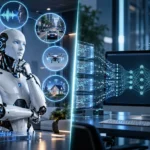



Predictive AI is a form of artificial intelligence that analyzes historical and current data to estimate what is likely to happen next. It uses statistical models, machine learning algorithms, and pattern recognition to identify relationships within large datasets. Businesses often use predictive AI to forecast customer behavior, financial outcomes, demand, risks, and operational changes before they occur.
Unlike systems designed mainly to generate new content, predictive artificial intelligence focuses on probabilities and future outcomes. It looks at past patterns and uses them to calculate the likelihood of specific events. For example, a predictive model may estimate whether a customer will cancel a subscription, whether equipment might fail, or which products are likely to sell next month.
Predictive AI has become increasingly important because organizations now collect more data than ever before. When that information is analyzed effectively, businesses can make decisions based on evidence rather than relying entirely on assumptions. Predictive analytics can support faster planning, better resource allocation, improved customer experiences, and more accurate forecasts across many industries.
How Does Predictive AI Work?
Predictive AI begins with data collection. Organizations may gather information from sales records, customer interactions, sensors, websites, financial systems, mobile applications, or other sources. Before a model can provide useful predictions, the data typically needs to be cleaned, organized, and checked for errors because poor-quality information can reduce the reliability of the final results.
Machine learning algorithms then examine the available data to identify recurring patterns and relationships. The model learns which factors are associated with particular outcomes and assigns different levels of importance to those variables. Once trained, the system can process new information and calculate the probability that a specific event or behavior will occur.
Predictive models must also be evaluated after development. Data scientists compare predictions with actual outcomes to measure accuracy and determine whether improvements are needed. As customer behavior, market conditions, and business environments change, models may require retraining with newer data so their predictions remain useful rather than becoming outdated over time.
Predictive AI vs Traditional Analytics
Traditional analytics often focuses on explaining what has already happened. A business dashboard might show last month’s revenue, customer traffic, conversion rate, or operational costs. These insights are valuable because they help companies understand past performance, but they do not automatically estimate what is likely to happen in the future.
Predictive AI goes further by using past information to forecast possible outcomes. Instead of simply reporting that customer churn increased last quarter, a predictive system may identify which current customers are most likely to leave next. This allows organizations to move from descriptive reporting toward proactive decision-making based on probability and identified behavioral patterns.
Traditional analytics and predictive AI are not competitors because companies often use them together. Historical reporting explains what happened, while predictive models help estimate what may happen next. Combining both approaches gives decision-makers a clearer understanding of current performance and potential future developments, making planning more informed and responsive.
Predictive AI vs Machine Learning and AI
Artificial intelligence is a broad field that includes technologies designed to perform tasks that normally require aspects of human intelligence. Machine learning is a major branch of AI that enables computer systems to learn patterns from data without being manually programmed for every possible situation. Predictive AI commonly relies on machine learning techniques to produce forecasts.
The terms are often used interchangeably, which can create confusion. Predictive AI describes a specific application of AI focused on forecasting future outcomes, while machine learning describes one of the main methods used to build those predictive systems. This guide on machine learning vs AI provides additional context about how these related technologies differ.
Not every machine learning model is designed for prediction, and not every AI application focuses on forecasting. Some systems classify images, translate languages, understand speech, or generate content instead. Predictive AI is specifically concerned with identifying patterns that can help estimate future events, behaviors, risks, demand, or performance based on available evidence.
Examples of Predictive AI in Everyday Life
Predictive AI appears in many everyday digital services, even when users do not realize it is operating behind the scenes. Streaming platforms may predict which movies or shows someone is likely to enjoy based on previous viewing behavior. Online stores can similarly estimate which products a customer may be interested in purchasing next.
Email platforms frequently use predictive technology to identify unwanted messages before they reach the main inbox. Navigation apps can estimate travel times by analyzing historical traffic patterns alongside current road conditions. Financial applications may also detect unusual spending behavior and predict whether a transaction appears suspicious enough to require additional verification.
Smartphone applications offer additional examples. Predictive keyboards suggest likely next words, while fitness platforms can analyze activity trends and provide personalized recommendations. These systems are useful because they transform large amounts of behavioral data into predictions that can make services more convenient, relevant, personalized, and responsive to individual needs.
Predictive AI in Marketing and Sales
Marketing teams use predictive AI to understand which customers are most likely to purchase products, respond to campaigns, or stop engaging with a company. Predictive lead scoring can rank prospects according to their estimated likelihood of converting. Sales teams can then prioritize stronger opportunities rather than spending equal amounts of time on every potential customer.
Predictive models can also support customer segmentation and personalized marketing. Instead of grouping audiences using only broad characteristics, businesses can estimate future interests based on browsing behavior, previous purchases, engagement patterns, and other signals. This allows marketers to provide more relevant recommendations, promotions, and messaging at times when customers may be more likely to respond.
Customer churn prediction is another important application. Subscription businesses can analyze usage patterns, support interactions, payment history, and engagement levels to identify customers who may be considering leaving. Teams can then intervene with better support, personalized offers, or product guidance before the customer decides to cancel the service.
Predictive AI in Healthcare
Healthcare organizations can use predictive AI to identify patterns that may help professionals estimate patient risks and healthcare needs. Models may analyze medical history, laboratory results, vital signs, and other clinical information to highlight patients who could require additional attention. These systems are generally intended to support healthcare professionals rather than replace medical judgment.
Hospitals may also use predictive models for operational planning. Historical admission patterns can help organizations estimate patient volumes, staffing requirements, bed demand, or resource needs. More accurate forecasting may improve scheduling and help healthcare teams prepare for periods when certain services are likely to experience higher demand.
However, medical predictions require particularly careful oversight because inaccurate results can have serious consequences. Healthcare organizations need reliable data, privacy protections, clinical validation, and qualified professionals who understand the limitations of automated recommendations. Predictive systems should provide useful decision support while leaving important medical decisions with trained healthcare professionals.
Predictive AI in Finance and Banking
Banks and financial institutions use predictive AI to evaluate risk, detect suspicious behavior, forecast financial performance, and understand customer needs. Credit models may estimate the likelihood that a borrower will repay a loan based on relevant financial information. These predictions can help lenders make faster decisions while maintaining established risk management procedures.
Fraud detection is another major application. Predictive systems can analyze transaction amounts, locations, devices, account history, and spending patterns to identify activity that differs from normal behavior. When unusual transactions are detected, banks can request additional verification or send the activity for review before potentially fraudulent payments cause greater financial damage.
Investment and corporate finance teams can also use predictive modeling for market analysis, cash-flow forecasting, and risk assessment. Predictions cannot guarantee future financial results because markets can change unexpectedly. However, they can provide additional information that helps professionals evaluate possible scenarios and make decisions with a clearer understanding of potential risks.
Predictive AI in Retail and E-Commerce
Retailers use predictive AI to estimate which products customers may buy and how much demand different items could receive. Demand forecasting can help businesses determine appropriate inventory levels across stores and warehouses. Better forecasts may reduce situations where popular products sell out while less popular inventory remains unsold for extended periods.
E-commerce companies also use predictive recommendations to personalize shopping experiences. Customer browsing history, previous purchases, search behavior, and interactions can help models estimate which products are likely to be relevant. Personalized recommendations may make it easier for shoppers to discover useful products while helping businesses improve engagement and increase potential sales.
Predictive pricing is another application, although it requires careful implementation. Businesses may analyze demand patterns, inventory levels, seasonal changes, and competitor activity when determining prices or promotional timing. When used responsibly, these insights can improve planning, but companies should avoid practices that create unfair, confusing, or discriminatory outcomes for customers.
Predictive AI in Manufacturing and Operations
Manufacturers commonly use predictive AI for equipment maintenance. Sensors can collect data about temperature, vibration, pressure, energy use, and equipment performance, allowing predictive systems to identify patterns that may indicate future failure. Maintenance teams can investigate potential problems before equipment unexpectedly stops working and interrupts production.
This approach is known as predictive maintenance. Instead of servicing every machine according to the same fixed schedule, organizations can prioritize equipment showing signs of unusual behavior. Predictive maintenance may reduce downtime, extend equipment life, improve workplace safety, and prevent unnecessary maintenance tasks when machinery is functioning normally.
Supply chain teams can also apply predictive AI to demand planning, transportation, inventory management, and delivery forecasting. Models can analyze historical sales, supplier performance, seasonal changes, and operational data to estimate future needs. Better forecasting can help companies prepare for disruptions and allocate resources more efficiently across complex supply networks.
Major Benefits of Predictive AI
One of the biggest benefits of predictive AI is better decision-making. Businesses can use data-driven forecasts to evaluate likely outcomes before committing resources or choosing a strategy. Although predictions are never certain, they can provide useful evidence that helps managers compare options and reduce reliance on intuition alone.
Predictive AI can also improve efficiency. Organizations may anticipate inventory shortages, equipment problems, customer churn, financial risks, or staffing needs before they become more difficult to manage. Addressing these issues earlier can reduce unnecessary costs and help employees focus their time on areas where intervention is likely to have the greatest impact.
Personalization is another major advantage. Predictive models can estimate what individual customers are likely to need or prefer based on their previous behavior. This can improve product recommendations, marketing messages, customer support, and digital experiences while allowing companies to deliver more relevant services instead of treating every user exactly the same way.
Risks and Limitations of Predictive AI
Predictive AI is only as reliable as the data and assumptions behind it. Inaccurate, incomplete, outdated, or biased data can lead models to produce misleading predictions. Organizations should therefore avoid treating model outputs as unquestionable facts and regularly evaluate whether the information being used accurately represents the environment in which predictions are being made.
Bias presents another important concern. Historical datasets may reflect previous inequalities or patterns that should not be repeated. If organizations train predictive systems without evaluating fairness, models can unintentionally disadvantage certain groups in areas such as employment, lending, insurance, healthcare, or customer service, creating ethical and potentially regulatory problems.
Privacy and security must also be considered because predictive systems often analyze significant amounts of personal or business information. Companies need strong controls governing how data is collected, stored, accessed, and used. Responsible predictive AI requires transparency, cybersecurity protections, human oversight, clear accountability, and processes for correcting mistakes when models produce unreliable results.
How Businesses Can Use Predictive AI Effectively
Companies should begin with a clearly defined problem rather than adopting predictive AI simply because the technology is popular. A practical use case might involve forecasting demand, identifying customers at risk of leaving, predicting equipment problems, or prioritizing sales leads. Clear objectives make it easier to select appropriate data and evaluate whether the model creates measurable value.
Data quality should receive significant attention before model development begins. Duplicate records, missing information, inconsistent formats, and outdated values can negatively affect predictions. Businesses also need enough relevant historical data to identify meaningful patterns, while ensuring that data collection and processing follow appropriate privacy, security, and regulatory requirements.
Human oversight remains essential after deployment. Employees should understand how predictions are generated, when they should be questioned, and what limitations affect the model. Organizations should monitor results continuously, compare predictions with actual outcomes, retrain models when conditions change, and establish clear responsibility for decisions influenced by predictive systems.
The Future of Predictive AI
Predictive AI is likely to become more deeply integrated into everyday business software. Instead of operating as a separate analytics platform, predictive capabilities may increasingly appear inside customer relationship management systems, financial applications, marketing platforms, supply chain software, and workplace tools. Employees could receive predictions directly while completing their normal tasks.
Models may also become more accessible to smaller organizations as cloud platforms and automated machine learning tools reduce the technical barriers to adoption. Businesses that previously lacked large data science teams may be able to develop basic forecasting systems more easily. However, easier access does not remove the need for responsible data practices or careful evaluation.
The most valuable predictive systems will probably combine strong technology with human expertise. AI can process large datasets and recognize complex relationships quickly, while people can provide context, judgment, ethical reasoning, and accountability. Organizations that understand this balance are more likely to use predictive AI effectively without becoming overly dependent on automated forecasts.
Conclusion
Predictive AI uses historical and current data to estimate what is likely to happen in the future. Machine learning algorithms identify patterns that help organizations forecast customer behavior, financial risks, demand, equipment problems, healthcare needs, and other outcomes. These capabilities make predictive technology useful across marketing, finance, retail, healthcare, manufacturing, and many other industries.
The main benefits include better forecasting, greater efficiency, earlier risk detection, improved personalization, and stronger decision support. However, predictive models can also produce inaccurate or unfair results when they rely on poor-quality data, biased assumptions, or outdated patterns. Organizations therefore need reliable data, ongoing testing, strong security, and meaningful human oversight.
Predictive AI works best as a tool for supporting decisions rather than replacing judgment entirely. Predictions represent probabilities, not guaranteed outcomes, and unexpected events can always change what happens next. Businesses that combine predictive insights with experienced professionals can gain practical advantages while managing the limitations and risks associated with automated forecasting.
FAQs
What is predictive AI in simple terms?
Predictive AI uses existing data to estimate what may happen next. It identifies patterns in past information and applies those patterns to future events, behaviors, risks, or business outcomes.
What is an example of predictive AI?
A retailer predicting which products will sell next month is a common example. Other examples include fraud detection, customer churn prediction, equipment maintenance forecasting, and personalized product recommendations.
What is the main benefit of predictive AI?
Its main benefit is helping people make more informed decisions about future possibilities. Organizations can anticipate risks, customer needs, demand, and operational problems before they become more difficult to manage.
Is predictive AI the same as generative AI?
No. Predictive AI forecasts likely outcomes using existing patterns, while generative AI creates new content such as text, images, or code. Both use artificial intelligence but serve different purposes.
Can predictive AI be 100% accurate?
No predictive system can guarantee perfect accuracy because future conditions can change unexpectedly. Reliable models improve decision-making by estimating probabilities, but their predictions still require monitoring, evaluation, and human judgment.