


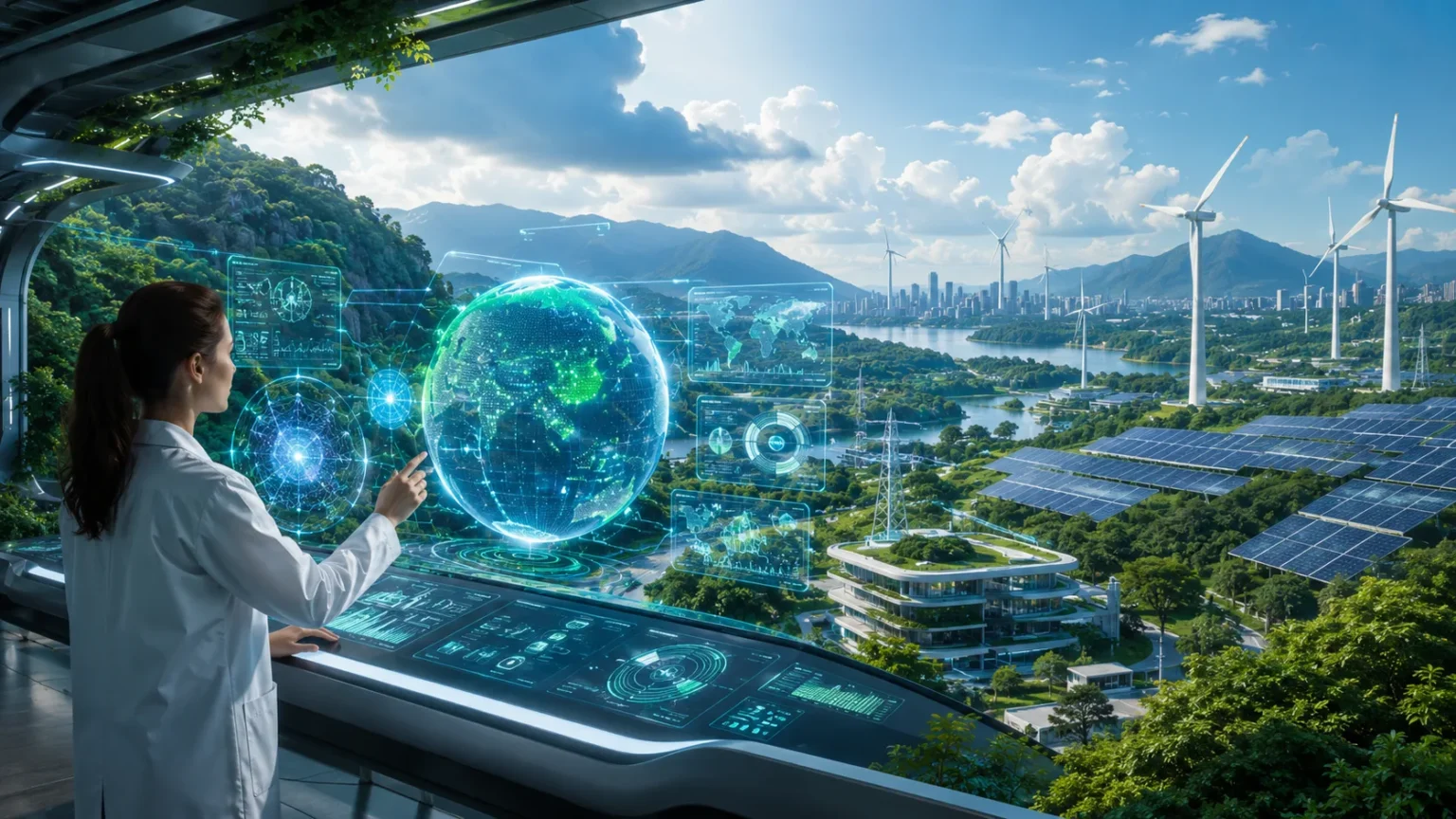
Can AI Help Fight Climate Change?
Climate change is one of the most complicated challenges facing the world because its causes and consequences touch almost every part of modern life. Energy production, transportation, agriculture, manufacturing, buildings, forests, and consumer behavior all contribute to greenhouse gas emissions, while communities must also prepare for rising climate risks.
Artificial intelligence is increasingly being explored as a tool for addressing some of these challenges. AI can process enormous datasets, recognize patterns that humans might miss, make predictions, optimize complicated systems, and help decision-makers respond more quickly when environmental conditions change.
So, can AI help fight climate change? Yes, but AI is not a climate solution by itself. It can support cleaner electricity, improve weather forecasts, identify methane leaks, track deforestation, optimize transportation, reduce energy waste, and help scientists understand climate risks more efficiently.
At the same time, artificial intelligence has its own environmental footprint. Training and operating large AI systems requires computing infrastructure that consumes electricity, water, equipment, and raw materials. The climate value of AI therefore depends on whether its real-world benefits outweigh the resources required to build and operate it.
How Can AI Help Fight Climate Change?
AI can contribute to climate action in two broad ways: reducing the greenhouse gas emissions that cause global warming and helping society adapt to climate impacts that can no longer be completely avoided. Both areas require better information, faster decisions, and more efficient systems.
On the mitigation side, machine learning can help optimize power grids, forecast renewable electricity production, improve industrial efficiency, reduce transportation waste, detect emissions, and support lower-carbon technologies. Even modest efficiency improvements can become meaningful when applied repeatedly across large energy and industrial systems.
On the adaptation side, AI can strengthen weather forecasting, flood prediction, wildfire monitoring, agricultural planning, and climate-risk analysis. Earlier and more localized information gives governments, businesses, farmers, and communities more time to prepare before dangerous conditions become severe.
The biggest opportunity therefore comes from using AI for climate change as a practical decision-support technology. AI works best when connected to real-world infrastructure, accurate environmental data, skilled people, effective policy, and clearly defined climate goals rather than being treated as a solution in isolation.
Why Artificial Intelligence Is Useful for Climate Action
Climate systems generate enormous amounts of information. Satellites, weather stations, ocean buoys, aircraft, energy meters, industrial sensors, traffic networks, and scientific instruments continuously collect data describing environmental and human activity across the planet.
Machine learning excels at finding patterns within large and complicated datasets. An algorithm can examine thousands or millions of observations and identify relationships that would take people far longer to detect manually. This makes AI useful for environmental monitoring, prediction, and optimization.
AI can also update predictions as new information becomes available. An electricity operator, for example, may need to respond quickly when cloud cover changes solar generation or when temperatures increase electricity demand. Automated systems can continuously analyze these changing conditions.
However, speed alone does not make an AI system useful. Climate decisions require reliable observations, scientific understanding, local knowledge, and human judgment. Artificial intelligence becomes most valuable when it helps experts interpret information and act more effectively rather than attempting to replace them.
How AI Can Improve Climate Modeling
Climate models help scientists understand how Earth’s atmosphere, oceans, land, ice, and ecosystems interact over long periods. These models require substantial computing power because researchers must simulate extremely complicated physical processes across enormous geographic areas.
Machine learning can complement traditional climate modeling by identifying patterns in historical observations and model outputs. Researchers can use AI to improve certain calculations, process model results, detect relationships, and potentially make some simulations more computationally efficient.
AI can also help with a challenge known as downscaling. Global climate models provide valuable information at broad scales, but local planners often need more detailed projections for individual regions, cities, watersheds, or agricultural areas.
Better localized information could help communities plan for changing temperatures, precipitation, drought, flooding, and other climate-related risks. AI does not eliminate uncertainty in climate projections, but it can provide researchers with additional tools for extracting useful information from extremely complex datasets.
AI and Weather Forecasting
Weather and climate are different, but better weather forecasting is an important part of adapting to a changing climate. Communities increasingly need timely information about storms, extreme rainfall, heat, drought, and other potentially dangerous conditions.
AI weather models can learn patterns from enormous collections of historical atmospheric observations. Once trained, some systems can generate forecasts quickly, giving meteorologists additional information that complements conventional physics-based numerical weather prediction.
Machine-learning systems are especially promising for weather nowcasting, which focuses on conditions expected during the next few minutes or hours. Rapid predictions can be useful for developing thunderstorms, intense rainfall, wind events, and other hazards that change quickly.
Meteorologists remain essential because forecasts must be interpreted and communicated within their real-world context. AI may recognize atmospheric patterns quickly, but human forecasters understand local vulnerabilities, uncertainty, public communication, and how different hazards could affect communities.
How AI Can Improve Early Warning Systems
Early warning systems provide people with time to prepare before dangerous weather or climate-related events occur. Even a relatively short warning can influence decisions about evacuations, transportation, emergency services, farming, schools, and infrastructure operations.
AI can combine information from radar, satellites, weather stations, river sensors, historical records, and forecasting models. Machine-learning algorithms can then identify conditions associated with floods, severe storms, heatwaves, or other hazards and help estimate where impacts may occur.
Flood forecasting provides a useful example. River levels depend on rainfall, soil conditions, upstream flows, terrain, and numerous other variables. AI can help analyze these relationships and support forecasts that give downstream communities additional preparation time.
Effective warnings still require much more than prediction. People need trustworthy communication, emergency plans, accessible technology, local response systems, and clear instructions. AI can strengthen part of the warning chain, but technology has little value if accurate information fails to reach people who need it.
How AI Supports Renewable Energy
Solar and wind power are essential components of lower-carbon electricity systems, but their output changes with weather conditions. Solar panels produce less electricity when sunlight decreases, while wind turbines depend on changing wind speeds.
AI can help predict renewable electricity generation by analyzing weather forecasts, historical production, cloud movement, wind patterns, and equipment performance. Better predictions allow electricity operators to plan more accurately for changes in supply.
Machine learning can also help identify problems with renewable energy equipment. Sensors on wind turbines or solar installations collect operating information, and AI systems can recognize unusual patterns that may indicate declining performance or developing mechanical problems.
This type of renewable energy optimization can improve reliability and reduce unnecessary downtime. AI cannot build solar panels or wind farms by itself, but it can help operators use existing renewable infrastructure more efficiently and integrate variable electricity sources into larger energy systems.
How AI Can Make Power Grids Smarter
Electricity grids must continuously balance supply and demand. Electricity production needs to respond to changing consumption while maintaining reliable voltage and frequency across enormous networks connecting power plants, homes, businesses, batteries, and renewable-energy systems.
Artificial intelligence can analyze electricity demand patterns and predict when consumption is likely to rise or fall. Utilities can use these forecasts to schedule generation, storage, and other resources more efficiently while reducing unnecessary waste.
AI may also support smart grids containing distributed energy resources such as rooftop solar panels, electric vehicles, home batteries, and flexible appliances. Coordinating millions of smaller energy resources creates a complicated optimization problem well suited to data-driven tools.
Grid modernization still requires physical infrastructure, transmission lines, energy storage, regulations, and investment. AI can improve decision-making within the electricity system, but software alone cannot solve problems caused by insufficient generation capacity or outdated physical networks.
How AI Helps Improve Energy Efficiency
Reducing wasted energy is one of the most practical ways to lower emissions. Buildings, factories, transportation networks, and commercial facilities frequently consume more electricity or fuel than necessary because operating conditions change throughout the day.
AI systems can analyze information from sensors, meters, equipment, weather forecasts, and occupancy patterns. Algorithms can then identify opportunities to adjust heating, cooling, lighting, machinery, or other equipment without significantly reducing comfort or productivity.
Predictive maintenance can create additional savings. Instead of servicing equipment only after it fails, machine learning can recognize patterns that suggest a component is becoming inefficient or likely to break, allowing maintenance teams to intervene earlier.
The climate benefit depends on how much energy is genuinely saved and where that energy comes from. Improving efficiency in a system powered mainly by fossil fuels can directly reduce emissions, while efficiency also helps renewable electricity resources serve more demand.
How AI Can Make Buildings More Sustainable
Buildings consume energy for heating, cooling, ventilation, lighting, appliances, computing, and numerous other activities. Their actual energy needs change according to outdoor temperature, occupancy, time of day, sunlight, humidity, and building design.
Smart building systems can use AI to analyze these conditions continuously. Heating and cooling equipment can then respond dynamically instead of following rigid schedules that may waste energy when rooms are empty or conditions change unexpectedly.
Machine learning can also compare building performance over time and identify unusual energy consumption. Facility managers can investigate inefficient equipment, air leaks, poor control settings, or other problems before they continue wasting energy for months.
AI works most effectively when combined with energy-efficient construction, insulation, efficient appliances, heat pumps, renewable electricity, and thoughtful architectural design. A poorly designed building cannot become genuinely sustainable simply by adding intelligent software.
How AI Can Reduce Industrial Emissions
Industry produces significant greenhouse gas emissions through fuel combustion, electricity use, chemical processes, and production of materials such as steel and cement. Improving industrial efficiency can therefore play an important role in climate mitigation.
Factories generate large amounts of operating data from sensors measuring temperature, pressure, flow rates, energy consumption, equipment conditions, and product quality. Machine-learning systems can analyze these measurements to identify more efficient operating conditions.
AI can also support process control by adjusting equipment within carefully defined limits. Small improvements in temperature management, production scheduling, material use, or energy consumption can become substantial when repeated across high-volume industrial operations.
However, efficiency alone cannot eliminate industrial emissions. Some manufacturing processes require new fuels, electrification, cleaner materials, recycling, carbon capture, or redesigned production technologies. AI can help optimize these transitions but cannot substitute for the underlying physical changes.
How AI Can Help Reduce Transportation Emissions
Transportation emissions come from cars, trucks, aircraft, ships, and other vehicles that largely depend on fossil fuels. Artificial intelligence can help reduce unnecessary fuel consumption by improving routes, traffic management, logistics, and vehicle efficiency.
Delivery companies can use optimization algorithms to determine routes that reduce distance, congestion, and empty vehicle movement. When multiplied across thousands of vehicles and daily journeys, better logistics can reduce both fuel costs and emissions.
Cities can also use traffic data to improve signal timing and understand congestion patterns. Reducing unnecessary idling and stop-and-go traffic can improve efficiency, although better public transportation, walking infrastructure, cycling, and cleaner vehicles remain important.
AI may additionally support charging decisions for electric vehicles. Smart charging systems can shift some electricity demand toward times when the grid has greater capacity or cleaner electricity is readily available, helping transportation and energy systems work together more effectively.
How AI Can Improve Public Transportation
Public transportation can reduce per-person emissions when buses, trains, and other shared systems successfully attract passengers away from individual car journeys. Reliable schedules and efficient service are therefore important components of sustainable urban mobility.
AI can analyze passenger demand, traffic patterns, delays, events, weather conditions, and historical travel behavior. Transit agencies may use this information to improve scheduling and place vehicles where demand is likely to be highest.
Predictive maintenance can also improve reliability. Sensors on trains, buses, rails, and other infrastructure can generate information that helps algorithms detect potential equipment problems before they cause major disruptions.
Technology cannot compensate for inadequate transit investment, poor accessibility, or routes that do not serve where people need to travel. AI can make public transportation more responsive, but successful low-carbon mobility ultimately requires thoughtful infrastructure and urban planning.
How AI Can Help Agriculture Adapt to Climate Change
Farmers are highly exposed to weather and climate conditions. Temperature, rainfall, soil moisture, pests, drought, and extreme weather can all influence crop productivity, while climate change may make some agricultural conditions increasingly unpredictable.
AI-powered agricultural tools can combine satellite imagery, weather information, soil sensors, and field observations to help farmers understand changing conditions. Better information may support decisions about planting, irrigation, fertilization, pest management, and harvesting.
Machine learning can also recognize signs of crop stress from images. Identifying water shortages, disease, or nutrient problems earlier can allow farmers to respond more precisely instead of treating an entire field unnecessarily.
The usefulness of AI in agriculture depends heavily on affordability, connectivity, accurate local information, and farmer access to technology. Climate-smart tools should support farmers rather than create systems that exclude smaller producers who lack expensive digital infrastructure.
How AI Can Reduce Water Waste in Agriculture
Agriculture requires large quantities of water, and climate change can intensify water stress in many regions. Irrigation that delivers too much or too little water can waste resources, increase costs, and reduce crop performance.
AI-assisted irrigation systems can analyze soil moisture, weather forecasts, crop growth, temperature, and evaporation conditions. Instead of watering fields according to a fixed schedule, farmers may be able to adjust irrigation according to changing plant needs.
Satellite and drone imagery can provide additional information about which parts of a field appear unusually dry or stressed. Precision irrigation can then focus resources where they are most useful rather than treating every location identically.
These technologies are not substitutes for responsible water management. Rivers, aquifers, irrigation infrastructure, pricing policies, and local ecosystems still determine whether agricultural water use is sustainable over the long term.
How AI Can Detect Methane Emissions
Methane is a powerful greenhouse gas released by sources including fossil-fuel operations, agriculture, waste, and natural processes. Detecting large human-caused leaks quickly can create opportunities to reduce emissions before they continue for long periods.
Satellites, aircraft, and ground sensors can measure atmospheric methane concentrations, producing enormous quantities of data. AI can help identify unusual patterns and determine which observations may indicate significant emission sources.
Machine-learning systems can also assist with interpreting satellite imagery and distinguishing potential methane plumes from background atmospheric variation. Analysts can then investigate likely sources and determine whether repairs or other mitigation measures are possible.
Detection only creates climate benefits when it leads to action. Companies, regulators, governments, and communities need systems for verifying emissions and correcting avoidable leaks after monitoring technology identifies them.
How AI Can Monitor Deforestation
Forests absorb carbon dioxide and support biodiversity, water systems, local communities, and regional climate conditions. Rapid deforestation can therefore contribute to both greenhouse gas emissions and ecological damage.
Satellites continuously photograph forested regions around the world, but analyzing every image manually would be extremely difficult. Computer vision can compare images over time and help identify changes that resemble logging, road construction, fires, or forest clearing.
Faster detection can help authorities and conservation organizations investigate suspicious activity sooner. AI may also distinguish between different types of land-cover change, allowing researchers to understand where forests are being lost and what may be driving that change.
Satellite monitoring cannot protect forests by itself. Enforcement, land rights, economic incentives, sustainable agriculture, community participation, and responsible supply chains are all essential. AI primarily improves the speed and scale at which information becomes available.
How AI Can Help Detect Wildfires
Wildfires are influenced by vegetation, weather, landscape conditions, ignition sources, and human activity. Climate change can increase fire risk in some regions by creating hotter or drier conditions that allow vegetation to burn more readily.
AI can analyze satellite imagery, cameras, weather measurements, lightning information, and environmental sensors to help detect potential fires. Identifying smoke or unusual heat quickly can allow emergency agencies to investigate before a small fire grows much larger.
Machine learning may also assist with fire-risk forecasting. By examining vegetation dryness, temperature, wind, previous fires, terrain, and other factors, models can highlight areas where dangerous conditions are developing.
Wildfire management remains complicated because preventing every fire is neither possible nor ecologically desirable. AI should support professional fire managers who understand local ecosystems, prescribed burning, emergency response, evacuation needs, and the difference between beneficial and destructive fire.
How AI Can Support Flood Prediction
Flooding can develop from intense rainfall, overflowing rivers, storm surges, snowmelt, drainage failures, or combinations of several factors. Predicting where water will travel requires understanding weather, terrain, soil, rivers, and infrastructure.
Machine-learning models can analyze historical floods together with current rainfall and river observations. They may help estimate which locations are likely to experience rising water and how conditions could change during the following hours or days.
Detailed elevation maps and satellite information can also help identify vulnerable areas. When combined with forecasts, these datasets can support emergency planning and provide communities with more useful information about potential impacts.
Flood prediction should ultimately lead to practical action. Better models matter most when warnings reach residents, evacuation routes are available, critical infrastructure is protected, and governments have plans for responding when forecasts indicate serious danger.
How AI Can Support Climate-Resilient Cities
Cities concentrate people, buildings, roads, electricity systems, and other infrastructure, making them particularly vulnerable to heatwaves, flooding, storms, and air pollution. Climate adaptation therefore requires understanding where risks are highest within individual neighborhoods.
AI can combine satellite imagery, temperature measurements, land-cover information, demographic data, and infrastructure maps to identify areas experiencing greater heat or flood exposure. Urban planners can use this information when prioritizing adaptation investments.
For example, mapping urban heat can reveal neighborhoods with limited vegetation and extensive heat-absorbing surfaces. Cities can then investigate interventions such as trees, shade structures, reflective materials, parks, or cooling facilities.
Technology must be used carefully because climate vulnerability is also shaped by income, housing quality, age, healthcare access, and social conditions. Effective climate resilience requires community participation rather than allowing algorithms alone to determine where public resources should go.
How AI Can Help Manage Water Resources
Climate change can alter rainfall patterns, snow accumulation, evaporation, and water availability. Water managers need to balance supplies for households, agriculture, ecosystems, industry, and electricity generation while preparing for droughts and floods.
AI can combine information from reservoirs, rivers, groundwater monitoring, weather forecasts, and historical demand. Algorithms may help managers identify emerging shortages and evaluate different operating strategies under changing conditions.
Machine learning can also help detect leaks within municipal water networks. Abnormal pressure or flow patterns may reveal infrastructure problems that would otherwise waste treated water for extended periods before becoming visible.
Good water governance remains essential. AI can improve forecasts and operational information, but societies still need equitable rules about how limited water resources are allocated when demand exceeds available supply.
How AI Can Improve Waste Management
Waste contributes to environmental problems through resource consumption, transportation, landfill emissions, and pollution. Better sorting, collection, recycling, and materials management can reduce some of these impacts.
Computer vision can help automated sorting systems identify different types of materials moving through recycling facilities. More accurate separation may improve the quality of recovered resources and reduce contamination in recycling streams.
AI can also optimize waste-collection routes by analyzing how quickly containers fill. Trucks may then collect waste when necessary instead of following inefficient fixed routes that require unnecessary driving and fuel consumption.
Waste prevention remains more valuable than simply making disposal more efficient. Product redesign, reuse, repair, recycling infrastructure, and reduced consumption all matter, with AI serving as one tool within a broader circular economy strategy.
How AI Can Track Greenhouse Gas Emissions
Climate policy requires knowing where emissions originate and whether reduction efforts are working. Traditional inventories estimate emissions using information about fuel use, production, transportation, agriculture, and other activities.
AI can help combine satellite observations, sensor measurements, industrial records, and other large datasets. Machine learning may identify patterns that reveal inconsistencies or previously overlooked emission sources.
More detailed information can potentially help companies and governments target reductions where they will have the greatest effect. It can also improve monitoring by comparing reported emissions with independent observations.
However, automated carbon accounting is only as trustworthy as its underlying data and methodology. Organizations should not treat AI-generated estimates as unquestionable facts, particularly when important financial or regulatory decisions depend on the results.
Can AI Help With Carbon Capture?
Carbon capture involves separating carbon dioxide from industrial processes or directly from the atmosphere and then storing or using it. Many approaches require substantial energy and expensive materials, which creates opportunities for technological optimization.
Machine learning can help researchers screen potential materials for capturing carbon dioxide. Instead of experimentally testing every possible candidate from the beginning, computational methods can identify promising materials for scientists to study more closely.
AI can also support operating decisions within carbon-capture facilities by analyzing temperature, pressure, flow rates, and other conditions. More efficient operation could reduce the energy penalty associated with capturing carbon.
Carbon capture remains only one part of climate mitigation. Avoiding emissions through clean electricity, efficiency, electrification, and other measures is often essential, while carbon removal may become particularly useful for emissions that are difficult to eliminate completely.
How AI Can Help Discover Better Climate Technologies
Developing cleaner technologies often requires scientists to investigate enormous numbers of possible materials and chemical combinations. Traditional experimentation can take years because researchers can physically test only a limited number of candidates.
Machine learning can examine existing scientific data and predict which materials may have useful properties. Researchers can then concentrate laboratory experiments on the most promising candidates rather than exploring every possibility equally.
Potential applications include batteries, solar cells, catalysts, low-carbon industrial processes, energy storage, and carbon-capture materials. Faster discovery could help reduce the time required to move promising ideas from theoretical possibilities toward practical testing.
AI predictions still need physical validation. A material that looks excellent within a computer model may be too expensive, unstable, difficult to manufacture, or environmentally harmful in real-world conditions.
Can AI Improve Battery Technology?
Energy storage is important for electric vehicles and electricity systems containing large amounts of variable renewable generation. Better batteries could increase storage capacity, reduce costs, improve safety, and extend useful operating life.
AI can help researchers analyze relationships between battery chemistry, manufacturing conditions, charging behavior, temperature, and degradation. Machine learning may reveal combinations worth investigating more closely in laboratory experiments.
Battery-management systems can also use data to estimate remaining charge and long-term battery health. Better operating decisions can reduce damaging conditions and potentially extend the useful life of expensive battery packs.
AI cannot remove the environmental challenges associated with mining, manufacturing, and recycling battery materials. Cleaner energy storage requires responsible supply chains, better material efficiency, recycling, and technological innovation alongside improved software.
How AI Helps Protect Biodiversity in a Changing Climate
Climate change affects ecosystems alongside other pressures such as habitat destruction, pollution, invasive species, and overexploitation. Understanding how wildlife populations respond requires monitoring enormous areas over long periods.
AI can help scientists analyze camera-trap photographs, acoustic recordings, satellite imagery, and other environmental information. Automated classification can identify species or landscape changes much faster than manually reviewing every observation.
Researchers can then examine how habitats shift as temperatures, rainfall, vegetation, and human land use change. This information may help conservation organizations prioritize areas important for protecting vulnerable species.
AI should complement ecological expertise and local knowledge. Wildlife behavior and ecosystem relationships are complicated, and a classification algorithm cannot fully understand the cultural, ecological, or social consequences of conservation decisions.
Can AI Help People Prepare for Heatwaves?
Extreme heat is a major climate-related health risk, particularly for older adults, outdoor workers, people with medical vulnerabilities, and communities with limited access to cooling. Cities can also become significantly hotter because of the urban heat-island effect.
AI can analyze weather forecasts, satellite temperature measurements, building information, vegetation, and neighborhood characteristics to identify areas where heat exposure may be especially severe.
Health agencies and local governments can use better risk information when planning cooling centers, public alerts, outreach programs, and emergency services. More targeted interventions may help reach vulnerable communities before temperatures become dangerous.
Technology cannot replace basic heat protections such as affordable cooling, shade, drinking water, green spaces, appropriate building design, and worker-safety rules. AI is most useful when it improves the timing and targeting of these practical measures.
How Businesses Can Use AI to Reduce Their Carbon Footprint
Businesses can use AI to identify inefficient energy use across buildings, factories, logistics systems, and supply chains. Smart monitoring systems can reveal where electricity, heating, fuel, or raw materials are being wasted.
Machine-learning tools can improve demand forecasting, helping companies avoid unnecessary production or transportation. Better predictions may reduce excess inventory, empty vehicle journeys, wasted food, and inefficient use of warehouse space.
Companies may also analyze supplier information to understand where their largest emissions occur. This can help sustainability teams focus attention on high-impact materials, transportation routes, production processes, or purchasing decisions.
Businesses should avoid assuming that adding AI automatically makes an operation sustainable. The real question is whether a specific application produces measurable reductions in energy use, emissions, waste, or climate risk after accounting for its own environmental footprint.
What Is the Carbon Footprint of AI?
AI requires computers housed in data centers, and those computers need electricity for processing, networking, storage, and cooling. Manufacturing servers and other infrastructure also requires materials, energy, transportation, and industrial production.
The environmental impact varies enormously depending on the size of the AI model, how often it is used, hardware efficiency, electricity source, data-center location, cooling technology, and how long equipment remains useful.
A small specialized model performing a valuable efficiency task may have a relatively different footprint from an enormous general-purpose system serving millions of requests. Talking about one universal “AI carbon footprint” therefore oversimplifies a diverse technology.
Climate-conscious AI development should focus on efficiency and measurable outcomes. Using smaller models where they are sufficient, improving hardware utilization, powering infrastructure with lower-carbon electricity, and avoiding unnecessary computation can reduce environmental costs.
Why Data Center Energy Use Matters
The rapid expansion of cloud computing and AI is increasing demand for data-center infrastructure. Large facilities can require substantial electricity because thousands of processors may operate continuously while cooling systems remove the heat they produce.
Where that electricity comes from determines much of the resulting climate impact. Additional demand supplied by fossil-fuel generation can increase greenhouse gas emissions, while cleaner electricity can reduce the operational carbon intensity of computing.
Timing and location also matter. A region may generate abundant renewable electricity during some hours but depend more heavily on fossil fuels during others. Designing flexible computing workloads could potentially allow some processing to occur when cleaner electricity is more available.
The challenge is therefore not simply choosing between AI and climate action. Society needs both efficient digital infrastructure and rapidly cleaner electricity systems so useful computing services do not undermine progress toward emissions reduction.
Does AI Use a Lot of Water?
Data centers can use water directly for certain cooling systems and indirectly through electricity generation and manufacturing. Water demand is particularly important in regions already experiencing drought or competition between households, agriculture, industry, and ecosystems.
The amount of water associated with AI varies depending on climate, cooling design, electricity source, facility efficiency, and local conditions. Simplified claims about how much water one AI request uses can therefore be misleading without detailed assumptions.
Companies can reduce impacts by improving cooling efficiency, considering local water stress when locating facilities, increasing transparency, and using technologies appropriate for regional environmental conditions.
Water and carbon impacts should also be evaluated together. A cooling method that saves electricity but substantially increases water consumption may create a different environmental tradeoff, particularly in water-scarce communities.
Can AI Make Climate Change Worse?
AI could indirectly increase emissions if rapidly growing electricity demand is supplied by fossil fuels. More computing infrastructure also means additional manufacturing, construction, mining, cooling, and electronic waste.
Efficiency improvements can sometimes create rebound effects. If AI makes a service cheaper or easier, people may use much more of it, potentially reducing or even eliminating some environmental savings produced by improved efficiency.
AI can also optimize environmentally damaging activities. The same algorithms that improve renewable energy systems could potentially improve fossil-fuel extraction, increase unnecessary consumption, or make carbon-intensive industries more efficient without reducing total emissions.
Whether AI becomes environmentally beneficial therefore depends on how it is developed and used. Technology has no automatic climate direction; governments, companies, researchers, and users determine which applications receive investment and how their impacts are managed.
The Problem of Poor Climate Data
Artificial intelligence learns from data, which means inaccurate or incomplete information can produce unreliable results. Climate and weather observations are not equally available everywhere in the world.
Some regions have dense networks of weather stations and sensors, while others have limited historical observations. Data gaps can make it harder for AI systems to understand local conditions, particularly when models were trained primarily using information from other locations.
This matters because communities with fewer resources may also be highly vulnerable to climate hazards. An AI tool that performs well in data-rich countries but poorly elsewhere could unintentionally widen existing inequalities.
Improving environmental observations should therefore accompany investment in AI. Weather stations, satellites, hydrological sensors, open datasets, skilled scientists, and local research capacity remain fundamental parts of trustworthy climate intelligence.
Can AI Climate Predictions Be Wrong?
Yes. Artificial intelligence models are not perfect and should never be treated as unquestionable predictors of the future. They learn statistical relationships from available data, and unexpected conditions may cause those relationships to perform differently.
Climate and weather systems are also inherently complicated. Small differences in initial atmospheric conditions can influence forecasts, while long-term projections depend partly on uncertain future human choices such as energy use and emissions.
Responsible systems communicate uncertainty rather than producing a single number that appears more precise than the underlying science allows. Users need to understand how confident a prediction is and which assumptions affect it.
Human experts remain essential for evaluating model performance, comparing multiple information sources, identifying unusual situations, and deciding how predictions should influence real-world climate decisions.
Why Human Expertise Still Matters
AI is extremely good at processing information, but climate action involves more than calculating the most mathematically efficient solution. Decisions affect livelihoods, communities, ecosystems, public health, energy prices, land use, and economic development.
A computer system might identify a technically efficient location for renewable infrastructure without understanding local cultural significance, community concerns, wildlife impacts, or political realities. Human consultation is necessary to interpret these tradeoffs.
Scientists are also needed to determine whether AI outputs make physical sense. Machine learning can detect statistical relationships without understanding the fundamental scientific mechanisms responsible for those patterns.
The most effective approach combines artificial intelligence and climate science rather than placing them in competition. AI can handle large-scale pattern recognition while experts provide scientific understanding, accountability, ethics, local context, and judgment.
What Are the Risks of Using AI for Climate Change?
One major risk is overconfidence. Organizations may assume that an advanced algorithm automatically provides accurate answers, even when training data are incomplete or the system has never encountered similar environmental conditions.
Another problem is transparency. Some sophisticated machine-learning systems can make predictions without providing simple explanations for how those conclusions were reached. This becomes particularly concerning when decisions affect public safety or significant investments.
Unequal access is another challenge. Wealthy organizations may have advanced models, computing infrastructure, and high-quality data while vulnerable countries and communities lack basic forecasting equipment or internet connectivity.
Environmental impacts must also be included. An AI climate project should evaluate not only what the algorithm accomplishes but how much computing, electricity, water, hardware, and other resources are required to produce those benefits.
How Can We Make Climate AI More Sustainable?
The first principle should be using the right amount of computing for the problem. Not every environmental task needs an enormous general-purpose model. Smaller specialized algorithms can often perform narrow forecasting, classification, or optimization tasks efficiently.
Developers can also improve software and hardware efficiency so each calculation requires less electricity. Extending hardware lifespan and designing equipment for repair, reuse, and recycling can reduce impacts associated with manufacturing and electronic waste.
Data centers should increasingly operate on lower-carbon electricity while considering local grid capacity and water availability. Transparency about energy, emissions, and water consumption can help governments and customers evaluate environmental performance.
Most importantly, climate AI projects should measure outcomes. A system designed to reduce emissions should demonstrate that it actually produces meaningful reductions rather than simply presenting environmental branding around a technically impressive application.
Where AI Can Make the Biggest Climate Difference
AI is most valuable where better prediction or optimization influences a large physical system. Electricity grids, industrial facilities, transportation networks, buildings, agriculture, and global environmental monitoring all provide opportunities where small improvements can scale.
Early warning systems are another high-value area because faster information can help communities prepare for extreme weather. In this case, the benefit is primarily adaptation and protection rather than direct emissions reduction.
Scientific discovery also offers long-term potential. If machine learning helps researchers identify improved batteries, low-carbon materials, catalysts, or other technologies faster, the eventual climate benefits could extend well beyond the computing system itself.
However, priorities should depend on measurable impact rather than technological excitement. The best AI climate solution is not necessarily the most advanced model; it is the one that reliably solves a meaningful environmental problem with reasonable resource use.
Is AI the Solution to Climate Change?
AI cannot solve climate change on its own because climate change is fundamentally connected to how societies produce energy, build cities, manufacture products, grow food, transport people, and manage land.
Major emissions reductions require cleaner electricity, energy efficiency, electrification, reduced methane emissions, improved industrial technologies, protection of ecosystems, and other physical and policy changes.
Artificial intelligence can accelerate or improve many of these efforts. It can help engineers operate cleaner systems more efficiently, give scientists better analytical tools, and provide policymakers with more detailed information.
AI should therefore be viewed as an enabling technology for climate action, not a replacement for climate action. It can strengthen solutions that already require investment, infrastructure, policy, scientific expertise, and public participation.
What Does the Future of AI and Climate Action Look Like?
AI climate tools are likely to become more integrated into forecasting, electricity management, environmental monitoring, agriculture, transportation, and scientific research. Improvements in sensors and satellite observations will provide even more information for these systems to analyze.
Specialized models may become especially important because many environmental problems do not require extremely large general-purpose AI. Efficient systems designed around specific scientific or operational goals can deliver useful results with lower computing requirements.
Governments and companies will also face greater pressure to measure AI’s environmental footprint. Electricity consumption, water use, hardware manufacturing, and data-center infrastructure will increasingly form part of discussions about responsible digital development.
The strongest future is one in which AI development and climate goals reinforce each other. Cleaner electricity makes computing more sustainable, while intelligent tools help energy, transportation, agriculture, industry, and communities become more efficient and resilient.
Can AI Really Make a Meaningful Difference?
AI can make a meaningful contribution when it moves beyond demonstrations and changes real-world decisions. A model that predicts electricity demand more accurately matters when grid operators actually use that information to operate the system more efficiently.
Similarly, identifying a methane leak matters when someone repairs it. Predicting a flood matters when the warning reaches a community in time. Detecting deforestation matters when authorities and communities can respond effectively.
This distinction between information and action is crucial. Many climate problems are not caused by a complete lack of knowledge; they persist because of financial, political, infrastructural, and social barriers.
AI’s greatest strength may therefore be helping people use existing resources and information more intelligently. Its contribution becomes significant when technology is connected to institutions capable of turning predictions and insights into measurable climate outcomes.
Final Thoughts: Can AI Help Fight Climate Change?
So, can AI help fight climate change? Yes. Artificial intelligence can support cleaner energy systems, improve extreme-weather forecasting, detect greenhouse gas emissions, monitor ecosystems, optimize transportation, reduce energy waste, and accelerate scientific research.
It can also strengthen climate adaptation by giving communities better information about floods, heatwaves, wildfires, drought, and changing water conditions. Faster analysis allows people to prepare earlier and allocate resources more strategically.
But AI comes with environmental costs of its own, including electricity consumption, water use, hardware production, and electronic waste. Climate benefits should therefore be measured rather than assumed whenever artificial intelligence is presented as a sustainability solution.
AI will not replace renewable energy, climate policy, conservation, efficient infrastructure, or changes in how economies operate. Used responsibly, however, it can become a powerful tool that helps scientists, businesses, governments, and communities make climate action faster, smarter, and more effective.
Frequently Asked Questions About AI and Climate Change
How is AI currently being used to fight climate change?
AI is used to forecast weather, optimize renewable electricity, improve energy efficiency, detect methane, monitor forests, analyze satellite imagery, predict climate risks, and support low-carbon technology research.
Can AI reduce carbon emissions?
Yes, AI can help reduce emissions by improving energy efficiency, managing power grids, optimizing transportation and industrial processes, and identifying avoidable greenhouse gas emissions. The actual reduction depends on how the technology is implemented.
Does artificial intelligence cause climate change?
AI itself is not a primary cause of climate change, but its data centers consume electricity and resources. Its carbon impact depends largely on computing demand, energy efficiency, hardware production, and the electricity sources powering its infrastructure.
How can AI help with extreme weather?
AI can process weather, satellite, radar, and sensor data to support forecasts for storms, floods, heatwaves, and other hazards. Better predictions can strengthen early warning systems and give communities more time to prepare.
Is AI good or bad for the environment?
AI can be either beneficial or harmful depending on how it is used. It can support major environmental improvements, but large-scale computing also consumes energy, water, and materials, making responsible and efficient deployment essential.