

Bear Robotics: How Service Robots Are Changing Hospitality
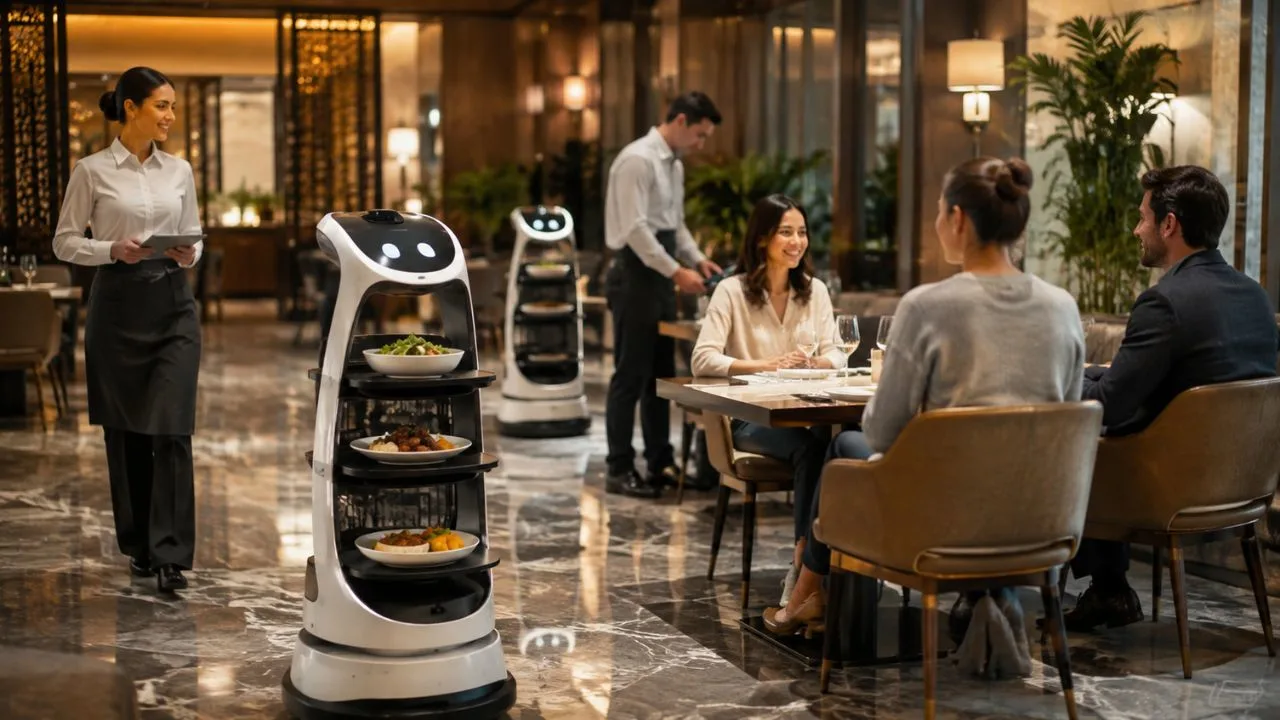
Bear Robotics is helping move service robots from technology demonstrations into everyday hospitality operations. Its autonomous mobile robots carry meals, return used dishes, move supplies and support cleaning tasks in restaurants, hotels, senior living communities and other service environments. The goal is to automate repetitive movement rather than the complete guest relationship.
Hospitality employees spend a significant part of each shift walking between kitchens, dining areas, service stations and guest rooms. These journeys may involve heavy trays, dirty dishes or routine supply deliveries. Bear Robotics develops machines that perform some of this physical transportation so employees can spend more time serving and communicating with guests.
The company is best known for its Servi range of food-running and bussing robots. Its current hospitality portfolio includes the original Servi, the higher-capacity Servi Plus and the narrower Servi Q. Bear has also expanded into autonomous commercial cleaning and fleet-management software that coordinates multiple robots across one property.
These machines can improve workflows, but successful adoption depends on more than purchasing a robot. Operators must select the right tasks, map safe routes, train employees and measure performance. This article explores how Bear Robotics works, where its robots add value and what hospitality businesses should consider before introducing automation.
What Is Bear Robotics?
Bear Robotics is an autonomous robotics company founded in May 2017. Its first prototype was called Penny, and the company later introduced Servi as its first mass-produced restaurant service robot. Its development has since expanded from restaurant assistance into hotels, healthcare, cleaning, warehouses and industrial material movement.
The company began with a simple operational problem: restaurant workers frequently carry heavy loads while repeatedly walking between the kitchen and dining room. Bear’s founders believed that robots could perform these physically demanding transportation tasks without removing the human attention that defines good hospitality service.
Bear Robotics describes its machines as assistants rather than replacements for servers. A robot can carry food or dishes, but it cannot fully understand a guest’s mood, solve every service problem or provide genuine human care. Its intended role is to reduce repetitive movement and give employees more time for higher-value interactions.
Bear’s systems are now used across restaurants, hotels, senior living communities, hospitals, entertainment venues, airport lounges and ghost kitchens. In June 2026, the company said it had shipped more than 16,000 robots into commercial service across North America, Europe and Asia. That deployment figure comes from Bear’s own announcement.
How Bear Service Robots Work
Bear’s hospitality robots are autonomous mobile robots, often called AMRs. Unlike a cart that an employee must push, an AMR can follow a mapped route by itself. Staff select a destination through a screen, tablet or connected control system, load the trays and send the machine toward a table or service point.
Servi uses LiDAR, cameras and mapping software to understand its surroundings. It detects people, furniture and other obstacles while moving through the property. When something blocks its planned route, the robot can slow down, stop or calculate a different path instead of continuing forward blindly.
The robot is not allowed to wander anywhere it chooses. During setup, technicians map the floor plan, identify safe pathways and create destinations such as tables, kitchens, bars and bussing stations. This controlled map helps the machine operate predictably inside a busy hospitality environment.
Internal weight sensors can identify when items have been removed from a tray. Servi can then continue to another programmed destination or return to its home position. This process turns a simple delivery cart into a repeatable transportation system that can support employees throughout an entire service period.
Servi for Everyday Restaurant Support
Servi is Bear Robotics’ compact food-running and table-bussing model. It can be configured with trays and a bus tub, allowing restaurants to move prepared meals toward guests and return used dishes to the kitchen without requiring an employee to carry every load manually.
The standard Servi has a total payload capacity of 66 pounds, with up to 22 pounds on each tray. Bear lists a battery life of approximately 10 to 12 hours and a four-hour charging time, although actual operation can depend on the route, load and working conditions.
Its relatively compact body is designed for dining rooms where staff, customers and furniture create changing obstacles. Stabilising trays help control movement during delivery, while LiDAR and cameras support navigation. Employees can also use accessories such as drink trays, bus tubs and call buttons for different workflows.
Servi is most valuable when it performs repeated journeys that do not require detailed guest interaction. A server can remain in the dining room checking orders and answering questions while the robot carries another set of meals from the kitchen. This division of work can reduce unnecessary back-and-forth walking.
Servi Plus for High-Capacity Service
Servi Plus is a larger model designed for restaurants, banquet spaces and other high-volume operations. Bear states that it can carry up to 16 entrées or 88 pounds, making it suitable for heavier food-running, clearing and supply-transport tasks during demanding service periods.
A higher-capacity robot may reduce the number of trips required between the kitchen and dining room. Instead of sending several smaller loads, employees can place multiple dishes on the robot and dispatch them together. This may be particularly useful for large tables, buffets, events and restaurant sections far from the kitchen.
The larger capacity does not mean that Servi Plus should operate without staff involvement. Employees still need to load items carefully, select destinations, monitor the workflow and serve guests appropriately. The robot handles transportation, while workers remain responsible for accuracy, presentation and customer care.
Businesses should also confirm that their aisles, doorways and turning areas are suitable for a larger machine. A robot that performs well in an open banquet hall may struggle in a compact dining room. Operators should base their decision on the property layout rather than selecting the model with the highest capacity.
Servi Q for Tight Spaces
Bear Robotics introduced Servi Q in May 2026 as a compact model for narrow hospitality layouts. The company says it can navigate passages as narrow as 18 inches, which may make it useful in bars, compact cafés, takeaway areas and restaurants with limited space between service stations.
Servi Q can move backwards when a corridor is too narrow for it to turn around. Backward bump detection helps the robot stop when it encounters an obstruction. This capability addresses a practical limitation of larger delivery robots that may need wide turning areas to leave confined spaces.
The model offers adjustable tray arrangements and a total stated capacity of about 66 pounds. It also includes an 18.5-inch display that can show promotions, daily specials, branding or wayfinding information while the robot moves through the venue.
A display may create an additional marketing opportunity, but operators should avoid overwhelming guests with constant advertising. The screen is most useful when its content supports the experience, such as identifying a delivery, promoting a relevant special or helping visitors find an area inside a large venue.
Changing Restaurant Workflows
The most immediate effect of Bear Robotics is the separation of transportation from hospitality. Traditionally, the same server may take an order, carry food, clear dishes and return supplies. A service robot allows part of that physical movement to be assigned to a machine while the employee remains available to guests.
Food running is one of the clearest applications. Kitchen employees can load completed dishes and send the robot toward the correct table or service station. A server then checks the order and presents the food, preserving human interaction while reducing the distance that staff must walk with heavy trays.
Bussing follows the same principle in reverse. Used dishes can be placed in a robot’s bus tub and returned to the dishwashing area. Faster clearing may help restaurants reset tables more efficiently, but staff must still remove waste, inspect surfaces and complete the cleaning required by food-safety procedures.
Robots can also move drinks, utensils, condiments and other supplies between stations. These small journeys can consume considerable time during a busy shift. Automating them may help employees remain in assigned sections, although the operator must design the workflow carefully to prevent the robot from creating congestion.
Supporting Hotel Operations
Bear Robotics also markets its service robots for hotel logistics. Potential applications include carrying food, bottled water, towels, toiletries and other items between service areas and guest locations. The company says its hotel delivery systems can be configured with enclosed compartments for multi-destination service.
In suitable properties, robots can integrate with elevators through connected systems and move between floors. This can support room-service and housekeeping deliveries without requiring an employee to complete every corridor journey. Elevator integration depends on the building’s technology and requires more planning than navigation on a single floor.
Robots may also help in hotel restaurants, lounges, event spaces and back-of-house areas. One property might use a robot to deliver dishes during breakfast and transport supplies during slower periods. Flexible use can improve the value of the machine when workflows are planned around actual operational demand.
Hotels should preserve a clear choice for guests who prefer human service. Some visitors may enjoy contactless delivery, while others expect direct assistance and conversation. Automation should expand the service options available rather than making every guest follow a robotic process they did not request.
Autonomous Cleaning in Hospitality
Bear’s hospitality strategy now extends beyond delivering food and supplies. In 2026, the company added Servi Clean and Servi Clean Max, which are autonomous floor-cleaning robots designed for commercial spaces. The systems can support tasks such as sweeping, vacuuming, dust mopping and scrubbing.
Servi Clean is designed for different flooring surfaces, including carpet, tile, hardwood, marble and polished concrete. Bear lists a four-hour vacuuming runtime, an eight-hour dust-mopping runtime and automatic docking when the battery becomes low. These figures are manufacturer specifications rather than independent performance tests.
Servi Clean Max is a larger hard-floor machine that can sweep, scrub and mop. Its dashboard allows managers to schedule tasks, change cleaning parameters and review work history. Automated cleaning may free staff to focus on detailed sanitation that requires judgement, inspection and manual attention.
Bear also presents an LG cleaning robot for hotel corridor use. The company describes a Marriott collaboration in which autonomous vacuuming was intended to let house attendants spend more time cleaning rooms and less time vacuuming hallways. The example demonstrates the wider strategy created through Bear’s relationship with LG.
Bear Universe Fleet Management
A single robot can be controlled as an individual tool, but large hospitality properties may need several machines. Bear Universe is the company’s cloud-based fleet platform for registering robots, editing maps, monitoring performance and managing automation from one dashboard.
Managers can use the platform to view robot locations, operating status and performance information. Remote troubleshooting may help identify issues before they significantly disrupt service. Data can also reveal whether a robot is completing meaningful work or spending too much time waiting at one station.
Multi-robot coordination becomes important when several machines use the same corridors and destinations. Bear’s systems are designed to organise movement so robots do not block one another or create repeated traffic conflicts. Servi Q can also operate alongside other Servi models within the same ecosystem.
Software does not remove the need for human supervision. Managers still need to review performance, update routes after floor-plan changes and create procedures for technical failures. Fleet data becomes valuable only when the business uses it to improve staffing, service timing and robot placement.
Reducing Physical Strain
One of the strongest arguments for hospitality robots is the reduction of repetitive physical work. Servers and support employees may carry heavy trays and walk long distances throughout a shift. Assigning some transport duties to robots can reduce the number of loads handled directly by workers.
University of Central Florida researchers interviewed 42 restaurant employees who had experience working with service robots. Participants commonly appreciated the machines’ ability to carry heavy trays and reduce physical exertion, although their overall reactions included both positive and negative experiences.
Reduced strain does not automatically guarantee a better job. Employees may receive additional duties, experience pressure to serve more tables or become responsible for correcting robot problems. Operators should examine the complete workload rather than assuming that automation always produces an immediate improvement.
A successful deployment should result in measurable changes, such as fewer heavy carrying tasks, more time with guests or smoother peak-period service. Staff feedback should be collected before and after installation so management can determine whether the robot is genuinely supporting workers.
Changing the Guest Experience
Service robots can attract attention because many customers have never interacted with one in a restaurant or hotel. UCF’s employee research found that some guests took photographs and children responded positively to the novelty. These reactions can make a robot part of the venue’s entertainment value.
Novelty, however, is temporary. A business cannot depend on customer curiosity after robots become more familiar. The long-term value must come from faster service, accurate delivery, cleaner spaces or more available employees rather than from the machine’s appearance alone.
Robots can also support consistency. They follow mapped routes and carry loads without becoming distracted by another table. Yet they cannot interpret every social situation. A machine may arrive efficiently while still needing a person to identify the correct guest, explain the dish or respond to a request.
The best experience combines predictable robotic support with attentive human service. Guests should notice that employees are easier to reach and that items arrive efficiently. When the technology becomes an obstacle that requires customers to solve problems themselves, it works against the purpose of hospitality.
Robots and Hospitality Jobs
Bear Robotics presents its products as tools that support employees rather than replace them. The company’s stated aim is to automate repetitive food-running and bussing tasks so staff can focus on guest interaction, service quality and other work requiring human judgement.
Employee concerns should still be taken seriously. In the UCF study, some workers viewed robots as helpful teammates, while others feared job displacement or experienced resentment. Reactions were influenced by the machine’s reliability, the quality of training and the way management introduced the technology.
Poor communication can turn a useful tool into a symbol of job insecurity. Managers should explain which tasks the robot will perform, how employee roles will change and whether staffing decisions are connected to the deployment. Workers should have an opportunity to ask questions and help design the workflow.
Hospitality robots are most effective when they expand employee capacity instead of removing the service relationship. The machine can carry plates, but humans still manage complaints, understand emotional cues, recommend products, handle exceptions and create the personal connection that guests remember.
Operational Benefits
A robot can complete routine transportation consistently throughout its available battery period. It does not become physically tired from walking, which may help a restaurant maintain food-running and bussing support during long or demanding service periods. The practical benefit depends on utilisation, reliability and route design.
Automation may increase service capacity by keeping employees closer to customers. A server who spends less time travelling to and from the kitchen may be able to check tables more often, respond more quickly and identify additional orders. Bear promotes this as a way to combine efficient logistics with stronger guest service.
Robots can also make workflows easier to measure. Managers may track deliveries, routes and operating time through connected software. These records can reveal bottlenecks, underused machines or service stations that should be repositioned. Operational data can support more informed decisions than observation alone.
The financial value is not guaranteed. Operators must consider rental or purchase costs, service agreements, training, charging space, software and downtime. A robot creates a return only when it performs enough useful journeys or allows staff to complete higher-value work that improves revenue or service quality.
Limits and Challenges
Technical problems remain an important risk. UCF’s research found that employees became frustrated by slow movement, glitches and limited functionality, especially during busy periods. A machine that blocks an aisle or repeatedly needs assistance may add work rather than reduce it.
The physical environment can also limit performance. Steps, narrow pathways, crowded waiting areas, unsecured doors and constantly changing furniture may make navigation difficult. A site assessment should test real conditions during peak service rather than evaluating the robot only in an empty dining room.
Robots also require cleaning and maintenance. Trays, screens, wheels and sensors must remain suitable for food-service environments. Employees need clear responsibility for charging, inspection and reporting faults. Without a daily care routine, small issues can become service disruptions.
Guest acceptance varies as well. Some customers enjoy robotic service, while others may worry about privacy, safety or the loss of human contact. Hospitality businesses should provide clear assistance, limit unnecessary data collection and ensure that guests can reach a person whenever the robot cannot meet their needs.
How to Introduce Service Robots
Begin with a specific operational problem instead of purchasing a robot simply to appear innovative. Measure how much staff time is spent running food, clearing dishes, transporting supplies or vacuuming corridors. A clear baseline makes it easier to determine whether automation produces an improvement.
Choose one workflow for the initial pilot. A restaurant might begin with kitchen-to-service-station delivery, while a hotel might test corridor cleaning or amenity transport. Limiting the first deployment gives employees time to learn and allows managers to identify problems without disrupting the entire operation.
Training should include loading, dispatching, cleaning, charging and handling unexpected stops. Bear says its deployment process includes floor mapping, customised workflows and employee integration sessions. Staff participation is essential because employees understand the practical obstacles that may not appear on a digital map.
Review results using operational and human measures. Track delivery time, staff walking, robot utilisation, guest complaints, employee feedback and technical interruptions. Continue, expand or redesign the deployment according to these results rather than assuming that every available robot should be added.
LG and Bear Robotics
LG Electronics invested $60 million in Bear Robotics in March 2024 and initially acquired a 21 percent stake. In January 2025, LG exercised an option to acquire an additional 30 percent, giving it a controlling 51 percent stake and making Bear Robotics a subsidiary.
The relationship combines Bear’s autonomous navigation and robotics software with LG’s manufacturing, commercial technology and international reach. Bear’s company history describes the partnership as supporting expansion into restaurants, retail, factories, warehouses and other environments.
For hospitality businesses, the partnership is visible in Bear’s broader product range. The company now markets food-running robots alongside LG-supported cleaning solutions and industrial systems. This suggests that future customers may purchase several automation functions through a connected robotics ecosystem.
LG’s ownership does not remove the need to evaluate each product independently. Businesses should still examine local support, system reliability, integration and total cost. A large corporate parent may improve resources and distribution, but operational performance must be proven at the individual property.
The Future of Bear Robotics
Bear Robotics is moving from a specialised restaurant-robot company toward what it calls a Physical AI platform. Its current portfolio includes service delivery, autonomous cleaning, industrial material movement and fleet software. This broader approach aims to automate more physical tasks through connected machines.
In June 2026, Bear announced a definitive agreement to acquire Kinisi Robotics, a UK-based company developing a wheeled humanoid called KR1. The transaction was described as subject to closing conditions, so it should be treated as an announced acquisition rather than assumed to have closed without further confirmation.
Kinisi’s technology is intended to add manipulation, including picking, placing, sorting and moving objects. That capability could eventually extend Bear’s hospitality robots beyond transportation. Future machines might handle a wider range of back-of-house or facility tasks, although such uses will require testing, safety controls and dependable performance.
The likely future of hospitality is not a fully robotic property with no employees. A more realistic direction is mixed teams in which specialised machines handle transportation and cleaning while people manage care, judgement and relationships. Bear Robotics is helping test how that division of work may operate at scale.
Frequently Asked Questions
What does Bear Robotics do?
Bear Robotics develops autonomous mobile robots for hospitality, cleaning and industrial work. Its Servi robots primarily help employees run food, clear dishes and move supplies through mapped indoor environments.
Does Bear Robotics replace restaurant servers?
The robots are designed to assist rather than completely replace servers. They handle repetitive transportation while employees remain responsible for guest communication, order accuracy, problem-solving and personalised service.
How much can a Servi robot carry?
The standard Servi has a stated total capacity of 66 pounds. Servi Plus can carry up to 88 pounds or approximately 16 entrées, according to Bear Robotics’ product information.
Can Bear robots work in hotels?
Yes. Bear markets robots for room-service support, housekeeping supplies, hotel dining and multi-floor delivery. Elevator operation requires compatible building integration and careful mapping.
Who owns Bear Robotics?
LG Electronics holds a controlling 51 percent stake in Bear Robotics after increasing its ownership in 2025. Bear therefore operates as an LG subsidiary while continuing to develop and market its own robotics platform.
Conclusion: How Bear Robotics Is Changing Hospitality
Bear Robotics is changing hospitality by automating the physical movement behind service. Servi robots can carry food, return dishes and transport supplies, while newer models address higher-capacity work and narrow restaurant layouts. Cleaning robots extend the same idea into hotel corridors and commercial floors.
The main advantage is not the removal of employees. It is the opportunity to reduce heavy, repetitive journeys so hospitality workers can remain closer to guests. Research shows that employees may value this physical relief, but technical problems, weak training and job insecurity can reduce acceptance.
Operators should approach service robots as workflow tools rather than attractions. A successful implementation begins with a measurable problem, includes employees in planning and tests the technology under real service conditions. Performance should be judged through efficiency, worker experience and guest satisfaction.
With LG’s majority ownership, new hospitality products and the planned addition of manipulation technology, Bear is building a wider automation ecosystem. Its long-term impact will depend on whether these systems consistently make service faster, work safer and hospitality more human rather than simply adding more machines.