
Elon Musk Tesla FSD Update: What’s New and What’s Next
Tesla’s Full Self-Driving technology remains central to Elon Musk’s plan to transform the company from an electric car manufacturer into a physical artificial intelligence business. Recent developments include new software for older vehicles, expanded customisation features, additional international approvals and a growing commercial robotaxi network.
The latest Tesla FSD update is built around version 14, which improves how the vehicle selects speeds, completes trips and responds to complicated driving situations. Tesla has also introduced FSD v14 Lite for vehicles with older AI3 hardware, helping more existing owners access behaviours developed for newer AI4 vehicles.
However, the name Full Self-Driving can create unrealistic expectations. Tesla continues to call the customer product FSD (Supervised) because an attentive driver must monitor the road and remain ready to take control. Tesla and the National Highway Traffic Safety Administration both classify the current consumer system as driver assistance rather than autonomous driving.
As of August 5, 2026, Tesla is pursuing two related but different goals. The company is improving supervised FSD for customer-owned vehicles while expanding unsupervised robotaxi operations within selected service areas. Understanding that distinction is essential when evaluating what has changed and what may realistically come next.
What Tesla FSD Means Today
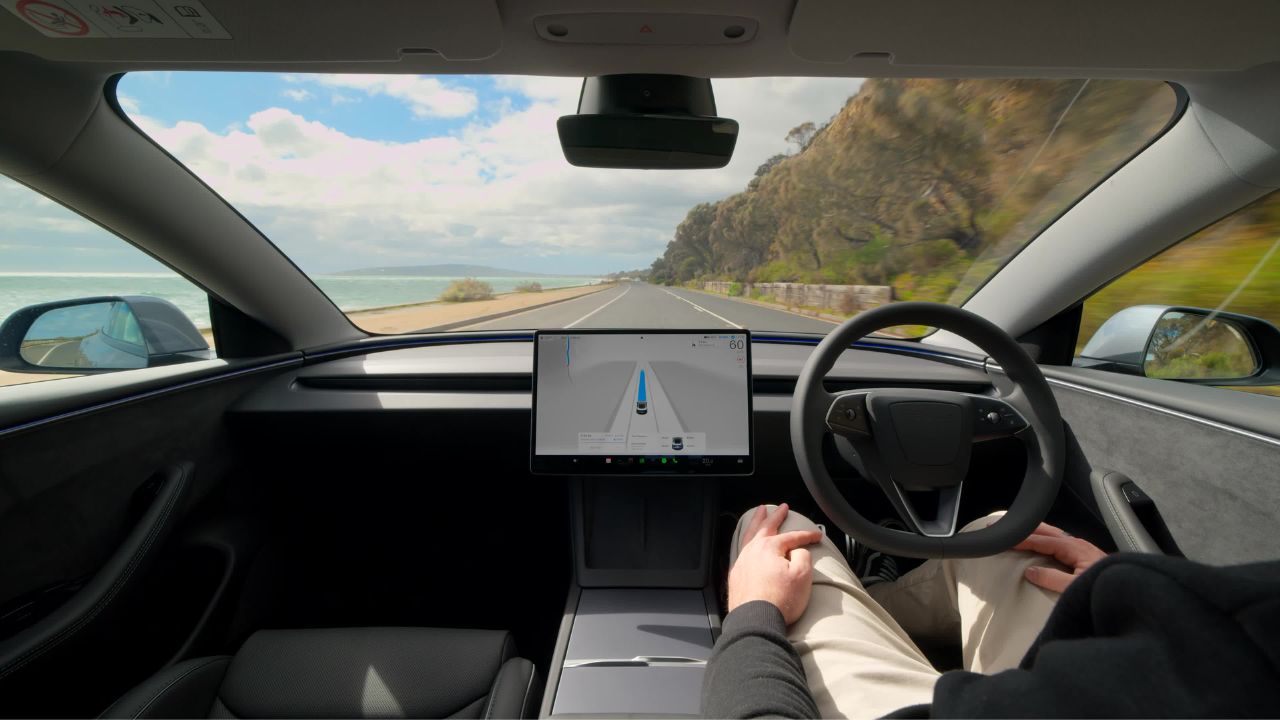
FSD (Supervised) is a collection of advanced driver-assistance features that can control steering, acceleration and braking during a journey. It can follow a navigation route, change lanes, negotiate intersections, enter and exit highways, drive around roundabouts and park the vehicle under the driver’s active supervision.
The system can operate on city streets, residential roads and highways rather than being limited to divided motorways. Drivers activate it through the touchscreen and can disengage it by steering, braking or using the vehicle’s relevant steering-wheel or gear-stalk control. Available functions can differ by model, hardware, software and region.
Despite its broad range of capabilities, the system does not make a customer’s Tesla autonomous. The driver remains legally and practically responsible for monitoring the road, identifying unsafe behaviour and intervening immediately. Tesla warns users not to become complacent while FSD is engaged.
NHTSA describes systems that continuously assist with steering and speed while requiring constant human attention as Level 2 advanced driver assistance. The agency states that no vehicle currently offered for consumer sale in the United States can perform all driving tasks without an attentive driver.
Why FSD Matters to Elon Musk
Elon Musk’s wider strategy depends on converting Tesla’s large vehicle fleet into a source of real-world driving information. Tesla uses anonymised driving data to identify challenging situations, improve its neural networks and distribute updated behaviour to eligible vehicles through over-the-air software releases.
This approach allows Tesla to develop one software foundation for several uses. Improvements created for supervised customer vehicles can contribute to robotaxi development, while experiences gathered from robotaxi operations can help train future FSD versions. Tesla describes both businesses as connected parts of its real-world AI strategy.
FSD also creates recurring revenue without requiring Tesla to manufacture an additional physical product. Customers can subscribe monthly, while the underlying software may improve over time. Higher adoption could therefore increase revenue from vehicles that Tesla has already delivered to their owners.
The longer-term opportunity is larger than a driver-assistance subscription. Musk’s strategy involves using autonomous software to operate paid transportation services and eventually support customer-owned vehicles that can travel without supervision. That future remains dependent on performance, validation, regulations and public confidence.
The Biggest Change: FSD v14 Lite
Tesla began delivering FSD v14 Lite to eligible AI3 vehicles in the United States and South Korea in July 2026. The release brings newer FSD behaviours to cars using the previous-generation camera and computing platform rather than limiting all meaningful improvements to AI4-equipped vehicles.
According to Tesla, v14 Lite distils driving behaviour from the AI4 version 14 series into the camera and processing configuration available on AI3. Distillation allows a smaller or more constrained system to learn useful behaviour from a more capable model without running the complete larger model directly.
The release is significant because many existing Tesla vehicles use AI3 hardware. Owners had questioned how far Tesla could continue improving those cars as its newer neural networks became larger and more computationally demanding. V14 Lite represents an attempt to extend useful software progress without immediately requiring a hardware replacement.
The word “Lite” also signals that the AI3 version may not reproduce every capability or performance improvement available on AI4. Tesla says features can vary according to hardware and vehicle configuration, so owners should check the software information inside their own vehicle rather than assuming identical performance across the fleet.
New Speed Profiles
FSD v14 gives drivers greater influence over how assertively the vehicle moves through traffic. Tesla now offers several Speed Profiles that affect driving speed, lane selection and lane-change frequency instead of relying on one general behaviour for every driver and journey.
The available profiles include Sloth, Chill, Standard, Hurry and Mad Max. Sloth drives more slowly and changes lanes less frequently than Chill. Standard aims to match the normal flow of traffic, while Hurry and Mad Max use progressively faster and more active behaviour.
These profiles can make FSD feel more predictable to people with different comfort levels. A cautious driver may prefer fewer lane changes, while someone travelling on a busy motorway may want the vehicle to respond more actively when slower traffic blocks the route.
A selected profile does not transfer responsibility from the driver to the software. Tesla states that drivers remain responsible for the vehicle’s speed and control at all times. Local limits, road conditions and surrounding traffic should take priority over the behaviour associated with a profile.
Better Arrival Options
Another important Tesla FSD update is the introduction of more detailed arrival choices. Instead of navigating only to a general map location, the system can consider whether the driver wants to finish the trip in a parking lot, on the street, in a driveway or at the curb.
The final part of a journey can be more difficult than following the main route. A vehicle must understand entrances, parking layouts, safe stopping positions and the difference between passing a destination and reaching a practical drop-off point.
Arrival Options are designed to make that final stage feel more intentional. They can reduce situations in which the car stops too early, passes the correct entrance or chooses a location that is technically close to the destination but inconvenient for the occupants.
The quality of the result can still depend on map information, visible road markings, access restrictions and the physical layout of the location. Drivers should remain prepared to guide the car manually when an entrance is blocked, privately controlled or difficult for the cameras to interpret.
Difficult Roads and Intersections
Tesla says v14 Lite addresses challenging situations involving route navigation, merges, forks, pedestrians, traffic lights and vehicles cutting into the Tesla’s path. These situations are important because they require the system to predict movement rather than simply remain centred in a clearly marked lane.
Merges and forks require early positioning and an understanding of which lane continues along the planned route. A late decision may result in sudden braking or an unnecessarily aggressive lane change. Improved planning can make the vehicle’s movement smoother and easier for surrounding drivers to understand.
Pedestrian interactions require additional caution because people can change direction quickly or appear from behind parked vehicles. Better responsiveness can help, but the supervising driver must still watch crossings, pavements and obstructed areas instead of assuming the cameras have detected every person.
Traffic lights and lane markings remain areas of regulatory attention. Although Tesla continues updating the system, NHTSA is investigating allegations involving red lights, wrong-way movements and improper lane use. A software update should therefore be viewed as progress rather than proof that every difficult situation has been solved.
Self-Driving Stats Arrive
Tesla’s Summer Release added Self-Driving Stats, allowing customers to view and share information about their FSD use. The displayed information can include the percentage of driving completed with FSD, total self-driving distance, hands-free distance and consecutive-day usage.
The feature turns FSD usage into something owners can measure over time. A driver can see whether the system is being used mainly on long journeys, daily commutes or only occasional trips. This may also help users evaluate whether the monthly subscription provides enough practical value.
Tesla describes the feature as making FSD more social and interactive. Shareable statistics can encourage owners to discuss long drives or high usage rates, potentially increasing awareness of the product among people who have not tried it.
Usage statistics should not be treated as a direct safety score. Completing many miles without taking control does not prove that the system will perform correctly on the next trip. Drivers should base intervention decisions on the immediate road situation rather than maintaining an uninterrupted FSD streak.
International FSD Expansion
Tesla has continued expanding FSD (Supervised) beyond North America. Its public availability information lists the United States, Canada, Mexico, China, Australia, New Zealand, South Korea and several European markets, along with Puerto Rico. Feature availability still depends on local approval and vehicle eligibility.
During the second quarter of 2026, Tesla received additional approval to deploy FSD in Lithuania, Estonia, Denmark and Belgium after an earlier approval in the Netherlands. Tesla said customers in those five European markets had driven more than 50 million kilometres using FSD by July.
International expansion matters because road rules, signs, driving habits and infrastructure vary significantly. A system that performs well in one country must adapt to different lane markings, roundabouts, speed rules and interactions with other road users.
Tesla cannot activate FSD everywhere through a software decision alone. Government approval may be required before drivers receive the feature, and Tesla states that it cannot provide exact launch dates for individual countries. Eligible vehicles can receive access through an update after approval is secured.
FSD Becomes Subscription-Only
Tesla currently offers FSD (Supervised) in the United States for $99 per month. The company’s support information states that it is no longer available as a new outright purchase and is offered through a monthly subscription for eligible customers.
A subscription lowers the immediate cost of trying the software. Customers can activate it for a road trip or evaluate it over several months without adding thousands of dollars to the original vehicle purchase price.
The model also reduces long-term ownership certainty. A subscriber must continue paying to retain access, and Tesla can change pricing or feature availability. Subscriptions are not refundable, although customers can cancel and continue using the system until the end of the paid billing period.
New eligible owners may receive a trial after taking delivery directly from Tesla. The wider complimentary v14 trial for existing and new owners has ended, but qualifying newly delivered vehicles can still receive a limited introductory trial based on the model and offer available at purchase.
Tesla Robotaxi Expansion
Tesla’s robotaxi service represents a different level of automation from consumer FSD. Its commercial vehicles operate without an in-car supervising driver only inside designated locations where Tesla has defined the service area, operating conditions and fleet procedures.
By the end of the second quarter of 2026, Tesla reported unsupervised robotaxi operations ramping in Austin, Dallas and Houston. It also launched unsupervised rides in Miami, Orlando and Tampa during July, while San Francisco Bay Area vehicles continued operating with a safety driver.
Tesla reported approximately 2.4 million cumulative paid robotaxi miles by the end of June 2026. The company was also preparing for possible expansion in Phoenix and Las Vegas through activities such as testing, permitting and first-responder training.
These deployments do not mean that consumer FSD has become unsupervised nationwide. Robotaxi operations are geographically controlled commercial services. Customer-owned vehicles continue to require active supervision regardless of whether Tesla operates driverless fleet vehicles in selected cities.
Cybercab Enters Production
Tesla began production of Cybercab at Gigafactory Texas during the second quarter of 2026. Cybercab is the company’s purpose-built autonomous electric vehicle and is intended to become a major part of the robotaxi fleet rather than serving as a conventional customer car with ordinary manual controls.
Tesla also began engineering test drives of production Cybercabs on public roads and offered employee rides at its Texas factory campus. The company stated that it expected production vehicles to begin entering robotaxi fleets in July.
The vehicle could improve the economics of Tesla’s transportation service because it is designed specifically for autonomous operation. Removing unnecessary driver-focused equipment and optimising the interior for passengers may reduce production, maintenance and operating costs.
Cybercab still faces a demanding scale-up process. Production quality, fleet maintenance, charging, cleaning, remote support, regulations and real-world safety must all work together. Building the vehicle is an important milestone, but successfully operating thousands of them is a separate challenge.
Tesla’s FSD Safety Claims
Tesla states that vehicles using FSD (Supervised) experience fewer collisions than vehicles driven without it. Its support materials claim seven times fewer major and minor collisions and five times fewer off-highway collisions under the comparisons used in Tesla’s Vehicle Safety Report.
Tesla’s wider FSD page also displays more than 11.5 billion supervised miles and describes FSD as seven times safer than an estimated average human driver. The mileage counter is company-operated and increases according to Tesla’s estimated fleet driving rate.
The Vehicle Safety Report explains that Tesla counts a collision as involving FSD when the system was active at any point during the five seconds before the event. Tesla includes collisions regardless of fault and uses vehicle telemetry to identify qualifying events.
The comparisons still require context. FSD usage, vehicle age, road type, driver population and data-collection methods can differ from the general US fleet. Tesla acknowledges that estimating a national comparison involves assumptions and limitations, even though the company says its internal fleet comparison demonstrates a significant safety benefit.
What Regulators Are Examining
NHTSA has an open investigation into allegations that Tesla vehicles using FSD performed manoeuvres that could violate traffic laws. The review covers responses to traffic lights, signs, lane markings and the system’s ability to provide drivers with clear and timely warnings.
The investigation was opened after NHTSA identified 62 consumer complaints, four media reports and 14 crash reports submitted under its Standing General Order that might relate to the alleged problem. Reported behaviours included proceeding against red lights, entering opposing lanes and using marked lanes incorrectly.
A separate investigation is examining FSD performance during reduced visibility caused by conditions such as glare, fog and airborne dust. NHTSA is assessing whether the system identifies degraded camera performance and gives the driver enough time to recognise the limitation and respond.
Regulatory investigation does not automatically establish that a defect exists. It means the agency is collecting information and evaluating potential risks. Drivers should nevertheless take the concerns seriously because Tesla’s camera-based system can be affected when environmental conditions reduce what the cameras can clearly observe.
AI3 and AI4 Hardware
AI4 vehicles have newer cameras and more processing capacity than cars equipped with AI3. Tesla has therefore developed its most advanced v14 behaviour around AI4 before adapting selected capabilities to older hardware through FSD v14 Lite.
Software optimisation can extend the usefulness of older equipment, but it cannot create unlimited processing capacity. A model designed for newer hardware may need to be compressed, simplified or trained through distillation before it can run reliably on the previous computer.
Owners should avoid assuming that every Tesla marketed with FSD capability will always receive identical software. Tesla’s current support information explicitly states that available functions can vary by hardware, configuration, software version, region, trim and model year.
V14 Lite is encouraging for AI3 owners because it shows Tesla is continuing to support the platform. However, future neural networks may widen the performance difference. Clear communication about feature parity and hardware limits will become increasingly important as Tesla develops larger driving models.
What Comes Next for FSD?
The next stage will likely involve continued refinement of v14 behaviour across AI3 and AI4 vehicles. Tesla can use fleet feedback to improve speed selection, arrival positioning, merges, pedestrian responses and other situations in which drivers frequently intervene. This is an inference based on Tesla’s current release priorities.
International availability is also likely to expand as Tesla secures additional approvals. The company’s recent progress in Europe demonstrates that one regulatory decision can open several connected markets, but Tesla has not provided dependable launch dates for every remaining region.
Tesla is increasing the infrastructure supporting future AI development. It reported that onsite AI-computing capacity in Texas more than doubled during the first half of 2026, while construction and equipment work continued for an Austin semiconductor facility intended to support future logic and memory-chip supply.
The largest unanswered question is when ordinary owners will be allowed to use FSD without supervising it. Tesla describes unsupervised driving as a future capability, but no nationwide consumer release date has been confirmed. Technical reliability and regulatory acceptance must advance before that transition can occur.
What Owners Should Do Now
Tesla owners should install current software updates before using FSD because the newest available build may include behaviour improvements and safety fixes. The vehicle must complete the relevant over-the-air update before an eligible subscription or trial can provide FSD features.
Before starting a journey, clean the exterior cameras and consider visibility conditions. Heavy rain, glare, fog, snow, dust or a blocked camera can reduce the system’s ability to understand the road. Manual driving may be the safer choice when visibility is poor.
Drivers should experiment cautiously with Speed Profiles rather than immediately selecting the most assertive setting. A profile that feels comfortable on an open highway may produce unnecessary lane changes in busy urban traffic, so the appropriate choice can vary by route.
Most importantly, owners must continue watching the road and surrounding traffic. FSD should reduce workload without replacing judgement. The driver should take control whenever the vehicle hesitates, selects an unsafe path, approaches an unclear intersection or behaves in a way other road users may not expect.
Conclusion: Elon Musk Tesla FSD Update
The latest Tesla FSD update brings meaningful improvements rather than full consumer autonomy. FSD v14 introduces more detailed Speed Profiles and Arrival Options, while v14 Lite extends newer driving behaviour to eligible vehicles using the older AI3 platform.
Tesla is also showing measurable progress outside customer vehicles. Its robotaxi network has expanded to several US cities, cumulative paid mileage has grown and production of the purpose-built Cybercab has begun at Gigafactory Texas.
At the same time, safety limitations and regulatory questions remain. Current customer FSD is supervised Level 2 driver assistance, and NHTSA continues examining its behaviour around traffic controls and reduced visibility. Drivers must remain attentive regardless of how capable the software appears.
What comes next will depend on Tesla’s ability to improve reliability across hardware generations, earn approval in more countries and scale robotaxis safely. Musk’s autonomous-driving vision is moving from demonstrations towards commercial operation, but nationwide unsupervised FSD for private owners has not yet arrived.
Frequently Asked Questions
What is the latest Tesla FSD version?
FSD version 14 is Tesla’s current major generation. Tesla began delivering a Lite version to eligible AI3 vehicles in the United States and South Korea in July 2026.
Is Tesla FSD fully autonomous now?
No. Customer FSD remains a supervised driver-assistance system. The driver must stay attentive, monitor the road and be prepared to take control immediately.
How much does Tesla FSD cost?
Tesla currently advertises FSD (Supervised) in the United States for $99 per month. New subscriptions are not available as an outright one-time purchase.
What is FSD v14 Lite?
FSD v14 Lite adapts driving behaviour developed for AI4’s v14 series to vehicles with AI3 cameras and computing hardware. It includes Speed Profiles, Arrival Options and improvements for difficult driving scenarios.
When will unsupervised FSD be available to Tesla owners?
Tesla has not confirmed a dependable nationwide release date for unsupervised consumer FSD. Availability will depend on technical development, safety validation and approval from relevant regulators.