


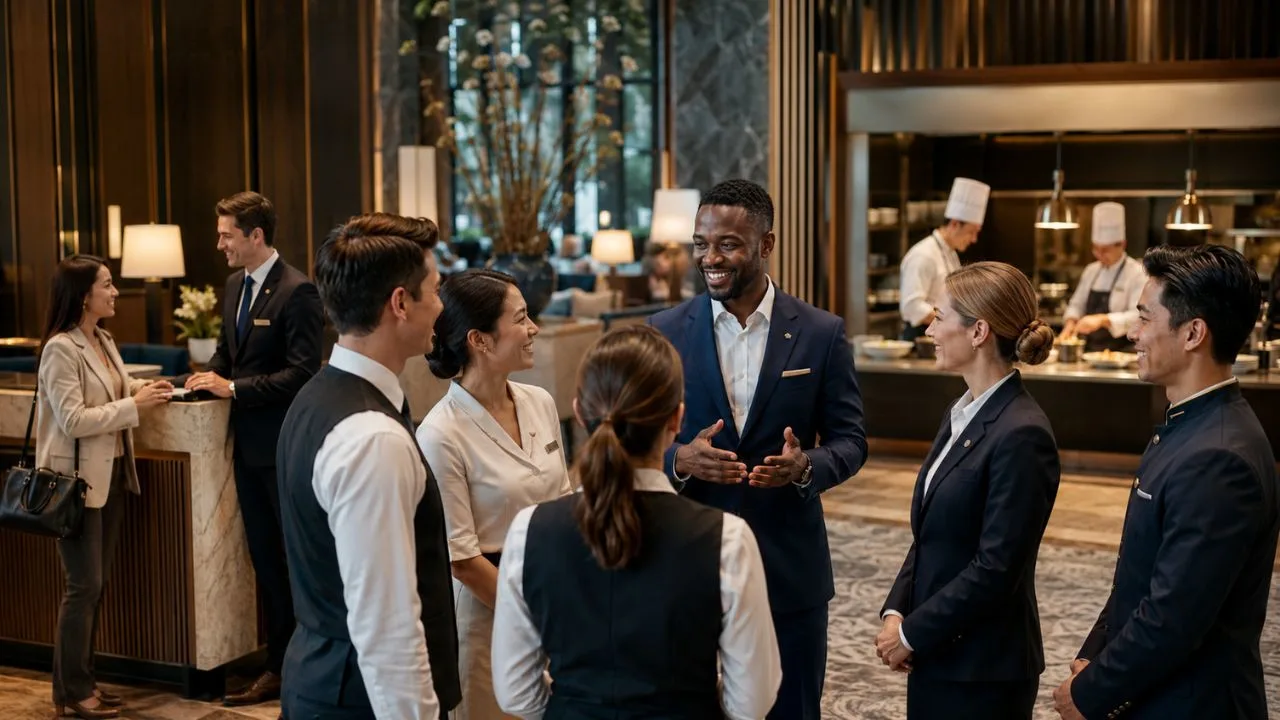
Building a strong team culture in hospitality means creating a workplace where employees feel respected, supported, prepared, and connected to a shared purpose. It is reflected in how managers communicate during a difficult shift, how departments help one another, and how employees are treated when mistakes happen. Culture is not a slogan displayed in a staff room; it is the experience people have while doing their work.
This matters because hospitality businesses depend heavily on human interaction. Guests may remember the room, food, décor, or location, but their overall impression is often shaped by how employees make them feel. Front desk agents, servers, housekeepers, chefs, supervisors, maintenance teams, and managers must work together consistently to deliver a smooth and welcoming guest experience.
Creating that consistency is challenging when teams work long or irregular hours, handle emotional situations, and serve people with different expectations. Hospitality employers also continue to face recruitment and retention pressure. In a 2025 AHLA survey, 65% of participating hotels reported staffing shortages, while 71% had vacancies they were unable to fill despite actively recruiting.
A positive hospitality workplace culture cannot remove every operational difficulty, but it can change how people respond to pressure. Employees are more likely to communicate, solve problems, and support guests when they trust their colleagues and leaders. The goal is not to create a workplace where every shift feels easy, but one where people know they will not face difficult moments alone.
What Does Team Culture Mean in Hospitality?
Hospitality team culture is the collection of values, behaviours, expectations, and working relationships that shape everyday employee experiences. It influences how people speak to colleagues, respond to guests, share information, manage conflict, and take responsibility. Even when leaders have not intentionally defined a culture, employees will create one through repeated habits and informal workplace norms.
A healthy service culture encourages professionalism without expecting employees to suppress every concern or emotion. Team members understand that guest satisfaction is important, but they also know that respectful treatment applies internally. Leaders do not demand warmth toward customers while tolerating dismissive, aggressive, or unfair behaviour behind the scenes.
Culture is also visible in the way departments interact. In a hotel, the guest experience may depend on communication between reservations, reception, housekeeping, food and beverage, maintenance, security, and finance. In a restaurant, servers, hosts, chefs, stewards, runners, and managers must coordinate closely. Departmental blame quickly becomes a customer-facing service failure.
The strongest hospitality cultures connect employee experience with guest experience. Research involving hospitality employees has found that organisational culture can influence job satisfaction, service-recovery performance, helpful workplace behaviour, and employees’ intention to leave. This suggests that culture affects not only morale but also the quality and reliability of customer service.
Define the Culture You Want to Create
Leaders should begin by defining what good culture looks like in observable terms. Values such as respect, excellence, teamwork, or integrity can sound impressive, but employees need to know how those words apply during a shift. “Respect,” for example, may mean listening without interruption, sharing accurate handover notes, and never humiliating someone for asking a question.
The desired culture should also reflect the business’s identity and guest promise. A luxury hotel may emphasise anticipation, discretion, and personalised service, while a casual restaurant may prioritise energy, speed, and friendly communication. Employees can deliver the brand more naturally when cultural expectations connect clearly with the experience the organisation wants guests to receive.
Involve employees when defining these expectations. Frontline team members understand operational pressures that senior leaders may not regularly see. Ask what currently helps them perform well, what damages cooperation, and what behaviours should become standard. Participation creates practical cultural principles and gives employees a stronger sense of ownership over the final commitments.
Once expectations are agreed, turn them into simple behavioural standards. A team might commit to raising concerns early, acknowledging handovers, offering help before assigning blame, and speaking respectfully during busy periods. These standards are easier to coach and measure than abstract values because managers can recognise them when they occur and address them when they do not.
Make Hospitality Leaders Responsible for Culture
Managers shape workplace culture through their everyday actions more than through formal announcements. Employees notice whether supervisors remain calm during pressure, apply rules consistently, communicate changes honestly, and take responsibility for their own mistakes. When leaders behave differently from the standards they promote, team members quickly learn that the stated values are optional.
The influence of managers is particularly important during a period of weakening workplace engagement. Gallup’s 2026 global workplace report found that worldwide employee engagement declined to 20% in 2025, while manager engagement fell to 22%. Gallup identifies falling manager engagement as a major factor behind the wider decline in employee engagement.
Hospitality businesses should therefore train managers to lead people, not only operations. A strong restaurant manager may understand stock, labour costs, reservations, and service timing, but still require coaching in feedback, conflict resolution, emotional intelligence, and performance conversations. Technical promotion without leadership development can leave both the new manager and the team struggling.
Leaders also need sufficient support from senior management. A supervisor cannot build trust while being given impossible staffing targets, conflicting instructions, or no authority to resolve employee concerns. Culture improves when managers receive realistic resources, clear priorities, leadership coaching, and permission to make sensible decisions for their teams and guests.
Build Psychological Safety Without Lowering Standards
Psychological safety means that employees can speak up, ask questions, report mistakes, and offer ideas without fearing humiliation or retaliation. It does not mean avoiding accountability or accepting poor performance. It creates an environment where problems can be identified early, before they develop into safety incidents, guest complaints, financial losses, or serious team conflict.
This is especially important in hospitality because staff regularly make fast decisions under pressure. A new server should feel able to confirm an allergy requirement, while a housekeeper should be comfortable reporting a maintenance or security concern. Employees who fear appearing inexperienced may remain silent even when clarification could protect a guest or colleague.
Leaders build safety by responding constructively when someone raises an issue. Thank the employee, understand what happened, address the immediate risk, and then examine the process. When every mistake produces public criticism, employees learn to hide errors. When mistakes are ignored entirely, standards fall. A fair response combines learning, accountability, and appropriate consequences.
Trust is strengthened through consistent commitments, clear responsibilities, and honest communication. SHRM’s 2025 guidance on workplace trust highlights psychological safety, follow-through, clarity, and recognition as important leadership behaviours. Employees are more willing to contribute when expectations are understandable and leaders reliably do what they say they will do.
Communicate Clearly Across Every Shift
Hospitality operations rarely pause, which means information must move effectively between people who may not work at the same time. Weak handovers can result in missed guest requests, unavailable rooms, repeated work, incomplete preparations, and avoidable complaints. Strong hospitality team communication should therefore be treated as an operational system rather than an informal courtesy.
Create a consistent structure for pre-shift briefings and end-of-shift handovers. Discuss expected occupancy or covers, special events, VIP guests, accessibility requirements, allergies, unavailable products, maintenance issues, and staffing changes. Keep the briefing focused enough to be useful while giving team members an opportunity to ask questions or identify concerns.
Choose communication channels carefully. Urgent operational updates may require a shift briefing or approved messaging platform, while policy changes need written documentation that employees can revisit. Avoid scattering important information across private messages, noticeboards, emails, and verbal conversations because employees may receive different versions of the same instruction.
Leaders should also communicate the reasons behind decisions whenever possible. Employees are more likely to support a new procedure when they understand the guest, safety, financial, or operational problem it addresses. Even when a decision cannot be changed, an honest explanation shows greater respect than expecting staff to follow unexplained instructions.
Create an Onboarding Experience That Builds Belonging
The first days of employment strongly influence how a new team member understands the workplace. If onboarding consists only of paperwork and rushed instructions, employees may conclude that they are expected to learn through mistakes. A structured hospitality onboarding programme should introduce both technical responsibilities and the way the team works together.
Begin with a warm welcome, a realistic explanation of the role, and a clear schedule for initial training. Introduce the employee to people across relevant departments, not only their direct supervisor. Explain who can help with guest questions, scheduling, equipment, payroll, safety, and personal concerns so the new starter does not need to discover everything during a crisis.
Assigning a trained buddy or mentor can make the transition easier. The buddy should model good habits, answer practical questions, and explain unwritten details without encouraging shortcuts that conflict with company standards. Managers should still remain involved because onboarding responsibility should not be transferred entirely to another frontline employee.
Check progress after the first shift, first week, and first month. Ask what feels clear, where the employee needs more practice, and whether the role matches what was described during recruitment. Early conversations can identify training gaps, team problems, or unrealistic expectations before uncertainty becomes disengagement or resignation.
Invest in Continuous Hospitality Training
Training should continue after onboarding because hospitality work changes with guest expectations, technology, regulations, menus, systems, and service standards. Employees need opportunities to practise both technical and interpersonal skills. Useful topics may include service recovery, accessibility, cultural awareness, conflict management, food safety, upselling, digital systems, and emergency procedures.
Practical training is generally more effective when it reflects real situations. Role-play a difficult guest conversation, simulate a rushed check-in, or walk through the response to an allergy concern. Employees build greater confidence when they can practise decisions in a supportive environment rather than encountering a complex scenario for the first time with a customer present.
Coaching should take place during everyday work as well. Managers can observe an interaction, ask the employee what went well, and suggest one specific improvement. Research on hospitality staff retention has found that training is associated with employee retention and that coaching and mentoring are particularly valued development approaches.
Training also communicates that hospitality roles can lead somewhere. An employee who sees investment in their skills may be more likely to imagine a future with the organisation. Development should be available fairly across departments and shifts, including to housekeepers, stewards, night staff, casual employees, and others whose contributions may be less visible.
Provide Clear Career Paths and Internal Opportunities
Many employees leave hospitality because they cannot see how an entry-level position can become a sustainable career. Leaders can challenge this perception by showing the range of pathways available in operations, culinary work, sales, revenue management, events, finance, human resources, technology, and senior leadership.
Create simple career maps explaining the skills and experience required for different roles. Employees should understand what progression involves and how they can prepare for it. Promotion decisions should be based on transparent criteria rather than personal relationships, visibility, or a willingness to work unreasonable hours.
Internal vacancies should be communicated broadly and employees should be encouraged to apply, even when they need further development. A useful performance conversation includes both current responsibilities and future ambitions. Managers can then suggest cross-training, shadowing, certifications, projects, or temporary assignments that move the employee toward an appropriate goal.
Career mobility is also a current workforce priority for the hotel industry. AHLA’s 2025 workforce reporting highlighted the importance of advancement opportunities alongside competitive wages, benefits, and flexible schedules. The organisation also noted that hospitality offers more than 200 potential career pathways across the sector.
Recognise Work Fairly and Specifically
Hospitality employees often perform valuable work that guests and senior leaders never see. A maintenance technician may prevent a major disruption, a housekeeper may notice a safety concern, and a steward may keep the kitchen functioning during an exceptionally busy service. Recognition ensures that behind-the-scenes contributions are not treated as invisible.
Effective appreciation should be timely and specific. Instead of saying “good job,” explain what the person did and why it mattered. A manager might recognise an employee for sharing accurate handover information, supporting another department, or calmly resolving a guest concern. Specific feedback reinforces behaviours that the organisation wants repeated.
Recognition should also be fair. Public-facing employees can receive more attention because their work is easier to observe, while night teams and operational roles may be overlooked. SHRM’s recent guidance warns that recognition bias can weaken motivation and trust when quieter or less visible contributors are repeatedly missed.
Not every form of recognition needs to be expensive or public. Some employees value private thanks, preferred development opportunities, additional responsibility, schedule flexibility, or a written note from a leader. Ask people how they prefer to be recognised and ensure rewards remain connected to genuine contribution rather than favouritism or popularity.
Support Wellbeing Through Better Work Design
Hospitality employees cannot consistently deliver warm and attentive service when they are physically exhausted or emotionally depleted. Workplace wellbeing requires more than wellness posters or occasional social events. It depends on staffing levels, workloads, breaks, scheduling, respectful management, safe equipment, and the ability to recover between demanding shifts.
Managers should monitor patterns such as repeated overtime, missed breaks, unstable schedules, and employees regularly covering several roles. Short-term flexibility is sometimes unavoidable, but constant emergencies indicate a work-design problem. Leaders should avoid celebrating exhaustion as dedication because that message can normalise unhealthy conditions and discourage employees from asking for support.
Predictable scheduling can improve employees’ ability to manage family, education, transportation, healthcare, and rest. Where operational demands allow, publish rotas early, distribute difficult shifts fairly, and provide a clear process for swaps. Flexible scheduling was among the approaches hotels reported using to attract and retain workers in AHLA’s 2025 survey.
Managers should also receive training to recognise and respond appropriately to distress. The World Health Organization recommends manager training that develops open communication, active listening, and understanding of workplace stressors. Support should include clear referral pathways while respecting privacy and avoiding attempts by unqualified managers to diagnose employees.
Build Inclusion Into Daily Operations
Hospitality teams may include people of different ages, nationalities, languages, religions, abilities, educational backgrounds, and employment arrangements. An inclusive workplace does more than recruit a diverse team. It ensures that people can contribute, access opportunities, and raise concerns without being excluded by informal groups, biased assumptions, or inaccessible practices.
Managers should examine who receives desirable shifts, training, guest-facing assignments, recognition, and promotion opportunities. Unequal patterns may develop even when no written policy intends them. Reviewing decisions and inviting employee feedback can reveal barriers that are difficult for leaders to notice from their own position.
Communication should also be accessible to the workforce. Important safety and operational information may need plain language, translated materials, demonstrations, or visual instructions. Employees should never be left to guess a critical procedure because the organisation assumed that everyone had the same language ability, experience, or learning preference.
An inclusive culture sets clear boundaries around discrimination, harassment, hazing, and disrespect. Research involving hotel employees has linked workplace hazing with poorer employee–organisation fit and stronger turnover intentions. Traditions that embarrass new starters or establish status through humiliation should not be dismissed as harmless hospitality culture.
Strengthen Cooperation Between Departments
Guests experience a hospitality business as one organisation, even when employees work in separate departments. A guest does not benefit from knowing that a request failed because reception, housekeeping, and maintenance misunderstood one another. Cross-department collaboration helps the business solve problems without forcing customers to navigate its internal structure.
Create opportunities for teams to understand one another’s work. New front desk employees might shadow housekeeping, while restaurant staff could learn how reservations and events are managed. This exposure builds empathy and helps employees understand how their own decisions affect workloads elsewhere in the operation.
Shared goals can also reduce departmental competition. If one department is rewarded for speed while another is measured only on accuracy, their priorities may conflict. Balanced measures should encourage the complete guest outcome, including service quality, safety, efficiency, and teamwork, instead of rewarding one team for transferring problems to another.
During service recovery, focus first on resolving the guest’s problem and then review the process without blame. A short cross-functional review can identify missing information, unclear ownership, or a system limitation. The aim should be preventing recurrence rather than proving which department was technically responsible.
Use Technology to Support Teams, Not Control Them
Hospitality technology can reduce repetitive work, improve communication, and help employees respond to guests more quickly. Scheduling systems, mobile task tools, property-management platforms, digital checklists, and automated requests can improve coordination when they fit naturally into the workflow and remain reliable during busy periods.
However, new technology can damage culture when employees believe it is being introduced mainly to monitor, replace, or pressure them. Explain what problem the tool is intended to solve, what information it collects, and how performance data will be used. Invite feedback from the employees who will rely on the system every day.
Training should accompany every major technology change. Do not assume that a short demonstration is sufficient, particularly when staff work different shifts or have different levels of digital confidence. Provide practice time, simple instructions, and accessible help so employees can learn without being criticised for slowing down an active service.
Research involving hotel employees in Lahore found that awareness of increasing artificial intelligence and robotics was associated with turnover intentions, while mutual trust influenced that relationship. The finding reinforces the importance of transparent communication and skills development when hospitality organisations introduce automation or AI-supported systems.
Handle Conflict Before It Damages the Team
Conflict is unavoidable in hospitality because employees work under pressure and depend closely on one another. The aim should not be to eliminate disagreement, but to prevent it from becoming personal, disrespectful, or disruptive. Managers need a clear and fair process for raising concerns before frustration begins affecting guests and colleagues.
Address problems promptly and privately. Listen to each person’s account, separate observable behaviour from assumptions, and identify the impact on work. Avoid deciding who is right based only on seniority, confidence, or personal familiarity. Employees are more likely to trust a process when they see that the same standards apply to everyone.
Leaders should distinguish between an ordinary misunderstanding and repeated harmful conduct. A communication error may require clarification and coaching, while bullying, harassment, threats, or discrimination need formal action. Encouraging employees to “sort it out themselves” is inappropriate when there is a power imbalance or a potential safety concern.
After resolving a disagreement, clarify future expectations and follow up. Conflict often returns when people leave a meeting with different interpretations of the agreement. A short written summary, clear responsibilities, and a scheduled check-in can ensure that the resolution changes workplace behaviour rather than temporarily ending the conversation.
Measure Whether the Culture Is Improving
Culture should be evaluated through several forms of evidence. Staff surveys can measure trust, communication, recognition, wellbeing, and confidence in management. Keep questions practical and repeat them consistently so changes can be tracked. Anonymous feedback may be particularly useful when employees do not yet feel safe speaking openly.
Operational indicators can provide additional context. Review employee turnover, absenteeism, internal promotions, training completion, grievances, safety incidents, guest complaints, and service-recovery outcomes. No single number proves that a culture is healthy, but patterns across several measures can reveal where employees are struggling.
Exit interviews should be treated as learning opportunities, although departing employees may not always disclose the complete reason for leaving. Compare their feedback with stay interviews involving current staff. Asking valued employees why they remain and what might cause them to leave can identify risks before resignation becomes the only available signal.
Share the findings and explain what will happen next. Repeatedly asking for feedback without taking visible action can make employees more cynical. Leaders may not be able to implement every suggestion, but they should acknowledge major themes, explain decisions, assign responsibility, and report progress against realistic commitments.
Create a Culture That Survives Busy Service
The true strength of hospitality team culture becomes visible during pressure. It appears when a restaurant is fully booked, a hotel experiences unexpected arrivals, or several employees are absent. In these moments, strong teams communicate clearly, prioritise safety, share work, and treat one another with respect rather than allowing stress to become hostility.
Building that culture requires consistency between the guest promise and the employee experience. A business cannot sustainably provide thoughtful hospitality to customers while treating its workforce as replaceable. Employees who feel valued, prepared, and supported are better positioned to provide the attentive service that builds guest loyalty.
Improvement does not require launching every initiative at once. Begin with the areas causing the greatest harm, such as poor communication, inconsistent management, unfair scheduling, or missing training. Small actions repeated across every shift can be more powerful than a large culture campaign that disappears when operational pressure returns.
Ultimately, hospitality is delivered by people working together. Facilities, menus, technology, and brand standards are important, but employees turn them into an experience. A strong hospitality team culture gives those employees the trust, skills, clarity, and support they need to care for guests and one another.
Why is team culture important in hospitality?
Team culture influences employee engagement, communication, service consistency, and staff retention. When employees trust and support one another, they can solve guest problems faster and provide a more welcoming experience.
How can hospitality managers improve staff morale?
Managers can improve morale through fair scheduling, useful feedback, specific recognition, appropriate staffing, and opportunities for development. Listening to concerns and following through on commitments also strengthens trust.
How do you motivate a hospitality team?
Connect each role to the guest experience, provide achievable goals, recognise meaningful contributions, and offer career development. Motivation is more sustainable when employees also have suitable tools, training, and manageable workloads.
What causes poor workplace culture in hotels and restaurants?
Common causes include inconsistent leadership, favouritism, weak communication, understaffing, unclear expectations, and limited development opportunities. Ignoring disrespectful behaviour or employee feedback can make these problems more severe.
How can hospitality businesses reduce employee turnover?
Improve onboarding, manager capability, scheduling, recognition, wellbeing support, and career progression. Regular stay interviews can also reveal why employees might leave before the organisation receives a resignation.