


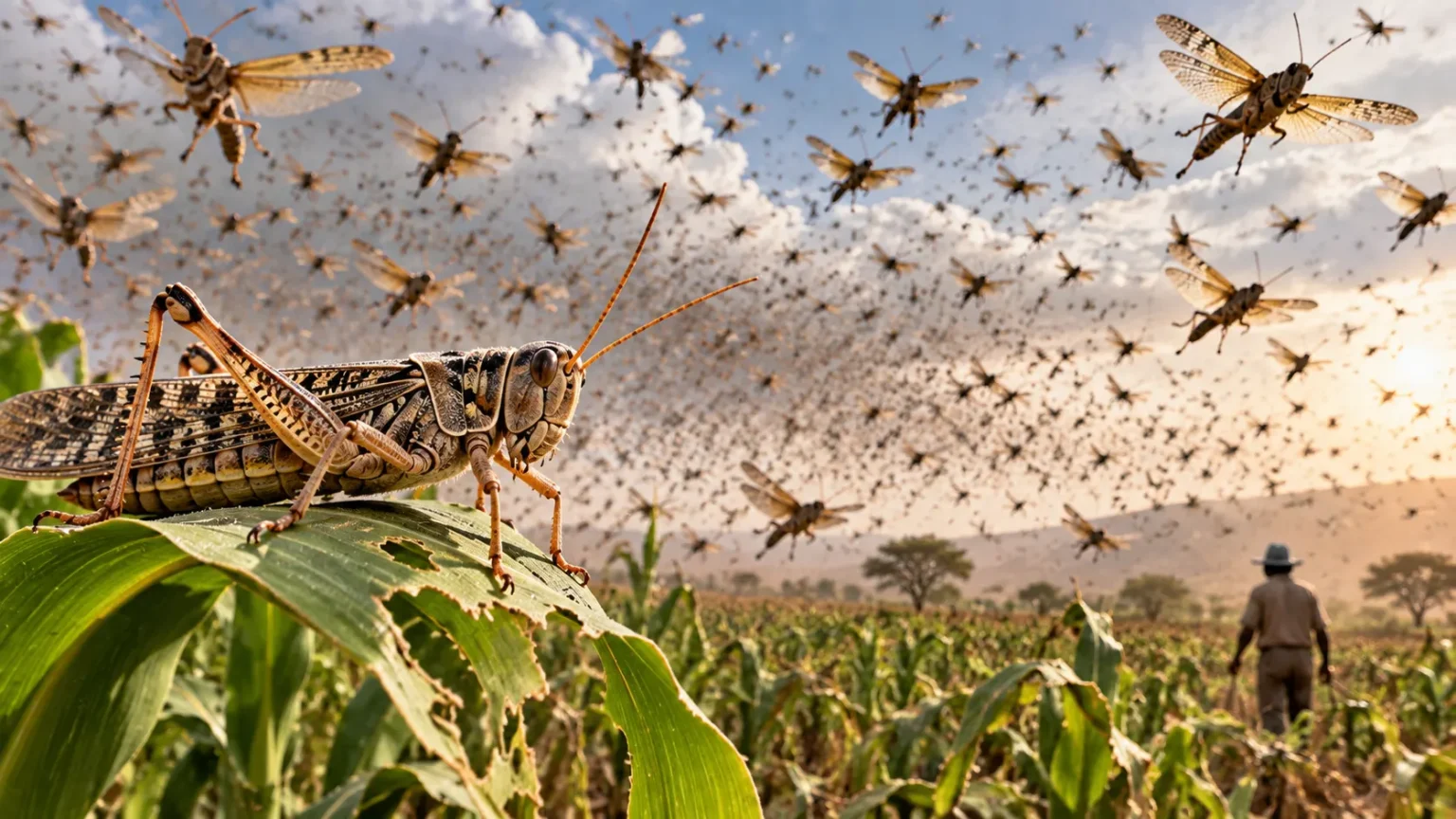
Locust: Facts, Life Cycle, Diet & Why They Swarm
A locust is a type of short-horned grasshopper known for its ability to change behavior and form massive swarms under certain environmental conditions. Most of the time, locusts can live relatively solitary lives and behave much like ordinary grasshoppers. However, when population density rises and food or breeding conditions shift, some species enter a more social phase called the gregarious phase. In that state, they gather, move together, and can form huge groups capable of traveling long distances. This transformation is what makes locusts different from most grasshoppers. Their biology, movement, feeding habits, and swarming behavior have fascinated scientists and challenged farmers for centuries.
Locusts are found in several regions of the world, especially areas with warm climates and seasonal rainfall. Some of the best-known species include the desert locust, migratory locust, red locust, and brown locust. These insects are especially important because they can reproduce rapidly when moisture and vegetation become favorable. Once their numbers increase enough, dense groups of young locusts called hopper bands may form, followed later by flying swarms of adults. These swarms can move across large areas in search of food. Because they feed on many kinds of vegetation, they can damage crops, pasture, and natural plants when populations become extremely high.
The locust life cycle begins with eggs laid in soil, followed by wingless juvenile stages called hoppers or nymphs, and eventually winged adults. Temperature, rainfall, vegetation, and population density influence how quickly the insects develop and whether they remain solitary or begin gathering. In favorable environments, several generations can occur relatively quickly, allowing numbers to rise dramatically. This rapid reproduction is one reason locust outbreaks can become difficult to control once swarming has begun. Monitoring breeding areas early is therefore an important part of locust management. Understanding each stage of the life cycle helps scientists predict where populations may increase and when preventive action is most useful.
Locusts are primarily plant eaters. Their diet can include grasses, leaves, shoots, flowers, fruits, seeds, bark, and agricultural crops, depending on species and availability. A single locust does not usually cause major agricultural damage, but millions of insects feeding together can consume enormous amounts of plant material. Large swarms may affect cereal crops, vegetables, fruit trees, pasture, and other food sources. This creates serious concerns for farming communities whose livelihoods depend on affected crops and grazing land. Swarms do not deliberately target farms, but cultivated fields can offer abundant vegetation, making them attractive feeding areas when locusts are moving through a region.
Perhaps the most remarkable characteristic of locusts is their ability to shift from scattered individuals into coordinated groups. Scientists describe this as phase polyphenism, meaning the insects can change aspects of their behavior, appearance, physiology, and movement depending on environmental and social conditions. Crowding is a major trigger, particularly when locusts repeatedly come into contact with one another. Rainfall can indirectly contribute by creating vegetation that supports breeding and population growth, followed by crowding as plants become concentrated or begin to dry out. The combination of reproduction, shrinking habitat, and close contact can push populations toward gregarious behavior. This ability explains why locust swarms can appear dramatically after periods that initially seemed favorable for vegetation and farming.
What Is a Locust?
A locust is not a separate insect group completely unrelated to grasshoppers. Instead, locusts are certain species of short-horned grasshoppers that can undergo dramatic changes when environmental conditions cause their populations to become crowded. In low-density conditions, these insects may behave independently and avoid one another. When density rises, their behavior can shift and they begin actively gathering into groups. This difference between solitary and gregarious phases is the defining feature of a true locust. Not every grasshopper species has this ability. That is why calling every large grasshopper a locust is technically inaccurate, even though the insects can look very similar to people who encounter them outdoors.
Locusts belong to the insect order Orthoptera, which also includes grasshoppers and crickets. They have strong hind legs adapted for jumping, chewing mouthparts, antennae, and two pairs of wings in the adult stage. Their body usually includes a head, thorax, and abdomen, like other insects. Color and body proportions can vary according to species, age, and whether the locust is in the solitary or gregarious phase. Some gregarious locusts show more noticeable coloration and different body characteristics than solitary individuals. These physical changes accompany broader changes in behavior and physiology. As a result, two locusts of the same species can sometimes appear surprisingly different depending on the conditions in which they developed.
One of the most important facts about locusts is that their populations naturally rise and fall. During quiet periods, locusts may exist at relatively low densities across large areas and attract little public attention. After suitable rainfall, however, vegetation grows and moist soil creates good breeding conditions. Locusts can then reproduce successfully and increase in number over several generations. If their available habitat later becomes more concentrated, the insects may be forced into closer contact. This crowding can trigger gregarious behavior and begin the process that eventually produces hopper bands and adult swarms. Outbreaks are therefore usually the result of a sequence of ecological events rather than a sudden unexplained appearance of insects.
The desert locust is one of the most widely known locust species because of its capacity to form large and mobile swarms across parts of Africa, the Middle East, and South Asia. Other locust species have their own geographic ranges and ecological preferences. The migratory locust has an especially broad distribution, while red and brown locusts are associated with particular regions of Africa. Different species vary in their breeding habitats, movement patterns, and responses to environmental conditions. However, all true locusts share the unusual ability to shift between low-density solitary behavior and high-density gregarious behavior. That flexibility helps them survive in unpredictable environments where food and rainfall can change rapidly.
For farmers and agricultural communities, locusts matter primarily because of what happens when their populations reach outbreak or plague levels. Solitary insects scattered across natural vegetation may cause little noticeable damage. Dense groups, however, can feed continuously as they move through fields and pasture. The scale of impact depends on swarm size, crop type, timing, local vegetation, and how long the insects remain in an area. Because locust movement crosses administrative and national boundaries, monitoring often requires cooperation between neighboring regions and countries. Early detection is especially valuable because small, localized populations are far easier to manage than enormous swarms already moving across the landscape.
Locust vs Grasshopper: What Is the Difference?
The easiest way to understand the difference between a locust and a grasshopper is to remember that all locusts are grasshoppers, but not all grasshoppers are locusts. Grasshopper is a broad term that includes many species with strong jumping legs and chewing mouthparts. Locust refers more specifically to grasshopper species capable of changing into a gregarious phase and forming organized groups when conditions encourage crowding. Most grasshoppers never develop this type of large-scale collective behavior. They may occur in high numbers, but that alone does not make them true locusts. The ability to undergo phase change is the key biological distinction.
When locusts are in their solitary phase, they can resemble ordinary grasshoppers in both appearance and behavior. They tend to avoid close contact with others and move independently through their habitat. As population density increases, repeated physical contact and other environmental cues can trigger changes in behavior. The insects become more attracted to one another, move together, and eventually form dense groups. Young gregarious locusts gather into hopper bands, while adults can form flying swarms. This social transformation is absent in ordinary grasshoppers. The distinction is therefore based less on basic body structure and more on how the insect responds to changing population and environmental conditions.
Physical differences can also develop between the solitary and gregarious phases of some locust species. Body color, size, shape, and proportions may change as the insects develop under crowded conditions. These changes are not instant in every characteristic, and some become more pronounced across developmental stages or generations. Behavioral changes can occur more quickly, which means an individual locust may begin acting more socially before all visible physical features have changed. Scientists study these transformations because they provide insight into how environment can influence animal behavior and development. The phenomenon also helps researchers understand when a seemingly harmless population is beginning to shift toward conditions associated with swarming.
Grasshoppers and locusts generally share similar diets because both primarily feed on plants. They use strong mouthparts to cut and chew leaves, stems, grasses, and other vegetation. However, the agricultural importance of locusts becomes much greater when large groups feed together. A scattered population of grasshoppers might damage individual plants or local fields, while a major locust swarm can affect vegetation across much larger areas. This difference in scale is why locusts have such a prominent place in agricultural history. Their ability to concentrate enormous numbers of feeding insects into a moving group makes them particularly challenging pests when outbreaks occur.
It is also important not to identify an insect as a locust simply because many grasshoppers are visible in one area. Some grasshopper species naturally become abundant without undergoing the biological phase changes associated with true locusts. Accurate identification usually requires knowledge of the species, behavior, location, and population pattern. Agricultural specialists and entomologists may use field observations, surveys, and species characteristics to determine what is present. This matters because monitoring and management strategies can differ according to the insect involved. Understanding the locust-grasshopper distinction helps explain why only a relatively small number of grasshopper species are capable of producing the enormous coordinated swarms associated with major agricultural outbreaks.
What Is the Life Cycle of a Locust?
The locust life cycle has three main stages: egg, hopper or nymph, and adult. This type of development is called incomplete metamorphosis because locusts do not pass through a pupal stage like butterflies or beetles. Instead, the young insect resembles a smaller, wingless version of the adult. A female lays eggs in suitable soil, usually placing them below the surface in a cluster known as an egg pod. The eggs remain there until environmental conditions allow development and hatching. Moisture and temperature are especially important because dry soil can limit successful breeding, while suitable rainfall can create favorable conditions for eggs and the vegetation young locusts need after emerging.
After hatching, young locusts enter the hopper stage. Hoppers do not yet have fully developed wings, so they primarily move by walking and jumping. As they grow, they pass through several developmental stages called instars and shed their outer covering through molting. Their wings gradually become more developed with each molt. Solitary hoppers usually remain dispersed, while gregarious hoppers can gather into dense, coordinated groups called hopper bands. These bands may move across the ground together in search of vegetation. Because hoppers cannot fly away, this stage can be especially important for monitoring and control efforts before the insects mature into highly mobile adults.
Eventually, the final juvenile stage molts into a winged adult. Newly developed adults may need additional time before becoming sexually mature. During this period, they can fly considerable distances and search for suitable environments containing food and breeding conditions. Adult behavior depends on phase, species, weather, and population density. Gregarious adults may remain together in swarms and move according to wind and available vegetation. Once conditions are favorable for reproduction, mature adults mate and females begin searching for suitable soil in which to lay eggs. This begins another generation and can allow populations to expand quickly when favorable conditions continue over multiple breeding cycles.
The speed of the locust life cycle varies according to species and environmental conditions. Warm temperatures can accelerate development, while cooler conditions generally slow it. Rainfall indirectly plays a major role because it moistens soil and stimulates plant growth, creating both egg-laying sites and food for young locusts. When favorable conditions occur repeatedly, locust populations may produce successful generations one after another. This can transform a previously scattered population into a much larger one in a relatively short period. Scientists therefore monitor rainfall, vegetation, soil conditions, and locust observations together rather than looking at insect numbers alone when assessing the likelihood of an outbreak.
The life cycle also explains why early intervention matters so much in locust management. Once adult swarms are airborne, they can travel across large regions and become difficult to locate and treat consistently. Eggs and hopper bands are much less mobile and may be concentrated in smaller areas. Monitoring known breeding zones can therefore provide opportunities to detect population increases before widespread migration occurs. This does not make control easy, especially in remote or inaccessible regions, but it improves the chances of limiting growth. Understanding where locusts are within their life cycle allows agricultural teams to select more appropriate monitoring, timing, and management strategies.
What Do Locusts Eat?
Locusts are primarily herbivorous insects, which means their diet consists mainly of plant material. Depending on species and availability, they may eat grasses, leaves, stems, shoots, flowers, seeds, fruits, and softer plant tissues. Many locust species can feed on a broad range of vegetation rather than depending on one specific host plant. This dietary flexibility becomes especially important during migration because a moving swarm encounters changing landscapes and plant communities. Individual insects generally consume a manageable amount of vegetation, but the picture changes dramatically when millions of locusts feed in the same area. Their collective appetite is what creates the potential for widespread agricultural loss during severe outbreaks.
Agricultural crops can provide attractive food sources because cultivated fields often contain dense concentrations of fresh vegetation. Locusts may feed on cereals, maize, millet, sorghum, rice, vegetables, legumes, pasture plants, and other crops depending on what is available in their range. Fruit trees and young plants may also be damaged if swarms settle and feed. The exact impact varies greatly from one outbreak to another. A swarm passing quickly through mature crops may produce a different level of damage from one that remains over young vegetation for an extended period. Farmers are particularly vulnerable when locust arrival coincides with sensitive crop growth stages.
Locust feeding behavior is closely connected to movement. A swarm does not necessarily remain in one location until every plant has been consumed. Adults may settle to feed and rest before continuing their movement when weather conditions become suitable. Wind strongly influences where flying swarms travel, while temperature can affect when they take off and land. As vegetation becomes less available, the insects may continue searching for new feeding areas. This movement creates uncertainty for farmers because swarms can cross regional boundaries rapidly. It also means that damage may be distributed across many areas rather than concentrated entirely within one location, depending on swarm size and migration patterns.
Young hoppers also feed heavily on vegetation as they develop. Because they cannot fly, hopper bands move across the ground and feed on plants available along their path. These bands can strip vegetation locally when densities are high. Their ground-based movement makes them easier to observe in some situations, but large bands can still cover substantial areas. Adequate food during the juvenile stage is important because locusts require energy and nutrients for growth and molting. When vegetation is abundant after rainfall, survival can improve, allowing more individuals to reach adulthood. This relationship between rainfall, vegetation, feeding, and successful development is central to understanding how outbreaks build.
Locusts are not generally viewed as specialized predators or meat-eating insects, although unusual feeding behavior can occur under stressful conditions. Their ecological role is primarily linked to plant consumption and nutrient cycling within grassland and dryland ecosystems. Problems arise when their natural population dynamics overlap with human agriculture at an enormous scale. From the insect’s perspective, a crop field is simply another concentrated source of edible vegetation. This is one reason locust management focuses on population monitoring rather than attempting to make individual crops entirely unattractive. Preventing or reducing large population buildup is usually more practical than protecting every potential food plant once massive swarms are already moving.
Why Do Locusts Swarm?
Locusts swarm because certain environmental and population conditions trigger a shift from solitary behavior to gregarious behavior. At low population density, individual locusts tend to avoid one another and live relatively independently. When large numbers become concentrated in the same area, repeated contact between individuals changes their behavior. They begin becoming more attracted to other locusts rather than moving away from them. This creates a feedback loop in which grouping leads to more contact and more coordinated movement. The process does not happen because locusts consciously decide to form a swarm. It is a biological response that evolved in species living in environments where food and suitable habitat can change dramatically.
Rainfall often plays an indirect but crucial role in setting the stage for swarming. In dry environments, periods of rain can create moist soil suitable for egg laying and stimulate rapid plant growth. Locusts suddenly have better access to food and breeding habitat, so more eggs survive and populations increase. If favorable rains continue, several generations may develop successfully. Later, vegetation may begin drying out or become concentrated into smaller green areas. Increasing numbers of locusts are then pushed closer together around the remaining food. This crowding provides the physical and social stimulation that encourages phase change. In this way, unusually favorable conditions can eventually contribute to the formation of destructive swarms.
Scientists have studied the sensory and chemical mechanisms involved in locust gregarization. Repeated physical stimulation, particularly contact involving the hind legs in some well-studied species, can contribute to behavioral changes associated with crowding. The insect’s nervous system and chemical signaling respond to this stimulation, producing greater attraction to other locusts and increased activity. As gregarious behavior develops, insects begin moving in coordinated groups. Juveniles form hopper bands, while winged adults form swarms. The full process also involves changes in physiology, appearance, and development. These findings show that swarming is a complex biological transformation rather than simply a large number of insects happening to gather in the same place.
Swarming can provide survival advantages to locusts living in unpredictable environments. When local food becomes scarce, moving collectively may help populations escape deteriorating habitat and locate new vegetation. Adult swarms can take advantage of favorable winds to travel substantial distances. Group movement also allows many individuals to respond together as environmental conditions change. From an evolutionary perspective, this flexibility enables locust species to survive dramatic cycles of drought, rainfall, vegetation growth, and scarcity. Unfortunately, the same behavior that helps locust populations survive can bring them into conflict with agriculture because migrating groups may encounter large areas of cultivated crops that provide abundant food.
Not every rainy season produces a major locust plague. Several factors must align, including successful breeding, population growth, continued favorable conditions, geographic concentration, and opportunities for gregarization. Weather patterns can also influence where swarms travel and whether they encounter additional breeding zones. This complexity makes prediction challenging. Modern monitoring therefore combines field surveys with weather information, vegetation observations, remote sensing, and population reports. The earlier specialists recognize increasing density and gregarious behavior, the better the opportunity to respond before swarms expand. Understanding why locusts swarm is ultimately important not only for biology but also for protecting food production and rural livelihoods.
How Big Can Locust Swarms Become?
Locust swarms can vary enormously in size. Some are relatively small groups spread across a limited area, while major outbreaks can produce swarms extending across many square kilometers. Within a dense swarm, large numbers of insects may occupy each square kilometer of airspace. Exact density changes constantly as locusts spread out, concentrate, land, and take flight. The overall visual effect can be dramatic because thousands or millions of moving insects may obscure parts of the landscape or sky. However, swarm structure is not perfectly uniform. Locusts continuously adjust their movement according to neighbors, wind, temperature, vegetation, and terrain as the group travels.
The mobility of adult swarms is one of the biggest reasons they are difficult to manage. Locusts generally move with prevailing winds rather than flying independently against strong air currents for long distances. Favorable winds can transport a swarm across large regions within a relatively short period. Daily travel distance depends on wind speed, temperature, species, and other conditions. Swarms often land during cooler periods or when they encounter suitable feeding or resting areas. They may then resume flight when temperatures rise and atmospheric conditions become favorable. This means their position can change significantly from one day to the next, complicating surveillance and response.
Large swarms can contain individuals at different levels of maturity. Immature adults may spend considerable time moving in search of suitable feeding and breeding conditions, while mature insects eventually settle where conditions allow reproduction. Swarms can also split into smaller groups or merge with other populations. Their shape and density may change throughout the day as airflow and landscape features influence movement. For monitoring teams, understanding these patterns is important because a swarm observed in one location cannot be assumed to remain there. Forecasting involves estimating how weather conditions may carry the insects and identifying possible areas where they could feed, settle, or breed next.
The agricultural impact of a swarm depends on more than its physical size. Timing, crop stage, local food availability, and how long the locusts remain in an area all matter. A smaller swarm feeding on a vulnerable crop at a critical stage can still cause serious local losses. Larger swarms passing over extensive agricultural regions can affect many farms and grazing areas. Livestock communities may also be affected if locusts consume pasture needed for animals. For this reason, assessments often examine both insect numbers and the types of vegetation at risk. The same swarm can have very different consequences depending on the landscape through which it moves.
Images of enormous swarms often attract public attention, but prevention efforts focus heavily on detecting populations before they reach that stage. Small groups and hopper bands are easier to target than huge airborne swarms. Once multiple swarms form across several countries, management becomes significantly more expensive and logistically difficult. Large-scale outbreaks may require aircraft, ground teams, surveillance systems, regional coordination, and extensive resources. This is why locust management is often described as a preventive challenge. Finding and treating emerging populations early can reduce the chance that smaller outbreaks develop into the spectacular but highly damaging swarms seen during major locust emergencies.
Where Do Locusts Live?
Locusts live in regions where climate, soil, and vegetation support their particular life cycles. Different species have different geographic ranges, so there is no single habitat shared by all locusts. Many well-known species occur in dry or seasonally dry environments where rainfall is unpredictable. These regions can alternate between long periods of sparse vegetation and sudden bursts of plant growth after rain. Such conditions favor insects capable of reproducing quickly when resources become available and moving when those resources disappear. This ecological pattern helps explain why phase-changing locust behavior evolved in several grasshopper species living in variable environments.
The desert locust is associated with arid and semi-arid areas stretching across parts of Africa, the Arabian Peninsula, the Middle East, and South Asia. During periods of low population density, it can remain scattered across broad desert regions. When favorable breeding conditions expand, populations may increase and begin moving into neighboring areas. Other species occupy grasslands, floodplains, agricultural landscapes, and seasonal wetland environments. The red locust, for example, has historically been associated with particular grassland regions in Africa. Understanding species distribution is essential because each locust requires different surveillance areas and may respond differently to rainfall and vegetation patterns.
Soil conditions are especially important during breeding because females must place eggs underground. Sandy or relatively loose soils with suitable moisture are often favorable for egg laying in some species. Extremely dry soil may reduce successful egg development, while excessive water can also be unsuitable. Vegetation nearby provides food for newly hatched hoppers. Therefore, breeding areas usually need a useful combination of moisture, soil texture, warmth, and plant growth. These conditions can appear temporarily after rainfall even in landscapes that normally seem extremely dry. Field teams often inspect recently greened areas because they may become important breeding zones when adult locusts are present.
Locust habitat is not fixed from year to year because weather changes where suitable conditions exist. One region may be too dry for breeding during one season and ideal after unusual rainfall the next. Wind can then carry adults toward entirely new areas where additional breeding becomes possible. This ability to follow temporary resources makes locust ecology highly dynamic. It also means that national borders have little relevance to swarm movement. Effective monitoring therefore often depends on sharing information across countries and tracking ecological conditions over a broad geographic area rather than focusing only on locations where swarms have already been reported.
Climate variability can influence locust risk by changing rainfall distribution, storm patterns, vegetation growth, and the frequency with which normally dry regions become suitable for breeding. However, individual outbreaks should not be explained by one environmental factor alone. Population history, local rainfall, habitat availability, wind patterns, monitoring coverage, and control efforts all influence what happens. Understanding habitat requires looking at this complete ecological picture. Locusts thrive when temporarily favorable conditions allow rapid reproduction, and they become especially problematic when those conditions occur repeatedly across connected regions. Their success is therefore closely tied to their ability to exploit landscapes that change dramatically over time.
How Locust Swarms Affect Crops and Agriculture
The most serious concern associated with locust swarms is their ability to damage crops over wide areas. Locusts use chewing mouthparts to remove leaves, stems, flowers, seeds, and other edible plant material. When a large swarm settles on agricultural land, thousands or millions of insects may feed simultaneously. Crops can lose substantial amounts of vegetation in a short period, particularly when plants are young or highly palatable. Damage may reduce yield, delay development, or destroy plants completely in severely affected fields. Because farmers invest months of labor and resources before harvest, sudden swarm arrival can create major financial losses with little warning.
Locusts can also affect livestock production when they consume pasture and forage. In dry regions, grazing resources may already be limited, so losing fresh vegetation can place additional pressure on pastoral communities. Animals may need to travel farther for food or depend on purchased feed, which can increase household costs. If swarms repeatedly affect the same area, vegetation recovery may become especially important for community resilience. The effects therefore extend beyond visible crop damage. Locust outbreaks can influence food availability, household income, livestock productivity, local markets, and the ability of farming families to prepare for the next planting season.
Small-scale farmers may be particularly vulnerable because they often have fewer financial resources to absorb a failed harvest. A commercial farm might have insurance, access to credit, irrigation, or operations spread across different locations, while a household farmer may rely heavily on one seasonal crop. If locusts damage that crop shortly before harvest, the family can lose both food and income. Wider outbreaks may also influence regional food prices when production falls or communities increase demand for replacement supplies. This is why major locust emergencies are treated not simply as pest-control problems but as potential threats to food security and rural livelihoods.
The severity of agricultural damage depends strongly on timing. Locust feeding during early plant development can prevent crops from reaching maturity, while damage around flowering or grain formation can reduce final harvests. Mature crops may sometimes tolerate limited feeding better, although severe infestations can still cause major loss. Farmers may also face uncertainty even before swarms arrive because predicted movement can affect planting decisions or emergency preparations. Local authorities and agricultural organizations therefore try to communicate swarm locations and likely movement as quickly as possible. Accurate information helps communities protect equipment, coordinate reporting, and prepare for potential crop impacts.
Locust management is most effective when it prevents large populations from reaching agricultural areas in the first place. Once massive swarms are spread across farmland, treatment becomes more difficult and crops may already be damaged. Preventive programs monitor remote breeding zones where increasing locust numbers can be detected early. Ground surveys, aerial observations, satellite-based vegetation monitoring, weather forecasting, and community reports can all contribute. When concerning populations are found, control teams may target them before further multiplication occurs. This approach recognizes an important principle of pest management: stopping an outbreak early is usually easier and less disruptive than responding after an enormous mobile population has already formed.
How Are Locusts Controlled?
Locust control begins with surveillance and early warning. Specialists monitor known breeding areas, rainfall, vegetation, and reports of unusual locust activity. Field teams may travel through remote regions to record insect density, developmental stage, behavior, and breeding conditions. Satellite information can help identify areas where rainfall has produced new vegetation, allowing survey teams to prioritize locations that may support locust reproduction. Weather forecasts are also valuable because wind influences adult movement. Combining these different sources of information allows authorities to estimate where populations are increasing and where they may move next. Early warning provides the best opportunity to control locusts while groups are still relatively small.
When control is required, teams may use ground-based or aerial treatments depending on the location, size, and accessibility of the population. Conventional insecticides have historically played a major role in emergency locust control because they can rapidly reduce large numbers of insects. Applications must be carefully planned to maximize effectiveness while reducing unnecessary environmental exposure. Trained teams consider product selection, dosage, weather, target area, safety procedures, and local conditions before treatment. Aerial operations may be needed for extensive or inaccessible infestations, while vehicle-mounted or handheld equipment can be useful against smaller or more concentrated populations. Appropriate oversight is essential because pesticides can affect more than the intended pest if they are used incorrectly.
Biological control methods are also part of modern locust management research and practice. Certain biopesticides use naturally occurring pathogens that specifically infect locusts and grasshoppers. These products can provide environmental advantages in some situations, although they may act more slowly than fast-acting conventional insecticides. Their effectiveness also depends on temperature, insect stage, operational timing, and outbreak conditions. Biological options can be especially useful when preventive treatment is possible before populations become overwhelming. Integrated management strategies may combine monitoring, targeted chemical treatments, biological approaches, and ecological knowledge rather than depending entirely on a single control method.
Community participation can improve surveillance because people living in affected regions may notice unusual insect numbers before official teams arrive. Farmers and pastoralists can report egg-laying adults, hopper bands, or moving swarms through local authorities or available reporting systems. However, controlling large locust populations should generally be coordinated by trained professionals rather than improvised locally with unsafe chemicals. Clear public communication is therefore important. Communities need accurate information about swarm movement, treatment operations, livestock precautions, crop risks, and how to report observations. Effective locust control depends not only on technology but also on coordination among national agencies, local communities, researchers, weather services, and neighboring countries.
No control strategy can guarantee that locust outbreaks will never occur. These insects inhabit vast and sometimes difficult-to-access regions, and favorable breeding conditions can develop quickly after unusual rainfall. Conflict, limited roads, insufficient funding, or delayed surveillance can make remote populations difficult to monitor. For this reason, long-term preparedness is just as important as emergency response. Maintaining trained survey teams, equipment, data systems, regional cooperation, and operational plans during quiet periods makes rapid action more likely when populations begin increasing. The goal of modern locust management is therefore not complete eradication but preventing ordinary populations from developing into widespread swarms that threaten agriculture and food security.
Interesting Locust Facts You Should Know
One of the most fascinating locust facts is that the same species can behave like two very different insects depending on population density. A solitary locust generally avoids others, while a gregarious locust actively gathers with them. This change affects movement, physiology, and sometimes appearance. Scientists call the phenomenon phase polyphenism, and it is one of the most dramatic examples of environmentally influenced behavior in insects. The transformation helps explain why quiet landscapes can eventually produce enormous groups without a new species suddenly arriving. The locusts were often already present in the broader region, but environmental conditions allowed their numbers and social behavior to change.
Locusts are also surprisingly capable travelers. Adult swarms can use favorable winds to cover long distances, allowing outbreaks to spread across regions and sometimes international borders. Although individual insects actively fly, the direction and speed of swarm movement are strongly influenced by air currents. This makes meteorological forecasting a valuable part of locust monitoring. Specialists can compare known swarm locations with forecast winds to estimate likely movement. The ability to travel widely also means that successful management in one country can protect neighboring regions, while uncontrolled breeding in one area may create problems elsewhere. Locust outbreaks are therefore naturally international challenges.
Another interesting fact is that locust swarms are highly coordinated without having a leader directing them. Each insect responds to nearby individuals, environmental cues, and movement patterns. This local behavior can produce organized group movement across an entire band or swarm. Similar principles are studied in research on collective animal behavior, including fish schools and bird flocks. Young hopper bands can march together across the ground before they have developed functional adult wings. Once mature enough to fly, gregarious adults can form moving aerial groups. The coordination is an emergent property of many individual insects responding to their immediate surroundings.
Locusts also have an important place in human history. Accounts of destructive locust outbreaks appear in historical writings from many cultures because agriculture has always been vulnerable to sudden insect invasions. Before modern forecasting and pest management, farmers had little ability to know when a swarm would arrive or where it would travel. Communities sometimes lost large portions of their harvest within a short period. Today, surveillance technology, aircraft, communication systems, remote sensing, and biological knowledge provide much greater capacity to respond. Even so, major outbreaks still demonstrate how difficult it can be to manage a highly mobile insect population across enormous and environmentally challenging landscapes.
Despite their reputation as agricultural pests, locusts are still part of natural ecosystems. At normal population levels, they consume vegetation, serve as prey for birds and other animals, and contribute to nutrient cycling. Problems arise when ecological conditions allow their numbers to increase far beyond ordinary densities and swarming behavior develops. This distinction is useful because it shows why the goal is not to eliminate every locust from nature. Ecological systems contain many species whose impact changes according to population size. Locust management focuses on preventing exceptional population growth from becoming a threat to food production while recognizing that low-density locust populations are a natural component of the environments where they occur.
Final Thoughts on Locusts and Their Swarming Behavior
Locusts are remarkable insects because of their ability to change dramatically according to environmental and social conditions. At low population densities, they may behave much like ordinary solitary grasshoppers and attract little attention. When breeding conditions become favorable and their numbers rise, crowding can trigger a shift toward gregarious behavior. Young insects begin forming hopper bands, while adults can eventually gather into highly mobile swarms. This transformation is the central feature that separates true locusts from most other grasshoppers. Understanding it helps explain why locust populations can remain relatively unnoticed for years and then suddenly become an urgent agricultural concern.
Their life cycle also reveals why rainfall and vegetation are so important. Moist soil supports egg development, while fresh plant growth provides food for newly hatched hoppers and adults. When favorable conditions occur repeatedly, several successful generations can cause populations to increase rapidly. If vegetation later becomes concentrated, locusts may crowd together and begin the process of gregarization. The relationship between weather, habitat, reproduction, and behavior makes locust forecasting a complex ecological task. Monitoring programs must therefore watch not only for visible swarms but also for the environmental conditions that could allow future swarms to develop.
The locust diet is broad enough to create serious problems when large numbers move through farming areas. Locusts can feed on grasses, leaves, crops, pasture, and many other forms of vegetation. A small number of insects usually causes little concern, but large groups feeding simultaneously can damage crops and grazing resources over substantial areas. The impact can extend beyond farms into household income, livestock production, local food supplies, and regional markets. This is why locust outbreaks are closely connected to food security. For vulnerable rural communities, preventing major swarm development can be just as important as responding to the insects once they arrive.
Modern locust management depends heavily on early detection. Survey teams, weather forecasting, satellite observations, community reporting, and regional information sharing can help identify breeding and population increases before swarms become enormous. Control methods may include carefully managed insecticide applications, biological products, and other integrated approaches. None of these methods works perfectly in every environment, especially when populations occur in remote or unstable regions. However, responding during the egg or hopper stages is generally more manageable than chasing large flying swarms. Preparedness during quiet years is therefore an essential part of reducing future agricultural damage.
Ultimately, the story of the locust is a powerful example of how strongly animal behavior can respond to environmental change. The insects do not swarm simply because there are many of them, nor do swarms appear without ecological triggers. Their emergence reflects a combination of rainfall, breeding success, vegetation, crowding, biological phase change, and movement. Understanding these connections makes locust outbreaks less mysterious and helps explain why monitoring and preventive action are so important. For farmers, scientists, and governments alike, learning how locusts live, eat, reproduce, and swarm is the foundation for reducing the damage these extraordinary insects can cause.
Frequently Asked Questions About Locusts
What is a locust?
A locust is a type of short-horned grasshopper that can change from solitary behavior to gregarious behavior when populations become crowded. In the gregarious phase, locusts can form large hopper bands and flying swarms.
Why do locusts swarm?
Locusts swarm when population growth and crowding trigger biological changes that make them more attracted to one another. Favorable rainfall, abundant vegetation, repeated breeding, and later concentration of insects into smaller areas can contribute to this process.
What do locusts eat?
Locusts mainly eat plant material such as grasses, leaves, stems, flowers, seeds, and agricultural crops. Large swarms can consume substantial quantities of vegetation because enormous numbers of insects feed together.
Are locusts and grasshoppers the same?
Locusts are a special type of grasshopper, but not all grasshoppers are locusts. True locust species can undergo a phase change that causes them to gather and move together in large groups.
How long does a locust live?
Locust lifespan varies according to species, temperature, food availability, and environmental conditions. Their development progresses from egg to hopper and then adult, with the total life cycle often lasting several months depending on conditions.
Can locusts fly?
Adult locusts have wings and are strong flyers. Gregarious adults can travel in swarms over large distances, with their direction strongly influenced by prevailing winds.
Where do locusts come from?
Locusts naturally live in regions suited to their species, including deserts, grasslands, semi-arid areas, and seasonal breeding zones. Swarms develop when local populations multiply and become gregarious rather than appearing from an entirely separate source.
Do locusts bite humans?
Locusts are plant-feeding insects and do not normally attack people. Their primary threat is to crops and vegetation rather than humans.
Why are locusts dangerous to agriculture?
Large swarms can contain enormous numbers of insects that feed on crops and pasture simultaneously. Severe outbreaks can reduce harvests, damage grazing land, and threaten food and income for agricultural communities.
How are locust swarms controlled?
Locust management combines surveillance, early warning, ground or aerial treatments, biological control options, weather forecasting, and regional coordination. The most effective approach is usually to identify and control increasing populations before they develop into massive flying swarms.