The bird dog exercise is a simple bodyweight movement that can improve core control, coordination, balance, and spinal stability. It is performed on your hands and knees while extending one arm and the opposite leg. Because it requires very little equipment, it can fit easily into home workouts, warm-ups, rehabilitation programs, and general strength routines.
Although the movement looks easy, good bird dog exercise form requires control rather than speed. Small mistakes such as arching the lower back, rotating the hips, or lifting the limbs too high can reduce the effectiveness of the exercise. Learning the correct setup, movement pattern, and progression can help you get more value from every repetition.
What Is the Bird Dog Exercise?
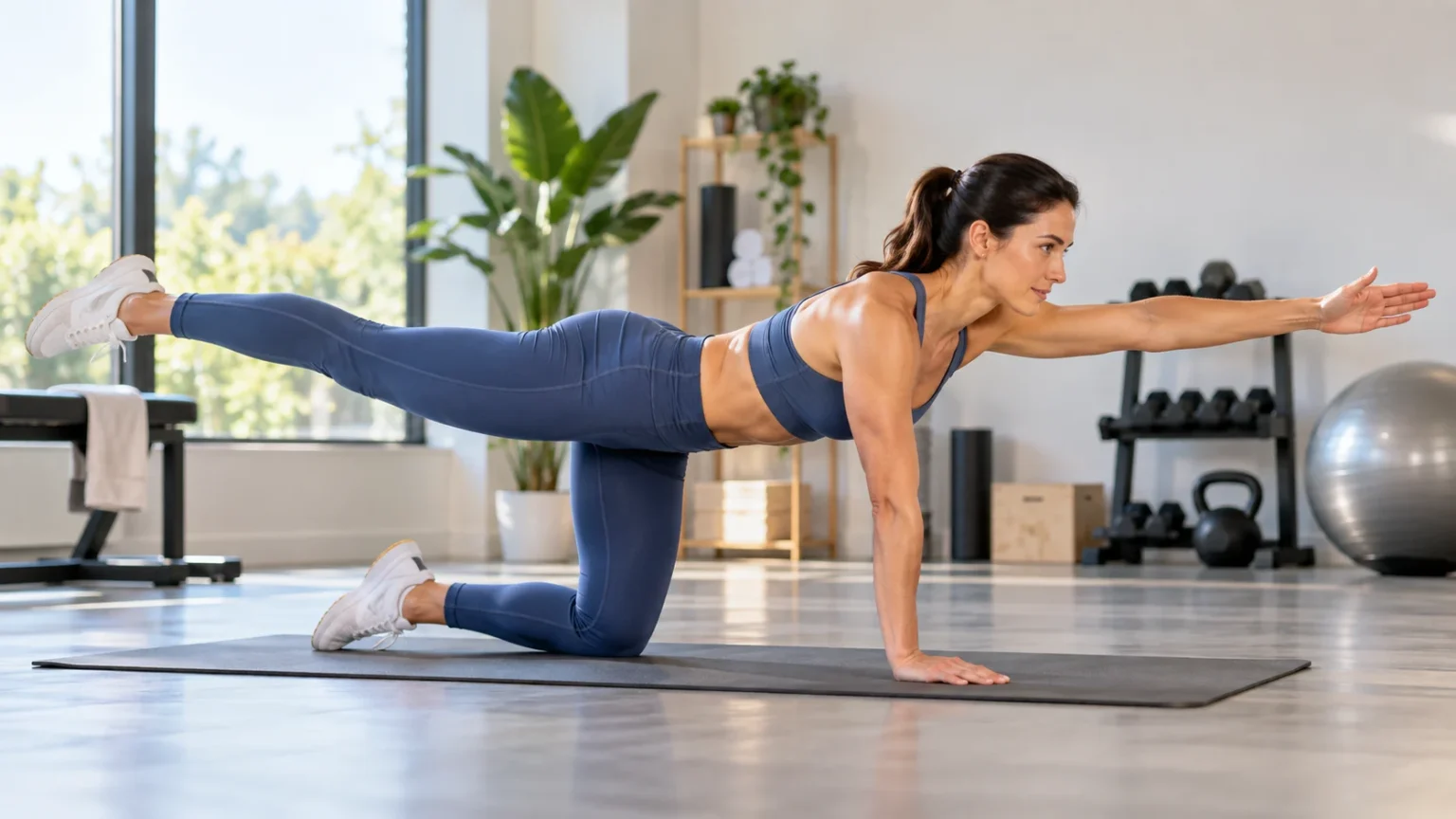
The bird dog is a quadruped core exercise performed from a hands-and-knees position. From this starting position, you extend one arm forward while extending the opposite leg backward, then return both limbs to the floor. The movement challenges your trunk to remain stable while your arms and legs move independently.
This exercise is often used in strength training, physical therapy, mobility routines, and beginner fitness programs. It does not require heavy resistance, yet it can challenge several muscle groups at the same time. The bird dog is especially useful for learning how to control the spine and pelvis during movement.
Unlike exercises that involve repeated bending or twisting, the bird dog focuses on resisting unwanted movement. Your abdominal, back, hip, and shoulder muscles work together to keep your torso steady. That makes the exercise useful for developing body awareness and movement control before progressing to more demanding exercises.
How to Perform the Bird Dog Exercise Correctly
Start on your hands and knees with your hands directly below your shoulders and your knees underneath your hips. Keep your fingers comfortably spread and distribute pressure evenly through both hands. Your spine should remain in a comfortable neutral position rather than being strongly rounded or excessively arched.
Gently brace your abdominal muscles, then slowly extend your right arm forward while moving your left leg backward. Reach in opposite directions rather than trying to lift both limbs as high as possible. Keep your hips facing the floor and avoid allowing your torso to rotate as you extend.
Pause briefly when your arm and leg are roughly in line with your torso, then return them to the starting position with control. Repeat on the opposite side using your left arm and right leg. Move slowly enough that you can maintain balance and proper alignment throughout every repetition.
Bird Dog Exercise Form Tips
Keep your lower back stable throughout the exercise instead of allowing it to sag as your leg lifts. Imagine gently drawing your ribs toward your pelvis while maintaining normal breathing. This light abdominal tension can help prevent excessive movement through the lumbar spine without requiring you to hold your breath.
Your extended leg should reach backward rather than upward. Lifting the leg too high often causes the pelvis to rotate or the lower back to arch, which changes the movement. Aim to create a long line from your heel through your hips while keeping both hip bones facing approximately toward the floor.
The same principle applies to your arm. Reach forward without excessively shrugging the shoulder or twisting through the upper body. Smooth, controlled movement matters more than reaching farther, so shorten your range if you cannot maintain a steady spine and level pelvis.
Which Muscles Does the Bird Dog Work?
The bird dog primarily challenges the muscles that stabilize the trunk, including the deeper abdominal muscles and muscles along the spine. These muscles help resist rotation and excessive arching while your limbs move. This makes the exercise different from traditional abdominal exercises that rely heavily on repeated spinal flexion.
The gluteal muscles and hamstrings also contribute as the leg extends behind you. Your hip muscles help control the pelvis and keep it from rotating toward the side of the lifted leg. Meanwhile, the shoulders and upper back work to support your body and control the arm reaching forward.
Because several areas must coordinate simultaneously, the bird dog is often considered a full-body stability exercise rather than only a core exercise. It teaches the trunk, hips, and shoulders to work together. This coordination can be useful for everyday movements as well as more advanced strength and athletic activities.
Benefits of the Bird Dog Exercise
One major benefit of the bird dog is improved core stability. Instead of simply strengthening muscles in isolation, the exercise teaches your trunk to remain controlled while the limbs move. This type of stability is useful during walking, running, lifting, carrying, and many other daily activities.
The bird dog can also improve balance and coordination because opposite limbs must move at the same time. This cross-body pattern requires concentration and body awareness. People who initially struggle with the movement often notice better control after practicing consistently with slow and deliberate repetitions.
Another advantage is accessibility. The exercise requires only enough floor space to kneel comfortably, making it easy to perform at home or while traveling. It can also be adjusted for beginners or progressed for experienced exercisers without requiring expensive equipment or heavy weights.
Bird Dog Exercise for Core Stability
Core stability involves more than having strong abdominal muscles. Your trunk must coordinate multiple muscle groups to control the spine and pelvis while forces move through the body. The bird dog trains this function by creating a challenge every time one arm and the opposite leg leave the floor.
As your limbs extend, gravity naturally tries to rotate or arch your torso. Your core muscles respond by resisting that unwanted movement. Maintaining a steady trunk throughout the exercise teaches you to create stability while still allowing your hips and shoulders to move freely.
For this reason, quality is more important than the number of repetitions completed. Five controlled repetitions on each side may provide more useful practice than twenty rushed repetitions with poor alignment. Focus on keeping your breathing relaxed and your torso stable from the beginning to the end of every repetition.
Common Bird Dog Exercise Mistakes
One common mistake is lifting the leg too high. This often causes the lower back to arch and shifts the focus away from controlled hip extension. Keep the leg closer to the height of your torso and imagine reaching your heel toward the wall behind you rather than toward the ceiling.
Another frequent error is allowing the hips to rotate. If one side of the pelvis rises as the leg extends, the core is no longer controlling rotation effectively. Practice with a smaller range of motion and move slowly until you can keep both sides of the pelvis relatively level.
Rushing is another problem because momentum makes the exercise easier while reducing the stability challenge. Move each arm and leg smoothly and pause briefly at the extended position. If you lose balance, reset your hands and knees rather than trying to complete the repetition with poor form.
How Many Bird Dogs Should You Do?
Beginners can often start with five to eight controlled repetitions per side. Each repetition should be slow enough that you can maintain a steady spine and pelvis. If your form begins to break down, ending the set is usually more useful than continuing simply to reach a specific number.
As your control improves, you can gradually increase to eight to twelve repetitions per side or add another set. Another option is to hold the extended position for several seconds before returning to the start. Longer holds can increase the stability challenge without requiring additional equipment.
There is no universal repetition target that works for everyone. Your training experience, goals, and current level of control should guide the amount you perform. The bird dog works well two or three times per week, but it can also be used more frequently as a light movement drill if it remains comfortable.
How to Make the Bird Dog Easier
If extending both an arm and opposite leg feels too difficult, begin by moving only one limb at a time. Lift one arm while keeping both knees on the floor, then practice extending one leg while both hands remain down. This allows you to learn trunk control before combining the movements.
You can also reduce how far you extend your arm or leg. A shorter range decreases the balance demand while still teaching the core to remain stable. Gradually increase the distance as your control improves rather than trying to reach the full position immediately.
Practicing near a wall can provide additional feedback. Position yourself so your hip is close to the wall and try to avoid rotating into it as you move your leg. This simple setup can help you recognize unwanted pelvic movement and improve your awareness of proper form.
How to Make the Bird Dog More Challenging
Once the standard bird dog becomes easy, increase the challenge gradually rather than sacrificing technique. One option is to hold the extended position longer while keeping your hips and shoulders steady. A five- to ten-second hold can make the exercise considerably more demanding without changing the basic movement.
You can also add light resistance using a resistance band around the foot or hand if your form remains controlled. Another progression is to bring the elbow and opposite knee toward each other underneath your torso before extending again. This adds movement while requiring you to regain a stable position with each repetition.
Advanced variations should only be added when you can perform the basic version consistently. The goal is not to make the exercise complicated for its own sake. Every progression should increase the stability challenge while allowing you to maintain smooth breathing, controlled movement, and comfortable spinal alignment.
When to Use the Bird Dog in Your Workout
The bird dog works well near the beginning of a workout as part of a general movement preparation routine. It can help activate the core, glutes, and shoulder stabilizers before strength training. Combining it with light movement and suitable warm-up stretches can help prepare your body for more demanding exercises.
It can also be performed during a core-focused workout. Pairing bird dogs with exercises such as side planks, dead bugs, or controlled bridges can create a balanced routine without requiring repeated spinal bending. Choose movements that match your experience level and allow you to maintain good technique.
Some people also use bird dogs on lighter training or recovery days. Because the exercise can be performed slowly with little external load, it can provide useful movement practice without creating a highly demanding workout. However, any exercise that consistently increases pain should be modified or stopped.
Is the Bird Dog Good for Back Pain?
The bird dog is sometimes included in exercise programs for people with certain types of back discomfort because it trains trunk stability without requiring large spinal movements. However, back pain has many possible causes, so no single exercise is appropriate for everyone. A movement that feels comfortable for one person may aggravate symptoms in another.
If you have mild discomfort and the bird dog has been recommended for you, begin with a small range of motion. Focus on keeping the spine stable and stop if symptoms become sharper, spread into the leg, or noticeably worsen. Exercise should be adjusted based on how your body responds rather than forced through pain.
Persistent or severe back pain should be assessed by a healthcare professional before relying on one exercise for relief. Pain accompanied by significant weakness, numbness, bladder or bowel changes, or symptoms following major trauma requires medical attention. The bird dog can support movement and strength, but it is not a diagnosis or treatment for every back condition.
Conclusion
The bird dog exercise is a practical movement for improving core stability, coordination, balance, and control of the spine and pelvis. It works several muscle groups at the same time while requiring minimal equipment. Proper technique depends on moving slowly, reaching rather than lifting excessively, and keeping your torso steady.
Beginners can start with a small range of motion or move one limb at a time before progressing to the full cross-body version. As control improves, longer holds, additional repetitions, or light resistance can make the exercise more challenging. Progress should always preserve good alignment rather than simply making the movement harder.
Adding bird dogs to a well-rounded fitness routine can help develop the stability needed for everyday movement and exercise. Pay attention to breathing, core control, hip position, and movement quality during every repetition. If the exercise causes persistent or worsening pain, seek appropriate professional guidance before continuing.
FAQs
What is the correct bird dog exercise form?
Start on your hands and knees, brace your core gently, and extend one arm with the opposite leg. Keep your hips level, spine neutral, and movements slow without excessively arching your lower back.
How many bird dogs should beginners do?
Beginners can start with about five to eight controlled repetitions per side. Focus on technique and balance before increasing repetitions, sets, hold times, or resistance.
What muscles does the bird dog exercise work?
Bird dogs work the core, spinal stabilizers, glutes, hamstrings, shoulders, and upper back. The exercise also trains coordination between the trunk, hips, and shoulders.
Can bird dogs help improve balance?
Yes. Bird dogs challenge balance because one arm and the opposite leg leave the floor simultaneously. Repeated practice can improve coordination, body awareness, and control during cross-body movements.
Should I do bird dogs every day?
Bird dogs can be performed regularly when they remain comfortable and your overall training allows adequate recovery. Daily practice is not necessary, and technique should take priority over performing the exercise frequently.