

Nipple Piercing: Healing, Aftercare, Risks and Pain
Nipple piercing is a form of body modification in which jewelry is placed through the nipple tissue, most commonly in a horizontal position. People choose nipple piercings for many reasons, including personal style, body confidence, aesthetics, self-expression, or simply because they like the look. Although the piercing procedure itself is relatively quick, healing takes considerably longer and requires consistent care.
One of the biggest misconceptions about a nipple piercing is that the difficult part ends once the needle has passed through the tissue. In reality, the piercing creates a wound that needs time to develop a stable channel around the jewelry. Friction from clothing, unnecessary touching, jewelry movement, improper cleaning, or changing the jewelry too early can interfere with that process.
Healing experiences also vary considerably. Some people experience noticeable soreness and swelling during the first few days, while others find the discomfort relatively manageable. Over the following months, tenderness may come and go even when the piercing appears normal on the outside. A piercing can look healed before the internal tissue has fully matured, which is why aftercare should not be abandoned simply because the skin looks better.
This guide explains nipple piercing healing, pain, aftercare, infection risks, jewelry choices, discharge, swelling, scarring, breastfeeding considerations, and warning signs. The goal is to provide practical, people-first information so you can understand what is normal during healing and recognize situations that deserve attention from an experienced piercer or healthcare professional.
How Does a Nipple Piercing Work?
A nipple piercing is normally performed by passing a sterile single-use piercing needle through appropriate nipple tissue and inserting jewelry into the new channel. Professional piercers evaluate anatomy before beginning because not every nipple has exactly the same shape, projection, or tissue distribution. Placement matters for comfort, healing, and long-term stability.
The piercing is usually positioned through the base of the nipple rather than deeply through the surrounding areola. Correct placement helps ensure that the jewelry sits naturally and that the tissue around it can support the piercing. Poorly positioned jewelry may experience excessive pressure, irritation, migration, or other healing problems.
Straight barbells are commonly used as initial jewelry because they can accommodate swelling while keeping movement relatively controlled. The jewelry should be long enough to allow for early swelling without being excessively long, because too much movement can create unnecessary friction. Once healing is well established, a professional piercer may recommend downsizing if the original bar is longer than needed.
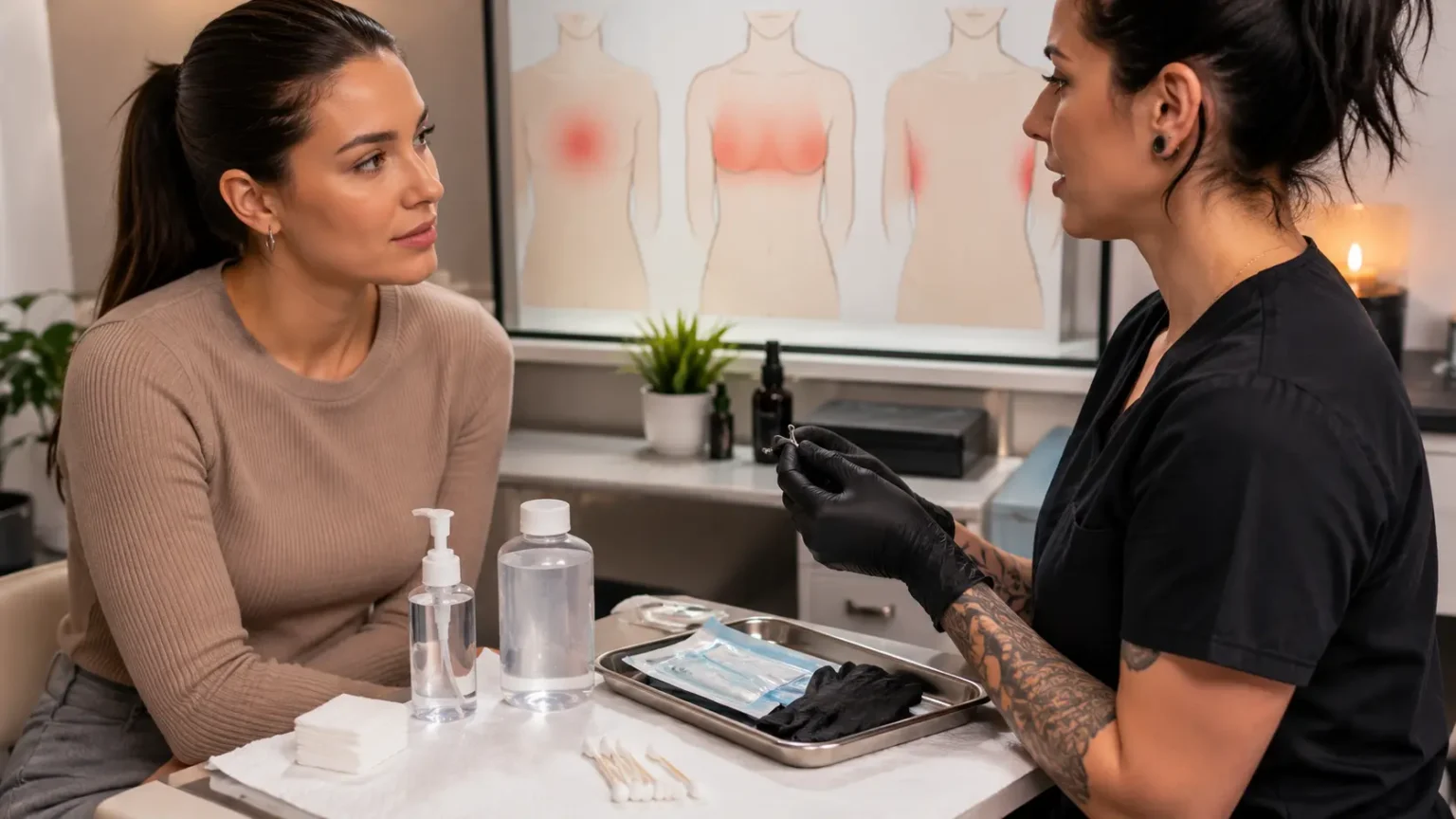
The environment and technique are important as well. A reputable piercing studio should follow appropriate hygiene and sterilization practices, use sterile equipment, and provide clear aftercare instructions. Choosing an experienced piercer is one of the most important steps you can take because correct placement, quality jewelry, and proper technique can reduce avoidable complications.
How Painful Is a Nipple Piercing?
Nipple piercing pain is highly individual. The nipple contains many nerve endings, so most people feel a strong, sharp sensation when the needle passes through. Fortunately, the intense part of the procedure usually lasts only a brief moment before changing into soreness, warmth, pressure, or throbbing.
Pain tolerance differs widely, which makes numbered pain ratings unreliable. One person may describe the piercing as intensely painful, while another may say it was easier than expected. Anxiety, previous piercing experience, anatomy, menstrual-cycle-related sensitivity, sleep, and the piercer’s technique can all influence how the experience feels.
If both nipples are pierced during the same appointment, the second piercing may sometimes feel more intense simply because the body is already alert to the sensation. This does not mean anything is wrong. An experienced piercer will normally allow a short pause between piercings if necessary and explain what to expect before continuing.
Pain afterward is usually more of a tenderness than the sharp sensation experienced during the procedure. Clothing rubbing against the area, accidentally bumping the jewelry, or sleeping directly on the chest can temporarily increase soreness. Significant or progressively worsening pain days later is different and may indicate irritation or infection rather than ordinary healing.
What Does a Nipple Piercing Feel Like Afterwards?
Immediately after the procedure, the nipple may feel warm, tender, swollen, or unusually sensitive. A small amount of spotting or minor bleeding can occur because the needle has passed through vascular tissue. These early changes are generally expected as the body begins responding to the new wound.
During the first few days, some people notice mild throbbing or discomfort when clothing touches the piercing. A soft, clean shirt or supportive garment may reduce accidental movement, although the best choice depends on personal comfort. The main objective is to minimize rubbing and snagging without creating excessive pressure.
Sensitivity may fluctuate over the following weeks. The piercing might feel comfortable for several days and then become slightly sore after exercise, sleeping awkwardly, or catching the jewelry on fabric. Temporary irritation does not necessarily mean healing has restarted from the beginning, but repeated trauma can certainly slow progress.
Pain should generally become less intense rather than progressively worse. Increasing heat, swelling, spreading redness or darkening, pus, fever, or a significant increase in pain can indicate infection and should not be dismissed as normal healing. The NHS lists worsening pain, heat, swelling, marked redness or darkening, pus, and feeling unwell among signs of an infected piercing.
How Long Does a Nipple Piercing Take to Heal?
Nipple piercings are slow-healing compared with many simpler ear piercings. The exact timeline varies between people because healing depends on anatomy, jewelry quality, aftercare, health, friction, and whether the piercing experiences repeated irritation.
An important concept is that the outside can look healed while deeper tissue is still developing. A piercing channel forms gradually around the jewelry, and the newly developing tissue can remain fragile for quite some time. Removing or changing jewelry too early can damage that tissue or cause the channel to narrow.
Healing may also be uneven. Someone might go several weeks without tenderness and then notice mild crusting or sensitivity after accidentally bumping the jewelry. This can be frustrating, but occasional setbacks are possible during a long healing process.
Rather than judging healing by appearance alone, look at the overall pattern. A well-healing piercing should become progressively calmer, with decreasing swelling, tenderness, and discharge over time. Persistent pain, repeated bleeding, ongoing substantial swelling, or worsening irritation deserves assessment from an experienced piercer or healthcare professional.
Nipple Piercing Healing Stages
The first stage begins immediately after piercing and involves inflammation. The body increases blood flow to the area and begins repairing the wound, which can produce tenderness, mild swelling, warmth, or small amounts of clear or blood-tinged fluid. These early symptoms usually become less noticeable as the initial inflammatory response settles.
The next phase involves tissue formation inside the piercing channel. New tissue develops around the jewelry while the body continues producing small amounts of normal wound fluid. This fluid can dry into light-colored crust around the jewelry, which is why crusting alone should not automatically be interpreted as infection.
As healing progresses, the piercing generally becomes less sensitive and more stable. The amount of crusting usually decreases, and ordinary movement becomes more comfortable. However, unnecessary twisting, pulling, or changing jewelry can damage the developing channel and return the piercing to a more irritated state.
The final stage involves maturation of the piercing channel. At this point the tissue is stronger and less easily damaged, but determining whether a nipple piercing has fully healed can be difficult without professional assessment. Waiting until healing is complete before making major jewelry changes is usually safer than relying on appearance alone.
What Is Normal During Nipple Piercing Healing?
Mild tenderness, temporary swelling, and limited redness or darker coloration around the entry points can be normal early in healing. The area should gradually become more comfortable rather than becoming increasingly painful.
A small amount of clear or pale whitish fluid can also occur as part of wound healing. When this dries, it may create a thin crust around the jewelry. The Association of Professional Piercers notes that some discoloration, itching, secretion of whitish-yellow fluid, and crust formation can occur during normal body-piercing healing.
Occasional sensitivity after the jewelry has been bumped or snagged may happen as well. A healing nipple piercing is not yet as resilient as mature skin, so relatively minor trauma can create temporary soreness.
What matters most is direction of change. Normal healing should trend toward less swelling, discomfort, and discharge. Symptoms that become increasingly severe, spread into surrounding breast tissue, or are accompanied by systemic illness should be treated differently from ordinary healing changes.
Nipple Piercing Aftercare: How to Clean It
Good nipple piercing aftercare focuses on gentle cleaning rather than repeatedly disinfecting or scrubbing the wound. The Association of Professional Piercers recommends sterile saline wound wash containing 0.9% sodium chloride for body-piercing aftercare and no longer recommends mixing homemade salt solutions because they can easily become too concentrated.
Before touching the piercing for any necessary reason, wash your hands thoroughly. In most cases, there is no benefit to handling the jewelry repeatedly. Spray or rinse the piercing with appropriate sterile saline and allow softened crust to rinse away rather than scraping aggressively around the holes.
Pat the area dry with clean disposable material if needed, or allow it to air dry. Reusable cloth towels can catch on jewelry and may carry bacteria if they are not completely clean. Avoid rubbing the area vigorously because friction can irritate developing tissue.
Cleaning more aggressively does not necessarily make the piercing heal faster. Excessive washing can dry and irritate the skin, while strong chemicals can damage new tissue. Consistency and gentleness are more useful than attempting to keep the piercing chemically sterile throughout the day.
Should You Use Salt Water on a Nipple Piercing?
Saline is commonly recommended, but the type matters. A commercially packaged sterile wound wash containing 0.9% sodium chloride is generally preferable because its concentration is controlled and the product remains sterile until used appropriately.
Homemade salt water used to be common aftercare advice, but accurately measuring an isotonic concentration at home is difficult. A solution that contains too much salt can dry or irritate the healing tissue, potentially making soreness and crusting worse.
Contact lens solutions, eye drops, and multi-ingredient saline products should not automatically be substituted for wound wash. The Association of Professional Piercers specifically distinguishes sterile wound-wash saline from products intended for other purposes.
If sterile saline is temporarily unavailable, follow the advice of your professional piercer rather than improvising with concentrated salt, alcohol, or harsh antiseptics. The goal is to support the body’s healing process rather than repeatedly exposing the new piercing to irritating products.
What Should You Avoid During Nipple Piercing Healing?
Avoid unnecessary twisting, rotating, pulling, or sliding of the jewelry. Older piercing advice sometimes recommended rotating jewelry regularly, but movement can disturb delicate new tissue and introduce contamination from the hands.
Friction should also be minimized. Tight or rough clothing, accidental snags, vigorous contact, and repetitive pressure can keep the area irritated. Athletes may need to think carefully about sports equipment, compression clothing, and activities where the chest is likely to be hit.
Avoid applying cosmetics, lotions, body sprays, or other unnecessary products directly around the healing holes. Even products that are safe on intact skin can irritate an open or recently formed piercing channel.
Swimming in pools, lakes, hot tubs, or other shared bodies of water may expose a healing piercing to microorganisms. The Association of Professional Piercers advises protecting healing piercings from submersion in bodies of water such as pools, lakes, and hot tubs while the piercing is still vulnerable.
Should You Twist Nipple Piercing Jewelry While Cleaning?
No routine twisting is required simply to keep the piercing from “sticking.” The new channel develops around the jewelry naturally, and repeatedly rotating the bar can tear fragile tissue that is trying to stabilize.
Movement also transfers whatever is on the exposed portion of the jewelry into the healing channel. Even after handwashing, unnecessary handling creates additional opportunities for contamination.
If dried material has collected around the jewelry, use sterile saline to soften it first. Allow loose debris to rinse away naturally rather than forcing the jewelry backward and forward to remove every visible crust.
If jewelry seems embedded, unusually tight, or difficult to move because swelling has increased, do not force it. Contact your piercer promptly because jewelry length may need evaluation, particularly if the ends are pressing deeply into the tissue.
Can You Shower With a New Nipple Piercing?
Normal showering is generally compatible with nipple-piercing healing. Clean running water can help rinse the area without the prolonged exposure associated with soaking in a bathtub.
Allow water to run over the chest naturally rather than aiming an extremely forceful stream directly at the piercing. When using shampoo, conditioner, or body wash, try to prevent concentrated product from sitting around the piercing holes.
Rinse the area thoroughly before leaving the shower so soap residue does not remain on the jewelry or healing tissue. Strongly fragranced products may be particularly irritating if repeatedly trapped around the piercing.
After showering, dry gently rather than rubbing with a towel. Towels can snag jewelry surprisingly easily, and an accidental pull can cause immediate pain, bleeding, or irritation even when healing had otherwise been progressing normally.
Can You Sleep on a New Nipple Piercing?
Sleeping directly on a fresh nipple piercing can create pressure, friction, and jewelry movement. If you normally sleep on your stomach, switching temporarily to your back or side may reduce soreness and irritation.
People who move frequently during sleep may find that a comfortable shirt or supportive garment prevents jewelry from catching on bedding. The right option should feel secure without compressing the nipple excessively.
Clean bedding is useful during healing because the piercing can come into prolonged contact with sheets and clothing during the night. Regularly changing pillowcases and bed linen is a simple hygiene measure.
If you accidentally sleep on the piercing and wake with mild temporary tenderness, that does not automatically mean serious damage occurred. Check for unusual bleeding, major swelling, jewelry displacement, or persistent pain and avoid repeating the pressure while the area settles.
Nipple Piercing Jewelry: What Material Is Best?
Jewelry quality is an important part of healing. Poor-quality metals may contain substances that trigger irritation or allergic contact dermatitis, making the piercing seem constantly inflamed even when there is no infection.
Implant-grade titanium is commonly used for body piercings because it is lightweight and suitable for many people with metal sensitivities. Other materials may also be appropriate depending on their exact composition and manufacturing quality, which is why discussing jewelry specifications with a knowledgeable piercer is preferable to choosing only by appearance or price.
Nickel deserves particular attention because it is a common cause of allergic contact dermatitis. The American Academy of Dermatology notes that nickel in jewelry is a frequent trigger of allergic skin reactions and recommends choosing jewelry that avoids problematic nickel exposure when sensitivity is present.
The finish of the jewelry matters in addition to the metal itself. Smooth, properly polished jewelry creates less friction against healing tissue than rough or poorly manufactured pieces. Quality jewelry should also fit the anatomy rather than squeezing the nipple or moving excessively.
Barbell vs Ring for a New Nipple Piercing
Straight barbells are often preferred as initial jewelry because they allow swelling while keeping the piercing relatively stable. Their movement pattern is generally more predictable than a ring that can rotate and shift continuously.
Rings may create additional movement and can catch on clothing more easily. They may be appropriate for some healed nipple piercings, but changing jewelry should be based on anatomy, healing progress, and professional advice rather than simply preference during the early stage.
Initial barbells are sometimes longer than the jewelry eventually needed because the piercing needs room to swell. Once swelling has fully settled, excess length can itself create problems by allowing the bar to move or snag unnecessarily.
A professional piercer can determine whether downsizing is appropriate. Trying to install shorter jewelry too soon risks compressing swollen tissue, while leaving excessively long jewelry indefinitely can contribute to irritation.
When Can You Change Nipple Piercing Jewelry?
Changing nipple jewelry too early is one of the easiest ways to disturb a piercing that seemed to be healing well. The outside may look calm long before the internal channel has developed enough strength to tolerate removal and reinsertion.
If the jewelry needs to be changed because the original bar is too long, damaged, or causing problems, have an experienced piercer perform the change. They can minimize trauma and determine whether the tissue is ready.
Cosmetic jewelry changes are better delayed until healing is well established. Removing jewelry for too long during healing can also allow the channel to narrow surprisingly quickly, which may make reinsertion difficult or cause additional damage.
Do not force jewelry through a piercing that seems to have partially closed. Forcing metal through resistant tissue can create a false passage, tearing, bleeding, or infection risk. A professional piercer can assess whether the channel remains open.
Nipple Piercing Swelling: What Is Normal?
Mild swelling shortly after piercing is expected because tissue has been intentionally punctured. This swelling should remain relatively localized and gradually decrease rather than expanding into the surrounding breast.
The initial jewelry needs enough space to accommodate swelling. If the ends of a barbell begin pressing into the nipple or appear to be sinking into the tissue, the jewelry may be too short for the amount of swelling present.
Swelling that suddenly increases after the piercing had been improving may reflect irritation from trauma, tight clothing, jewelry pressure, or infection. Consider what happened recently, but do not automatically assume every change is harmless.
Warm, painful swelling spreading beyond the immediate piercing site is more concerning. Breast infections such as mastitis can cause a hot, painful swollen area, and the NHS notes that infection can sometimes enter through a nipple piercing.
Is Nipple Piercing Discharge Normal?
A small amount of pale or clear wound fluid can occur during normal healing. This fluid can dry into a light crust around either opening of the piercing. Normal healing secretion is generally different from thick pus associated with infection.
The amount should generally decrease as healing progresses. Occasional small amounts may reappear after the jewelry has been irritated or bumped, particularly before the channel has fully matured.
Do not squeeze the nipple simply to see whether fluid comes out. Repeated pressure can irritate the piercing and make discharge more likely, creating a cycle where monitoring itself becomes the source of continued inflammation.
Thick yellow or green discharge, especially when accompanied by increasing pain, heat, swelling, redness or darkening, or feeling unwell, is more suspicious for infection. These symptoms warrant medical assessment rather than repeated home cleaning alone.
What Does an Infected Nipple Piercing Look Like?
An infected piercing usually becomes increasingly inflamed rather than slowly improving. The area may become more swollen, painful, hot, or intensely red on lighter skin, while deeper skin tones may show darkening, warmth, or swelling more prominently.
Pus may drain from the piercing. It can appear white, yellow, or green and may have an unpleasant smell. Minor pale crust alone is not necessarily infection, so the overall pattern matters more than color by itself.
Systemic symptoms make infection more concerning. Feeling feverish, chilled, shivery, weak, or generally unwell suggests the problem may extend beyond simple localized irritation. The NHS includes these symptoms among warning signs for infected piercings.
A breast lump, rapidly expanding swelling, severe pain, or a localized pocket of infection may indicate an abscess. Breast abscesses can require antibiotics and drainage, so significant worsening should not be managed only through saline rinses.
What Should You Do If a Nipple Piercing Is Infected?
Seek medical advice if you suspect a genuine infection, particularly when symptoms are worsening or spreading. A clinician may need to determine whether antibiotics or another treatment is appropriate.
Do not automatically remove the jewelry before seeking guidance. If infection is present, removing jewelry can sometimes allow the outer openings to close while infection remains trapped deeper within the tissue. The NHS advises leaving jewelry in unless a doctor tells you to remove it.
Continue reasonable hygiene while arranging care, but avoid repeatedly treating the area with alcohol, hydrogen peroxide, or strong antiseptics. Irritating tissue that is already inflamed can worsen discomfort and interfere with healing.
Medical evaluation is especially important if you develop fever, chills, rapidly spreading inflammation, a painful breast lump, or significant pus. These symptoms are more serious than ordinary piercing irritation and should not be treated as something you simply need to “wait out.”
Irritated Nipple Piercing vs Infection
Irritation and infection can look similar at first, but their patterns often differ. Irritation frequently follows a clear mechanical trigger such as catching the jewelry, sleeping on the piercing, using harsh products, or wearing jewelry that moves excessively.
An irritated piercing might become temporarily red, sore, or crusty but gradually settles when the source of irritation is removed. Systemic illness is not typical with simple mechanical irritation.
Infection is more concerning when pain, warmth, swelling, or discharge progressively increases. Spreading inflammation, thick pus, fever, chills, or feeling generally unwell should shift the concern away from simple irritation.
Metal sensitivity can create another confusing presentation. Nickel allergy can cause an itchy, inflamed rash where jewelry touches the skin, and jewelry is a common source of nickel exposure. If irritation persists despite otherwise appropriate care, jewelry material deserves consideration.
Can Nipple Piercings Cause Allergic Reactions?
Yes. Jewelry can cause allergic contact dermatitis, particularly when it contains nickel or another metal to which the person is sensitive. Symptoms may include itching, redness or darker discoloration, rash, flaking, or persistent irritation.
Allergic reactions can be mistaken for infection because the tissue may look inflamed and occasionally weep. However, allergy tends to be strongly associated with contact with the jewelry rather than producing the same pattern of spreading warmth, pus, and systemic illness seen with bacterial infection.
The American Academy of Dermatology identifies nickel as one of the most common causes of allergic contact dermatitis and specifically notes jewelry as an important exposure source.
If metal sensitivity is suspected, speak with your piercer or healthcare professional before simply removing the jewelry. Switching to an appropriate high-quality material may solve the problem while preserving the piercing, depending on how well the tissue is otherwise healing.
What Is Nipple Piercing Rejection?
Piercing rejection occurs when the body gradually pushes jewelry toward the surface instead of maintaining a stable channel around it. The piercing may appear increasingly shallow, and more of the bar can become visible over time.
Migration can happen before full rejection. Jewelry placement slowly changes because the tissue surrounding it is unable to maintain its original position. Poor placement, unsuitable anatomy, repeated trauma, excessive jewelry pressure, or other factors may contribute.
Unlike an infection, rejection does not necessarily cause pus or fever. The tissue may instead become thin, irritated, or scarred as the jewelry moves toward the surface.
If you suspect migration or rejection, consult a reputable piercer promptly. Continuing to leave jewelry in tissue that has become extremely thin can result in tearing and more noticeable scarring.
Nipple Piercing Bumps and Scar Tissue
Small bumps near piercing openings can develop for several reasons, including repeated irritation, friction, pressure, or scar tissue. Not every bump is an infection, and squeezing it can make the problem worse.
Hypertrophic scar tissue may remain close to the original wound and appear raised or firm. Some people are more prone to excessive scar responses than others.
Persistent bumps can also result from jewelry that is too long, too short, poorly angled, or made from a material that irritates the skin. Correcting the mechanical cause is often more important than applying multiple topical products.
Have unusual or growing scar tissue assessed professionally, particularly if you have a personal or family history of keloids. A dermatologist can help distinguish different types of scars and recommend appropriate treatment when needed.
Can Nipple Piercings Cause Permanent Scars?
Any piercing can leave some degree of permanent mark because it creates a channel through the skin. Even after jewelry is removed and the opening closes, small dots or slight changes in texture may remain.
More noticeable scarring becomes more likely when the piercing has experienced migration, rejection, significant trauma, infection, or repeated attempts to repierce the same damaged tissue.
Picking crusts, squeezing bumps, or allowing jewelry to tear through thinning tissue can also increase tissue damage. Gentle aftercare and early attention to complications may help limit unnecessary scarring.
People who know they develop prominent scars should discuss this with an experienced piercer before proceeding. Individual healing biology matters, and no professional can guarantee that a body piercing will leave absolutely no visible mark.
Can Nipple Piercing Change Sensitivity?
Nipple sensation can change after piercing, but the direction and degree vary considerably. Some people report increased sensitivity because jewelry creates additional movement or stimulation, while others notice little difference.
Temporary changes in sensation can also occur during healing because swelling and inflammation affect how the area feels. This should not necessarily be interpreted as a permanent change while the piercing is still recovering.
Rarely, significant nerve or tissue damage could potentially reduce sensation. Correct anatomical placement by an experienced professional helps minimize unnecessary injury.
People considering a nipple piercing primarily because they hope it will reliably increase sensitivity should understand that the result cannot be predicted. Aesthetic outcomes are more controllable than changes in sensory experience.
Nipple Piercing and Breastfeeding
Many people can breastfeed after having nipple piercings, although experiences vary. Piercing can potentially create scar tissue or affect individual milk ducts, but a previous healed piercing does not automatically prevent breastfeeding. Cleveland Clinic notes that many people with previous nipple piercings can still breastfeed successfully.
Jewelry should not remain in place while a baby is nursing. It can interfere with latch and presents a choking risk if part of the jewelry becomes loose or detached.
Pregnancy also changes breast and nipple tissue, and swelling or growth can make existing jewelry uncomfortable. Anyone who becomes pregnant with nipple jewelry should discuss timing of removal with their piercer and maternity healthcare team.
If breastfeeding problems occur after previous nipple piercing, a lactation professional can assess milk transfer and latch rather than assuming the piercing is automatically responsible. Breastfeeding depends on multiple anatomical and physiological factors.
Should You Get a Nipple Piercing During Pregnancy?
Pregnancy is generally not an ideal time to create a new nipple piercing because breast tissue is changing and the body will need to heal a fresh wound while preparing for breastfeeding.
A new piercing can take a long time to stabilize, while pregnancy-related breast enlargement can change how the jewelry fits. A bar that initially had adequate space may later become tight or uncomfortable.
There is also little benefit in creating a new nipple wound shortly before breastfeeding, when jewelry would ultimately need to be removed during nursing. Allowing piercing tissue to mature well before pregnancy is a more practical situation when possible.
Anyone who already has nipple piercings and becomes pregnant should discuss them with appropriate professionals rather than waiting until jewelry becomes embedded or painful. Individual anatomy and timing will influence the best approach.
Can You Exercise With a New Nipple Piercing?
Exercise does not automatically need to stop completely after piercing, but activities that create friction, impact, heavy sweating, or pressure against the chest can cause irritation.
Running and high-impact exercise may create uncomfortable movement, particularly during the first days. A clean, supportive garment may reduce bouncing and accidental contact as long as it does not press painfully against the jewelry.
Contact sports create additional concerns because a blow to the chest or snagged barbell can cause substantial trauma. Athletes should discuss practical protection with their piercer before returning to activities where the jewelry may catch on clothing or equipment.
After exercise, shower and clean the area according to your normal aftercare routine rather than repeatedly scrubbing because you have sweated. Sweat itself does not require aggressive disinfection, and overcleaning can create its own irritation.
Can You Swim With a New Nipple Piercing?
Swimming is best approached cautiously during the healing period because pools, lakes, rivers, hot tubs, and oceans can expose an open or immature piercing to microorganisms.
Chlorinated water is not sterile, and chlorine itself can also be irritating to sensitive healing tissue. Hot tubs may be particularly problematic because warm shared water can support microbial growth.
The Association of Professional Piercers advises avoiding submerging healing piercings in bodies of water such as pools, oceans, lakes, and hot tubs or using an appropriate waterproof protective barrier when exposure cannot be avoided.
If your lifestyle involves frequent swimming, consider timing the piercing for a period when you can realistically follow healing precautions. Planning ahead is easier than repeatedly exposing a fresh piercing and hoping irritation does not occur.
Can You Remove a Nipple Piercing Temporarily?
A healing nipple piercing can narrow or close if jewelry is removed, sometimes much faster than expected. The younger the piercing, the less reliable the channel usually is without jewelry.
Even long-established piercings can shrink when jewelry is removed for extended periods. How quickly this happens varies greatly between individuals, so nobody can guarantee that a particular piercing will remain open.
If temporary removal is required for a medical procedure or another important reason, speak with your piercer beforehand. In some situations a suitable nonmetallic retainer may be possible, although medical requirements always take priority.
Do not repeatedly remove and reinsert jewelry during healing for convenience. Each reinsertion can damage the developing channel and introduce irritation or contamination.
What Happens If You Decide You No Longer Want It?
If a healthy, fully healed nipple piercing is no longer wanted, jewelry can usually be removed and the channel allowed to close naturally. The amount of closure varies depending on how long the piercing has existed.
A small visible mark may remain after closure. Some people retain a tiny opening or indentation even years after removing jewelry, while others notice relatively little evidence of the old piercing.
If the piercing is actively infected, do not remove the jewelry without medical guidance. Closing the surface while infection remains underneath may complicate drainage, which is why infected piercings need a different approach from healthy unwanted piercings.
If jewelry is stuck, embedded, or difficult to unscrew, avoid forceful removal. A professional piercer or healthcare professional can help prevent unnecessary tearing and tissue damage.
How to Choose a Safe Nipple Piercer
Start by looking for a professional who performs nipple piercings regularly rather than someone who only occasionally offers the procedure. Experience with anatomy, placement, jewelry sizing, and complication management matters.
The studio should appear organized and hygienic, and your piercer should be willing to explain sterilization practices. Sterile single-use needles and appropriately processed reusable equipment are fundamental safety expectations.
Jewelry information should also be transparent. A professional piercer should be able to explain what material is being inserted, why that size is appropriate, and whether a later downsizing appointment may be necessary.
Pay attention to communication. A good piercer should discuss anatomy, healing expectations, risks, aftercare, and your questions without pressuring you. You should feel comfortable stopping the process at any point before the piercing is performed.
Common Nipple Piercing Aftercare Mistakes
One frequent mistake is overcleaning. People sometimes assume that a fresh piercing must be disinfected repeatedly with alcohol, peroxide, or strong antiseptic products. These substances can irritate healing tissue rather than speeding recovery.
Another mistake is touching or rotating the jewelry throughout the day. The more frequently you handle a healing piercing, the greater the opportunity for mechanical trauma and contamination.
Changing jewelry too early is another common cause of setbacks. A piercing that looks calm externally may still contain delicate immature tissue inside the channel.
Finally, people sometimes ignore mechanical problems because they assume every irritation is simply “part of healing.” Jewelry that is embedding, excessively long, poorly fitted, or migrating should be assessed rather than tolerated indefinitely.
When Should You See a Doctor?
Seek healthcare advice when nipple piercing symptoms become progressively worse instead of improving. Increasing heat, severe swelling, spreading redness or darkening, significant pain, or thick pus are important signs to take seriously.
Fever, chills, shivering, or feeling generally unwell suggest the body may be responding to more than a localized irritation. These symptoms deserve prompt evaluation rather than additional home cleaning.
A painful lump or swelling extending into the breast also needs attention because infections can sometimes progress into mastitis or an abscess. Nipple piercing is one potential entry point for infection into breast tissue.
Seek urgent care if symptoms progress rapidly, you feel severely unwell, or redness and swelling are spreading quickly. Early treatment of a significant infection is much easier than waiting for a complication to become advanced.
How to Make Nipple Piercing Healing Easier
The simplest strategy is to create an environment in which the tissue can heal with minimal interference. Use quality jewelry, follow gentle saline-based aftercare, and avoid unnecessary movement.
Plan clothing around comfort during the early stages. Smooth fabrics that do not catch on jewelry can make everyday activities and sleep considerably easier.
Be patient with the timeline. Nipple piercings often require more healing time than people expect, and attempting to accelerate the process by cleaning more aggressively or changing jewelry early can have the opposite effect.
Finally, use professional help when something does not seem right. A reputable piercer can address jewelry fit and mechanical irritation, while a healthcare professional should evaluate suspected infections, significant breast swelling, fever, or other medical concerns.
Final Thoughts on Nipple Piercing
A nipple piercing can be a rewarding form of body modification, but it requires more commitment to healing than the brief piercing procedure might suggest. Initial pain usually passes quickly, while the channel itself takes much longer to become stable.
Good aftercare is generally straightforward: keep handling to a minimum, use appropriate sterile saline, prevent unnecessary friction, and leave properly fitted jewelry in place while the tissue heals. The Association of Professional Piercers specifically recommends sterile 0.9% sodium chloride wound wash rather than homemade salt solutions for routine body-piercing aftercare.
Understanding the difference between normal healing and complications is equally important. Mild tenderness and light crusting can be expected, while worsening heat, swelling, pain, pus, fever, or spreading inflammation can indicate infection and deserve medical assessment.
The safest experience begins before the piercing happens. Choose an experienced piercer, use high-quality jewelry, understand the long healing process, and be prepared to protect the area from unnecessary trauma. With realistic expectations and appropriate care, many nipple piercings heal successfully and remain comfortable long term.
Frequently Asked Questions About Nipple Piercing
How Painful Is a Nipple Piercing?
Most people experience a brief sharp pain during the procedure followed by tenderness or throbbing. Pain tolerance varies, and soreness should generally become less intense as the piercing begins healing.
How Long Does a Nipple Piercing Take to Heal?
Nipple piercings typically require a long healing period, and the outside may look healed before the internal channel is fully mature. Avoid changing jewelry early simply because tenderness has disappeared.
What Should I Use to Clean a Nipple Piercing?
A packaged sterile wound wash containing 0.9% sodium chloride is commonly recommended. Avoid harsh chemicals, excessive cleaning, and homemade solutions that may contain too much salt.
How Can I Tell If My Nipple Piercing Is Infected?
Increasing pain, warmth, swelling, pronounced redness or darkening, thick pus, fever, chills, or feeling unwell can indicate infection. Seek healthcare advice if these symptoms develop or worsen.
Can You Breastfeed After Having Nipple Piercings?
Many people can breastfeed after nipple piercings, although individual experiences vary. Jewelry should be removed while nursing because it may interfere with latch and can present a choking hazard for the baby.