Seated leg lifts are a simple lower-body exercise that can help strengthen the muscles around your hips, thighs, and knees without requiring complicated equipment. Because the movement can be performed from a chair, it works well for beginners, older adults, office workers, and people looking for a low-impact exercise option.
Although seated leg lifts appear easy, proper technique matters if you want to get the most from the exercise. Controlling the movement, maintaining good posture, and progressing gradually can make the exercise more effective while reducing unnecessary strain. Understanding the correct form, benefits, common mistakes, and useful variations can help you add seated leg lifts safely to your routine.
What Are Seated Leg Lifts?
Seated leg lifts are performed while sitting upright and extending or raising one or both legs using controlled muscle effort. Depending on the variation, the movement can emphasize the quadriceps, hip flexors, abdominal muscles, and surrounding stabilizers. It requires very little space, making it convenient for home workouts, rehabilitation programs, or movement breaks during the workday.
A basic seated leg lift usually involves sitting near the front of a stable chair with both feet on the floor. One leg is slowly straightened or lifted until it reaches a comfortable position before being lowered again. The movement should remain smooth rather than using momentum to swing the leg upward.
Different versions of seated leg lifts can target slightly different muscles. Straight-leg raises place more demand on the hip flexors and quadriceps, while knee-extension variations emphasize the front of the thigh. Adding ankle weights or resistance bands can increase difficulty once basic bodyweight repetitions become comfortable.
Muscles Worked During Seated Leg Lifts
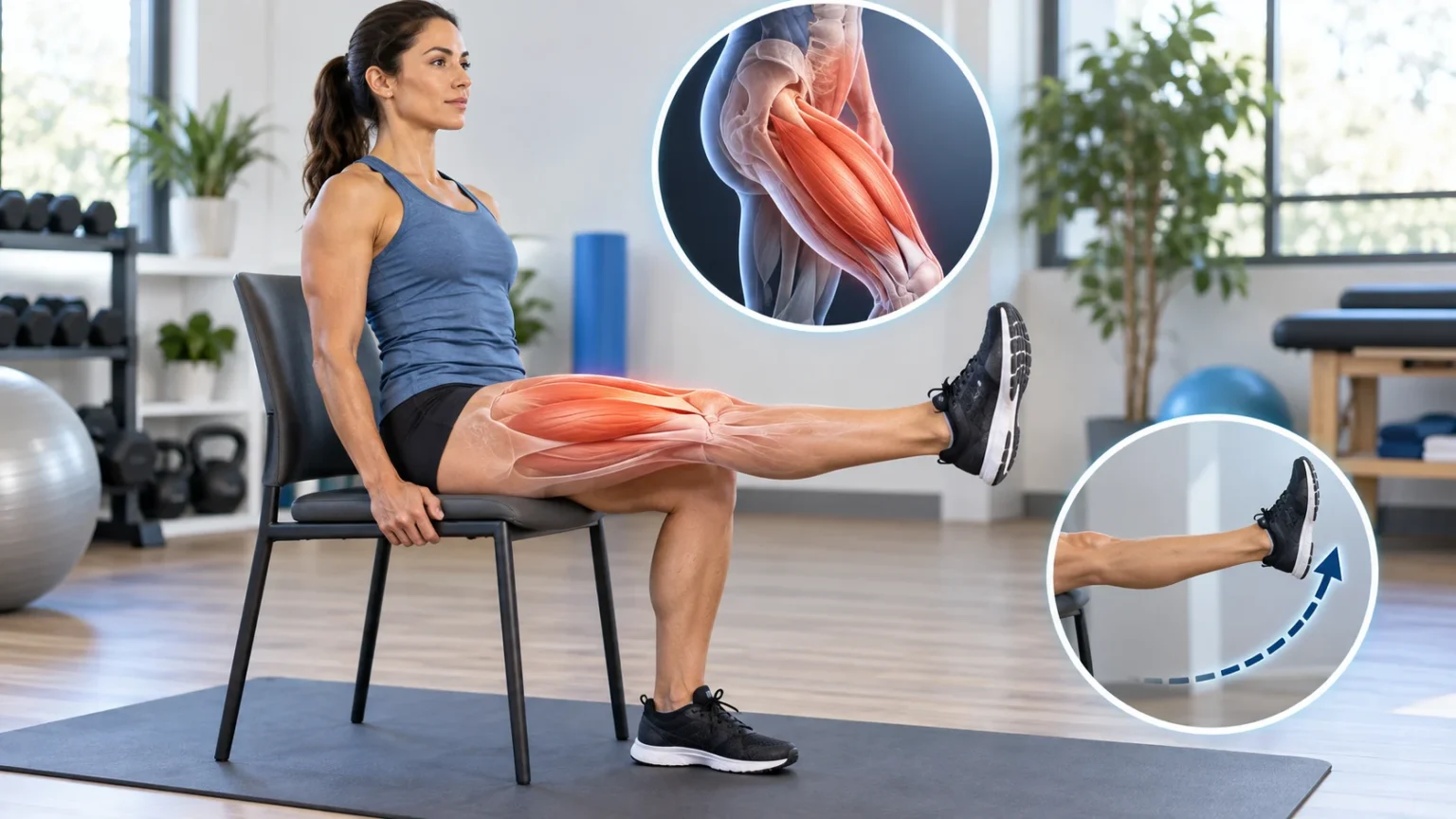
The quadriceps are among the main muscles used during seated leg lifts, particularly when you straighten the knee. These muscles run along the front of the thigh and help with standing, walking, climbing stairs, and controlling knee movement. Strengthening them can support many everyday activities that require lower-body stability and endurance.
The hip flexors also become active when the entire leg is lifted rather than simply straightened at the knee. These muscles help bring the thigh toward the torso and contribute to walking, running, and stepping movements. Controlled leg lifts can provide a convenient way to work these muscles without standing or using gym equipment.
Your abdominal and postural muscles may also engage to keep the torso steady while the leg moves. Sitting upright without leaning backward requires the trunk to provide support. Although seated leg lifts are not primarily a core exercise, maintaining good posture can encourage better control throughout the movement.
How to Perform Seated Leg Lifts Correctly
Start by sitting on a sturdy chair that does not roll or slide easily. Place your feet flat on the floor about hip-width apart and sit tall with your shoulders relaxed. Keep your back in a comfortable neutral position rather than rounding forward or leaning heavily against the chair.
Slowly extend one leg until the knee is comfortably straight while keeping the thigh controlled. Pause briefly at the top and gently tighten the muscles at the front of your thigh. Lower the foot back toward the floor in a slow, controlled manner instead of allowing the leg to drop suddenly.
Repeat the movement for the desired number of repetitions before switching sides. Beginners might start with eight to twelve repetitions per leg and gradually increase as the exercise becomes easier. Focus on smooth movement and comfortable muscle effort rather than trying to lift the leg as high or as quickly as possible.
Benefits of Seated Leg Lifts
One of the biggest benefits of seated leg lifts is improved lower-body muscle strength. The exercise can strengthen the quadriceps and hip muscles that contribute to everyday movements such as standing from a chair, climbing stairs, and walking. Stronger surrounding muscles may also improve confidence during common daily activities.
Seated leg lifts can be particularly useful for people who prefer low-impact exercises. Because the movement is performed while sitting, it does not require supporting your full body weight through the legs. This can make the exercise accessible to beginners or individuals gradually rebuilding strength after a period of reduced activity.
The movement is also convenient and easy to perform almost anywhere. You can do seated leg lifts at home, at work, or while traveling without specialized equipment. Short exercise sessions throughout the day can help reduce long periods of inactivity and provide a simple way to maintain regular movement.
How Seated Leg Lifts Support Knee Strength
The quadriceps play an important role in supporting and controlling movement around the knee. Seated leg lifts that involve knee extension activate these muscles and can help improve their strength over time. Strong quadriceps are useful for movements such as walking, standing, squatting, and controlling your body when going down stairs.
Strength around the knee can be especially important after periods of inactivity because muscles can lose capacity when they are not regularly challenged. Controlled strengthening exercises allow the muscles to gradually tolerate more work. However, exercise should be matched to your current ability rather than progressed too aggressively.
If you experience persistent pain behind the knee, avoid assuming that weakness is always the cause. Several structures can produce discomfort in that area, so unexplained, severe, or worsening symptoms may need professional assessment before you significantly increase exercise intensity.
Seated Leg Lifts for Hip Strength and Mobility
Certain seated leg lift variations activate the hip flexor muscles that lift the thigh toward the body. These muscles contribute to walking, stepping over objects, climbing stairs, and moving the leg forward. Regular strengthening can help maintain the capacity needed for these movements, particularly for people who spend much of the day sitting.
Long periods of sitting can sometimes make the hips feel stiff or inactive. Performing gentle seated movements can provide a convenient way to move the hip joint without requiring an entire workout. Alternating between leg lifts, short walks, and other comfortable movements can help break up prolonged periods in the same position.
Hip strength should still be developed in multiple directions rather than relying on one exercise alone. Standing exercises, bridges, side-leg movements, and resistance training may eventually complement seated leg lifts. A varied routine generally prepares the hips more effectively for the different movements required during everyday life.
Common Mistakes to Avoid
Leaning too far backward is one of the most common mistakes during seated leg lifts. This often happens when the leg feels too heavy to raise using controlled muscle effort. Leaning can reduce the intended challenge to the target muscles and may encourage people to use momentum rather than strength.
Another mistake is lifting or lowering the leg too quickly. Fast movements can make the exercise feel easier because momentum begins doing part of the work. Slowing the repetition gives the muscles more time under tension and makes it easier to notice whether you are maintaining comfortable alignment throughout the movement.
Trying to push through sharp pain is also unnecessary. Mild muscular effort or fatigue can be normal during strengthening, but stabbing pain, increasing joint discomfort, numbness, or other unusual symptoms should not be ignored. Reduce the movement range, lower the resistance, or stop the exercise if symptoms clearly worsen.
Seated Leg Lift Variations
A seated knee extension is one of the simplest variations. Sit upright and slowly straighten one knee until the leg is nearly parallel with the floor, then lower it with control. This version primarily targets the quadriceps and works well for people who are beginning to develop lower-body strength.
For a greater challenge, you can perform a seated straight-leg raise. Extend the knee first and then lift the entire straight leg slightly while maintaining an upright torso. This variation increases the demand on the hip flexors and requires greater control than a basic knee extension.
More advanced exercisers can add light ankle weights or resistance bands. Resistance should be introduced gradually because even a small amount of added weight can significantly increase the difficulty. Prioritize controlled repetitions and consistent form before increasing resistance, repetition numbers, or exercise duration.
How Many Seated Leg Lifts Should You Do?
The appropriate number of repetitions depends on your current strength, experience, and reason for performing the exercise. Beginners can often start with one or two sets of eight to twelve repetitions on each leg. The final repetitions should feel challenging enough to require effort while still allowing good technique.
As strength improves, you can gradually increase repetitions, sets, or resistance. For example, you might progress from ten repetitions to fifteen before adding a light ankle weight. Changing only one training variable at a time makes it easier to understand how your body responds to the increased workload.
More repetitions are not automatically better. Quality matters because controlled movements place more consistent demand on the target muscles. If your posture starts collapsing, your leg begins swinging, or discomfort increases, ending the set may be more useful than forcing additional repetitions with poor technique.
Tips for Getting Better Results
Perform each repetition slowly enough that you remain in control from beginning to end. A brief pause near the top of the movement can increase muscle engagement without requiring heavier resistance. Lowering the leg gradually is equally important because the muscles continue working during the downward portion of the exercise.
Consistency matters more than performing an extremely difficult session once in a while. Including seated leg lifts several times throughout your weekly exercise routine can gradually build strength and movement confidence. They can also be used as part of a broader lower-body workout alongside walking, squats, bridges, and balance exercises.
Pay attention to progression as the exercise becomes easier. If you can complete many repetitions without noticeable effort, your muscles may need a slightly greater challenge to continue adapting. Increasing resistance, slowing the movement, adding repetitions, or choosing a more difficult variation can provide gradual progression.
Who Can Benefit From Seated Leg Lifts?
Beginners can benefit because seated leg lifts require very little coordination or equipment. The seated position provides stability while allowing someone to focus on controlling the leg. This makes the exercise a practical introduction to strength training for people who are not yet comfortable with more demanding lower-body movements.
Older adults may also use seated leg exercises to maintain thigh strength and movement capacity. Strong lower-body muscles contribute to walking, standing, and many daily activities. However, anyone with significant joint problems, recent surgery, or medical restrictions should follow advice from their healthcare or rehabilitation professional.
Office workers and people with sedentary routines may find seated leg lifts particularly convenient. Performing several controlled repetitions during breaks can introduce movement without leaving the workspace. They should not replace regular walking and full-body exercise, but they can complement a more active routine.
When to Avoid or Modify Seated Leg Lifts
Seated leg lifts should be modified if the movement consistently causes sharp knee, hip, or back pain. Reducing the height of the lift, performing fewer repetitions, or switching to a simpler variation may improve comfort. Exercise does not need to be painful to strengthen muscles or produce meaningful benefits.
People recovering from surgery, fractures, major ligament injuries, or significant tendon problems should follow their rehabilitation plan before adding new exercises independently. The appropriate amount of resistance and range of motion can vary considerably between conditions. A physical therapist may recommend a modified version based on the stage of recovery.
Stop and seek appropriate medical advice if exercise produces significant swelling, unexplained weakness, numbness, locking, or rapidly worsening pain. These symptoms may require assessment rather than simply pushing through additional repetitions. Exercise is most useful when it matches the condition of the joint and the person’s current physical capacity.
How to Add Seated Leg Lifts to Your Workout
Seated leg lifts can work well near the beginning of a workout as a gentle activation exercise. Performing one or two controlled sets can prepare the quadriceps and hips before more demanding movements. They may also be useful toward the end of a session when you want additional muscle work without performing another standing exercise.
You can combine seated leg lifts with other simple exercises to create a basic lower-body routine. Chair squats, calf raises, bridges, and comfortable walking can strengthen different muscles and movement patterns. Using several exercises provides more balanced development than relying entirely on one movement.
On busy days, seated leg lifts can also be performed independently as a short movement break. Even a few minutes of activity can interrupt extended sitting and encourage you to move more frequently. The greatest long-term benefit usually comes from combining these small habits with consistent full-body physical activity.
Conclusion
Seated leg lifts are a simple and accessible exercise for strengthening the quadriceps, hip flexors, and supporting muscles of the lower body. They require minimal space and no specialized equipment, which makes them suitable for home workouts, office movement breaks, and beginner exercise routines.
Proper form makes the movement more effective. Sit tall, keep the torso controlled, raise and lower the leg slowly, and avoid using momentum. Once basic repetitions become easy, progression can come from additional repetitions, resistance, slower tempo, or more challenging variations.
The exercise should generally feel like controlled muscular work rather than sharp joint pain. If persistent knee, hip, or leg symptoms interfere with the movement, adjust the exercise or seek appropriate evaluation. Used consistently as part of a balanced routine, seated leg lifts can contribute to stronger and more confident everyday movement.
FAQs
Are seated leg lifts good for your knees?
Seated leg lifts can strengthen the quadriceps, which help support and control the knee. They should be performed within a comfortable range, especially if you already have knee pain or another diagnosed condition.
Do seated leg lifts strengthen your core?
Your core muscles help stabilize your torso during the exercise, especially when you avoid leaning backward. However, seated leg lifts mainly target the legs and hips rather than serving as a complete core workout.
How often should I do seated leg lifts?
Many people can include seated leg lifts two to four times per week, depending on their routine and recovery. Beginners should start gradually and increase volume as strength and exercise tolerance improve.
Can seniors do seated leg lifts?
Yes, seated leg lifts can be an accessible strengthening exercise for many older adults because the chair provides stability. People with significant medical or joint conditions should follow individualized advice from a qualified healthcare professional.
Should my legs be straight during seated leg lifts?
It depends on the variation. Knee extensions straighten the lower leg while the thigh stays supported, whereas straight-leg lifts involve raising the extended leg. Both versions can be useful when performed with controlled technique.