

Wall pushups are one of the simplest ways to build upper-body strength without starting on the floor. They use the same basic pushing pattern as traditional pushups but place less resistance on the arms, shoulders, chest, and core. This makes them useful for beginners, older adults, people returning to exercise, or anyone working toward stronger pushup variations.
Because your body stays more upright, wall pushups are generally easier to control and modify. You can change the difficulty simply by moving your feet closer to or farther away from the wall. This flexibility makes the exercise practical for home workouts, office movement breaks, rehabilitation-style routines, and strength training programs that need a lower-impact pushing exercise.
Good technique still matters even though wall pushups look simple. Hand placement, body alignment, breathing, and controlled movement determine how effectively the exercise trains your muscles. Learning proper wall pushup form can also create a strong foundation for progressing toward countertop pushups, incline pushups, knee pushups, and eventually standard floor pushups.
What Are Wall Pushups?
Wall pushups are a bodyweight exercise performed while standing and pressing against a stable wall. Instead of supporting most of your body weight on your hands and feet as you would during a traditional pushup, you remain upright at an angle. This reduces resistance while still training the basic movement of pushing your body away from a surface.
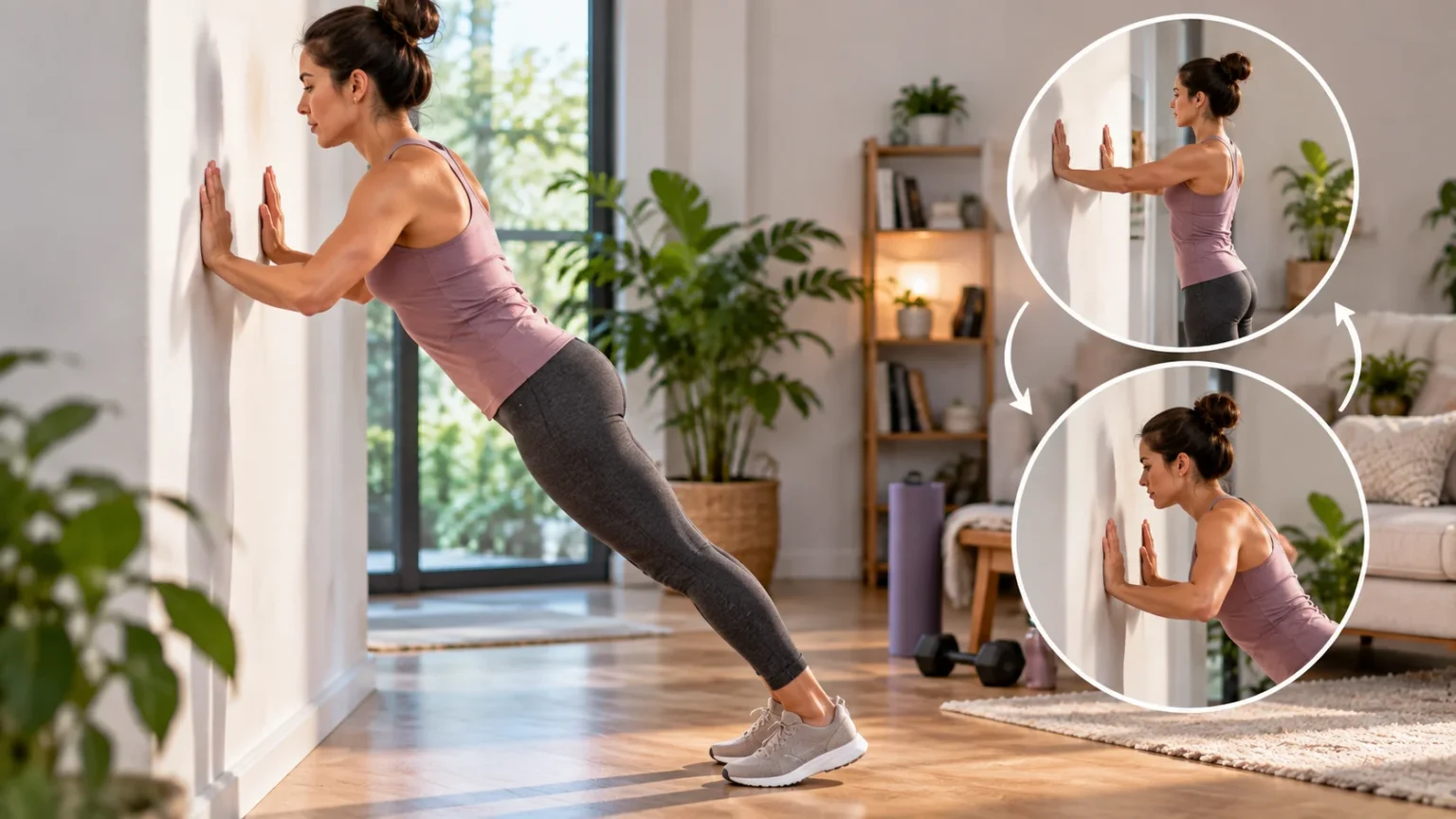
To perform the movement, you place both hands on the wall approximately shoulder-width apart and step your feet backward. You then bend your elbows and slowly bring your chest toward the wall before pressing yourself back to the starting position. The body should remain relatively straight rather than bending excessively through the hips or lower back.
Wall pushups can be adjusted for different fitness levels without requiring special equipment. Standing closer to the wall makes the movement easier, while stepping farther away increases the amount of body weight your upper body must control. This makes wall pushups especially useful when learning exercise technique before moving on to more demanding pushup variations.
Benefits of Wall Pushups
One of the main wall pushup benefits is accessible upper-body strength training. The exercise works the chest, shoulders, and triceps without requiring you to lower yourself to the floor. That can be helpful for people who currently find standard pushups too challenging or who want to practice the pushing movement with greater control.
Wall pushups can also improve confidence with bodyweight exercises. Beginners often struggle with traditional pushups because they require enough strength to support and move a significant percentage of body weight. Starting against a wall allows you to learn proper alignment, elbow control, and pressing technique before gradually increasing the difficulty.
Another advantage is convenience. Wall pushups can be performed almost anywhere that has a stable wall and enough space to stand safely. They require no weights, machines, or gym membership, making them easy to include in home workouts, travel routines, short exercise breaks, and simple full-body fitness programs.
Muscles Worked During Wall Pushups
The chest muscles, particularly the pectorals, are among the primary muscles used during wall pushups. They help bring the upper arms forward as you press your body away from the wall. Although the resistance is lower than during floor pushups, controlled repetitions can still provide useful strength practice, especially for beginners.
Your triceps also contribute significantly to the movement. These muscles along the back of your upper arms straighten the elbows as you push away from the wall. The front portion of the shoulders assists as well, which is why maintaining comfortable elbow and hand positioning is important for keeping the exercise controlled and avoiding unnecessary shoulder strain.
Several stabilizing muscles are involved even though wall pushups mainly target the upper body. Your abdominal muscles, back, hips, and legs help keep your body aligned while you move toward and away from the wall. Light core engagement can prevent your hips from drifting forward or your lower back from excessively arching during each repetition.
How to Do Wall Pushups With Proper Form
Stand facing a sturdy wall and place your palms against it at approximately chest or shoulder height. Keep your hands about shoulder-width apart, although a slightly wider position may feel more comfortable for some people. Step backward until your arms are straight and your body forms a gentle angle toward the wall without forcing your heels to lift.
Slowly bend your elbows and allow your chest to move toward the wall. Keep your body long from your head through your hips rather than leading with your face or allowing your stomach to move forward first. Your elbows should travel at a comfortable angle rather than spreading directly outward at shoulder height.
Pause briefly when your chest approaches the wall, then press evenly through both palms to straighten your arms. Avoid snapping or locking your elbows aggressively at the top. Repeat the movement slowly, maintaining control throughout each repetition and adjusting your foot position if the exercise feels either too difficult or too easy.
Breathing and Body Alignment During Wall Pushups
Breathing normally can make wall pushups feel smoother and more controlled. A simple pattern is to inhale as you lower your chest toward the wall and exhale as you push away. Avoid holding your breath through multiple repetitions because breath-holding can make the exercise feel unnecessarily tense and may reduce your ability to maintain comfortable form.
Keep your head in a neutral position throughout the movement. Looking excessively upward can place unnecessary strain on the neck, while allowing your chin to collapse toward your chest may affect upper-body alignment. Imagine maintaining a long line from the top of your head through your spine as your elbows bend and straighten.
Your core should feel gently active rather than tightly braced. Avoid sucking your stomach inward aggressively or squeezing your glutes as hard as possible. A moderate level of tension is usually enough to keep your ribs, pelvis, and lower back organized while still allowing you to breathe naturally during each repetition.
Beginner Wall Pushup Routine
Beginners can start with one or two sets of approximately 8 to 12 controlled repetitions. Choose a distance from the wall that allows you to complete every repetition without shaking excessively or losing your body position. Rest for around 30 to 60 seconds between sets, giving your arms and shoulders enough time to recover.
Focus on movement quality rather than trying to complete as many repetitions as possible. Each repetition should look similar from beginning to end, with a controlled lowering phase and smooth press back to standing. If the final repetitions require you to twist, arch your back, or push unevenly, reduce the number of repetitions or move slightly closer to the wall.
As your strength improves, gradually increase the routine to two or three sets. You can also slow the lowering portion of each repetition to make your muscles work harder without dramatically increasing resistance. Practicing wall pushups two or three times per week can provide enough repetition for many beginners while still allowing recovery between sessions.
How to Make Wall Pushups More Challenging
The easiest way to progress wall pushups is to move your feet farther from the wall. Increasing the body angle places more resistance through your chest, shoulders, and arms. Make small adjustments rather than stepping dramatically backward, and make sure you can still keep your heels stable and your body aligned throughout the movement.
Once wall pushups become easy, you can progress to a sturdy countertop, desk, railing, or other stable elevated surface. Lowering the height of the surface gradually increases the percentage of body weight your upper body must support. This progression bridges the gap between vertical wall pushups and more demanding pushups performed closer to the floor.
You can also increase difficulty by slowing each repetition or briefly pausing near the bottom position. For example, lower yourself for three seconds, pause for one second, and then press back smoothly. Avoid rushing progression simply to reach floor pushups, because building control and strength at each level usually produces better technique later.
Common Wall Pushup Mistakes to Avoid
One common mistake is allowing the elbows to flare directly outward. This position may feel uncomfortable around the shoulders and can make it harder to maintain a smooth pushing motion. Keep your elbows at a natural angle below shoulder height, adjusting your hand position slightly if necessary to find a movement path that feels comfortable.
Another mistake is bending mainly through the hips instead of moving the body as one controlled unit. Your chest, hips, and legs should travel toward the wall together rather than leaving your lower body behind. Keeping light tension through your abdomen can help maintain alignment without turning the exercise into an overly rigid posture.
Many people also move too quickly. Dropping toward the wall and bouncing back reduces control and may make it harder to notice poor technique. Slow repetitions give your muscles more time under tension and allow you to identify whether your shoulders, wrists, elbows, or lower back are becoming uncomfortable before continuing.
Who Can Benefit From Wall Pushups?
Wall pushups are particularly useful for people beginning a strength-training routine. They provide an approachable way to develop chest, shoulder, triceps, and core strength without immediately requiring floor-level exercise. Beginners can use them to understand pushup mechanics before moving toward steeper body angles and more challenging variations.
Older adults may also find wall pushups practical because they can be performed while standing and require less effort to get into position. They can be included alongside appropriate leg, balance, mobility, and cardiovascular exercises in a broader fitness routine. Exercise choices should still reflect individual strength, balance, joint health, and medical considerations.
Wall pushups can also benefit people returning to training after an extended break. Starting with a manageable variation makes it easier to rebuild movement quality without immediately chasing previous performance levels. Athletes and experienced exercisers can even use wall pushups as part of a warm-up when they want light upper-body movement before more demanding pressing exercises.
Safety, Pain and When to Modify Wall Pushups
Wall pushups should feel challenging to the muscles without causing sharp pain. Stop or modify the exercise if you experience significant wrist, elbow, shoulder, neck, or back discomfort. Moving closer to the wall, reducing repetitions, or adjusting your hand height may make the movement more comfortable without eliminating the exercise completely.
Pay attention to your lower back and pelvic position as well. Excessively arching the lower back can occur when your feet are too far from the wall or your core cannot comfortably control the angle. If you regularly experience lower back pain radiating to the pelvis, consider getting appropriate professional guidance rather than assuming exercise technique alone explains the symptoms.
People recovering from surgery, significant injury, or a medical condition should follow any exercise restrictions provided by their healthcare professional. Wall pushups can be easier than traditional pushups, but easier does not automatically mean appropriate for every condition. Choose a variation that matches your current ability and stop if symptoms appear or become noticeably worse.
Best Practices for Better Wall Pushup Results
Consistency is more useful than doing a very large number of repetitions occasionally. Include wall pushups regularly within a balanced strength routine and give your muscles sufficient recovery between challenging sessions. Combining pushing exercises with appropriate pulling, leg, core, mobility, and cardiovascular work can help create more complete overall fitness.
Progress gradually once your current version feels comfortable. Instead of immediately adding dozens of repetitions, consider increasing the body angle, slowing your tempo, or progressing to a lower stable surface. Small increases in difficulty make it easier to maintain correct technique while continuing to challenge your muscles as strength improves.
Remember that wall pushups are not simply a temporary exercise that only beginners can use. They can serve as a warm-up, rehabilitation-style movement, light training option, or starting point within a progression system. The most appropriate version is the one that challenges your current abilities while allowing controlled movement and comfortable joint positioning.
Conclusion
Wall pushups provide an accessible way to strengthen the chest, shoulders, triceps, and supporting muscles without the difficulty of a traditional floor pushup. Their upright position allows beginners to practice the basic pushing pattern while controlling how much resistance they use. No special equipment is required beyond a secure wall and enough space to move safely.
Proper wall pushup form involves keeping your hands comfortably positioned, maintaining a long body line, bending your elbows with control, and pressing evenly through both palms. Breathing naturally and avoiding excessive lower-back arching can make the movement more comfortable. Slow, consistent repetitions are usually more useful than rushing through a high number.
Start with a manageable number of repetitions and gradually make the exercise harder as your strength develops. You can move farther from the wall, slow your repetitions, or progress to lower surfaces over time. With consistent practice and appropriate modifications, wall pushups can become a valuable part of a balanced strength-training routine.
FAQs
How many wall pushups should a beginner do?
A beginner can start with around 8 to 12 controlled repetitions for one or two sets. Choose a number that allows you to maintain good form without excessive fatigue or joint discomfort.
Do wall pushups actually build strength?
Yes, wall pushups can strengthen the chest, shoulders, triceps, and supporting muscles, particularly in beginners. As they become easier, gradually increasing the resistance is important for continued strength development.
Can I do wall pushups every day?
Some people can tolerate light wall pushups daily, but muscles still benefit from recovery after challenging sessions. Two or three strength-focused sessions per week may be a practical starting point for many beginners.
Are wall pushups easier than regular pushups?
Yes. The upright body angle means your upper body supports less of your total weight than during a floor pushup. This makes wall pushups an accessible starting variation for building strength and technique.
How do I progress from wall pushups to regular pushups?
Gradually move from wall pushups to countertop or incline pushups, then progress toward lower surfaces, knee pushups, or standard pushups. Advance only when you can complete your current variation with consistent, controlled form.