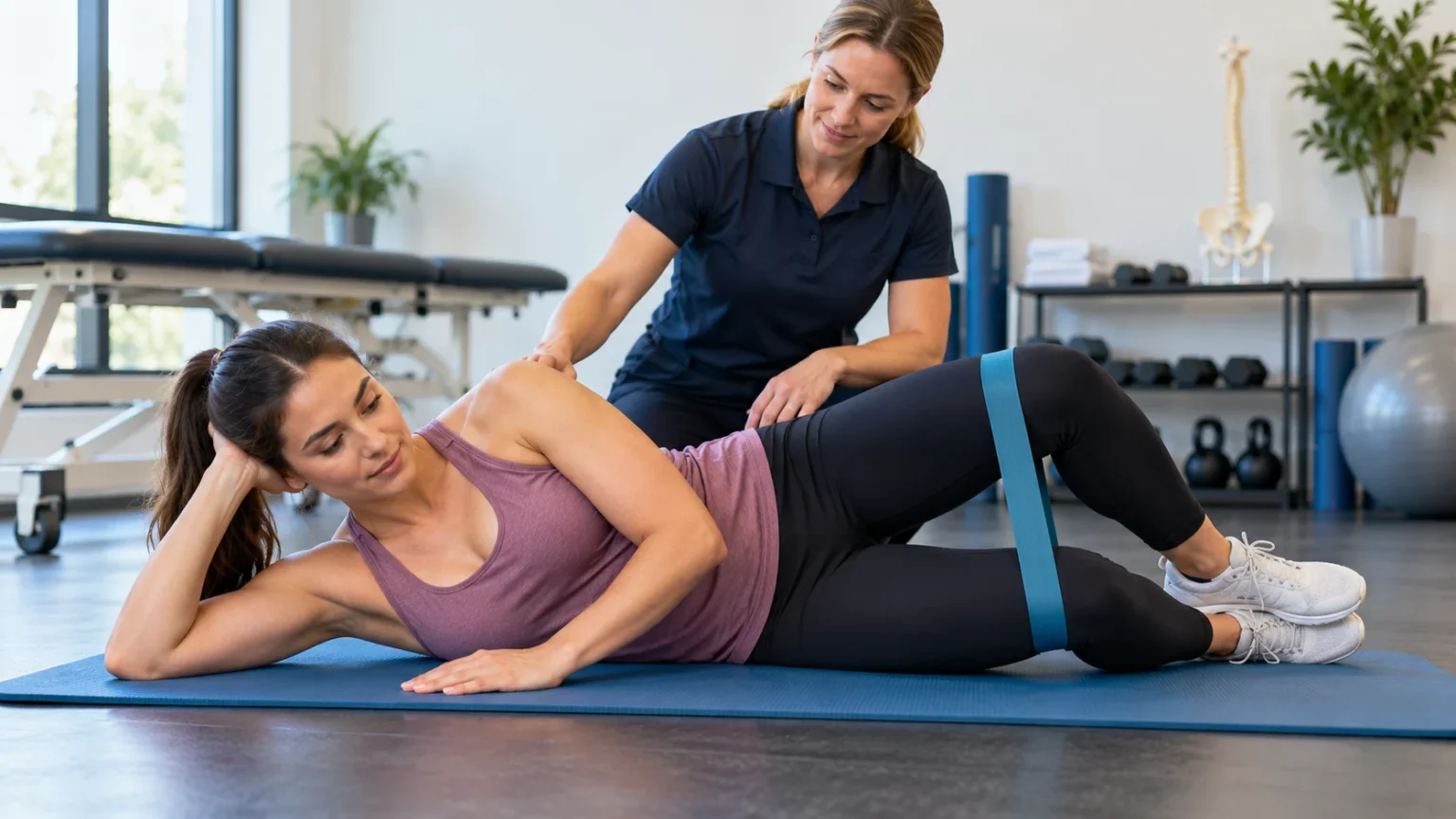
What Is the Clamshell Exercise?
The clamshell exercise is a simple strengthening movement that primarily targets the muscles around the hips and buttocks. It involves lying on your side with your knees bent and slowly lifting your upper knee while keeping your feet together. The movement resembles a clamshell opening, which explains how this popular rehabilitation exercise received its name.
Clamshells are commonly included in physical therapy programs, lower-body workouts, and hip-strengthening routines. They help activate muscles responsible for stabilizing the pelvis and controlling hip movement. Because the exercise requires minimal equipment, it can be performed at home, in a gym, or during supervised rehabilitation sessions.
Although the clamshell exercise looks easy, correct technique is important for achieving its intended benefits. Excessive hip rotation, rushed movements, and poor body positioning can reduce muscle engagement. Learning proper clamshell form helps you strengthen the targeted muscles while maintaining controlled movement and avoiding unnecessary discomfort.
What Muscles Does the Clamshell Exercise Work?
The clamshell exercise primarily targets the gluteus medius and other muscles involved in hip rotation and stabilization. The gluteus medius is located along the outer portion of the hip and helps maintain pelvic stability during movement. It plays an important role in activities such as walking, standing on one leg, and climbing stairs.
The gluteus maximus also contributes to the movement, particularly through its upper fibers. Smaller hip rotator muscles work alongside the larger gluteal muscles to control the position of the thigh. Together, these muscles help support coordinated movement around the hip joint during exercise and everyday physical activities.
The abdominal muscles and surrounding trunk stabilizers also assist by keeping the pelvis and torso steady. Although the clamshell is not primarily a core exercise, maintaining a stable body position requires some abdominal control. This combination makes the movement useful for training hip coordination and improving awareness of lower-body positioning.
Benefits of the Clamshell Exercise
One of the main benefits of the clamshell exercise is improved strength in the muscles surrounding the hips. The gluteal muscles help control leg movement and maintain stability during everyday activities. Strengthening these muscles may improve movement coordination and make activities such as walking, climbing stairs, and standing more comfortable.
Clamshells can also support pelvic stability by training muscles that control the position of the thigh. These muscles contribute to maintaining balance during movements that involve standing on one leg. Developing better hip strength and control can be useful for recreational activities, strength training, and selected rehabilitation programs.
Another advantage is that clamshells are accessible to many beginners. They require little space and can be performed without weights or specialized machines. The exercise can also be modified with resistance bands or changes in positioning, allowing individuals to adjust the difficulty according to their strength, experience, and rehabilitation needs.
How to Do the Clamshell Exercise Correctly
Begin by lying comfortably on one side with your hips and knees slightly bent. Stack your hips directly above each other and position your head on a pillow or your lower arm for support. Keep your feet together and align your shoulders, hips, and torso so that your body remains stable throughout the exercise.
Gently engage your abdominal muscles before slowly lifting your upper knee toward the ceiling. Keep your feet touching and avoid rolling your pelvis backward as the knee rises. Lift only as high as you can while maintaining control, since excessive movement may shift the effort away from the intended hip muscles.
Pause briefly at the top before lowering your knee slowly to the starting position. Focus on smooth, controlled movement rather than performing the exercise quickly. Complete a comfortable number of repetitions on one side before switching positions, paying attention to muscle engagement and any changes in discomfort.
Correct Body Position for Clamshell Exercises
Proper body alignment helps ensure that the clamshell exercise targets the intended hip muscles. Your shoulders and hips should remain stacked while your knees are comfortably bent in front of your body. Keeping your torso stable prevents unnecessary twisting and allows the movement to occur primarily through the upper hip joint.
The position of your feet also matters during clamshell exercises. Your heels should remain together as the upper knee moves upward, allowing the thigh to rotate externally. If your feet separate excessively or your pelvis rolls backward, the exercise may become less effective for training controlled hip rotation.
Your head and neck should remain supported in a comfortable position throughout the movement. Avoid lifting your head or placing unnecessary tension on your shoulders while concentrating on your hips. Using a pillow beneath your head and adjusting your knee position can make the exercise more comfortable without changing its basic purpose.
How Many Clamshell Repetitions Should You Do?
The ideal number of clamshell repetitions depends on your strength, exercise experience, and physical goals. Beginners may start with one or two sets of eight to twelve controlled repetitions per side. This provides an opportunity to learn the movement without creating unnecessary fatigue or relying on poor technique.
As the exercise becomes easier, you can gradually increase repetitions or introduce light resistance. However, performing large numbers of repetitions does not automatically produce better results. The quality of muscle engagement, consistent movement control, and appropriate progression are more important than reaching an arbitrary repetition target.
People using clamshells during injury rehabilitation should follow the recommendations of their physical therapist. Recovery programs may require different repetition ranges depending on symptoms and functional limitations. If discomfort increases or your technique becomes difficult to maintain, reduce the exercise intensity and reassess your approach.
Clamshell Exercise for Beginners
The bodyweight clamshell is a useful starting exercise for individuals learning to strengthen their hip muscles. It allows you to practice controlled hip rotation without needing resistance bands or additional equipment. Beginners can focus on proper positioning and muscle awareness before progressing toward more demanding variations.
Start by lying on your side with both knees bent and your feet touching. Slowly raise your upper knee while keeping your pelvis stable and your shoulders relaxed. The movement does not need to be large, especially when you are still learning how to activate the muscles around your outer hip.
Begin with a manageable number of repetitions and rest whenever necessary. Avoid comparing your movement range with other people because hip mobility and muscular control vary between individuals. Once you can complete each repetition comfortably and consistently, you may consider progressing to a slightly more challenging version.
Resistance Band Clamshell Exercise
Resistance band clamshells provide an additional challenge by increasing the effort required to lift the upper knee. A small loop resistance band is typically positioned around the thighs, slightly above the knees. The band creates resistance as the hips rotate, encouraging greater muscular effort when the movement is performed correctly.
Begin in the standard side-lying clamshell position with your knees bent and your feet together. Slowly lift your upper knee against the resistance while keeping your hips stacked. Avoid choosing a band so strong that it causes your pelvis to twist or forces you to shorten the movement excessively.
Lower your knee with control while maintaining gentle tension on the band. The resistance should feel manageable throughout the exercise rather than causing strain or discomfort. Beginners should first become comfortable with the bodyweight version before introducing bands, especially when performing clamshells as part of a rehabilitation program.
Reverse Clamshell Exercise
The reverse clamshell is a variation that emphasizes different muscles involved in hip rotation. Unlike the traditional clamshell, which involves lifting the upper knee, the reverse version typically keeps the knees together while raising the upper foot. This movement focuses more on internal hip rotation and challenges muscles responsible for controlling that direction.
Begin by lying on your side with your knees bent and your hips comfortably stacked. Keep your knees touching while slowly lifting your upper foot away from the lower foot. Move only through a comfortable range and avoid twisting your pelvis or shifting your torso backward.
Lower your foot slowly before repeating the movement with controlled technique. The reverse clamshell can complement traditional clamshell exercises by training different aspects of hip rotation. However, the variation may not be appropriate for everyone, particularly when hip pain or restricted movement makes internal rotation uncomfortable.
Clamshell Exercise for Hip Stability
Hip stability is important for maintaining controlled movement during standing, walking, and other everyday activities. Muscles around the pelvis work together to prevent excessive movement and support proper coordination between the trunk and legs. Clamshell exercises help train some of these muscles through a controlled, low-impact movement pattern.
The gluteus medius contributes to pelvic control when standing on one leg. During walking, this muscle helps manage the forces created as body weight shifts between the legs. Strengthening the surrounding hip muscles through appropriate exercises may support better movement tolerance and muscular endurance.
Clamshell exercises can form part of a broader hip-stability program that includes bridges, side steps, and standing balance exercises. However, clamshells alone may not provide enough challenge for every functional goal. Combining different movements helps develop strength and coordination across the positions used during normal daily activities.
Can Clamshell Exercises Help With Knee Pain?
Clamshell exercises are sometimes included in rehabilitation programs for people experiencing certain types of knee pain. Hip muscles help control thigh movement, which can influence how forces are distributed around the knee. Improving hip strength may support movement control during activities such as walking, squatting, and climbing stairs.
People with patellofemoral pain, which affects the front of the knee, may benefit from hip-strengthening exercises as part of a comprehensive treatment program. However, clamshells are not a universal treatment for knee pain. Their usefulness depends on the underlying condition, individual movement patterns, and other contributing factors.
A physical therapist may combine clamshell exercises with quadriceps strengthening, balance training, and gradual activity progression. This broader approach addresses multiple muscles involved in knee function. If knee pain persists, worsens, or develops after an injury, professional assessment is important before relying on any single exercise.
Clamshell Exercises for Lower Back Support
The muscles around the hips contribute to movement coordination and pelvic stability, which can influence lower-body and spinal function. When these muscles are weak or poorly coordinated, certain everyday tasks may feel more demanding. Clamshell exercises can help strengthen selected hip muscles while requiring relatively little spinal movement.
Some physical therapy programs include clamshells when addressing lower back discomfort, particularly when hip strength is part of the rehabilitation plan. The side-lying position may feel comfortable for certain individuals because it avoids demanding upright movements. However, the exercise does not directly treat every cause of lower back pain.
People with persistent back pain should avoid assuming that strengthening one muscle group will resolve all symptoms. Back pain can involve several contributing factors, including joints, nerves, muscles, and general physical conditioning. A personalized exercise program may provide better results by addressing individual movement needs and functional limitations.
Clamshell Exercise for Runners and Athletes
Runners and athletes often include clamshell exercises in their training routines to strengthen muscles responsible for hip rotation and stabilization. These muscles help control the position of the legs during repeated movement. Maintaining adequate hip strength may support training tolerance and coordination during running, jumping, and changes in direction.
Clamshells are commonly used during warm-up routines or as accessory exercises in lower-body strength programs. Their low equipment requirements make them convenient for training at home or while traveling. However, the exercise does not replace more demanding strength movements that develop force production and control during athletic activities.
Athletes may benefit from combining clamshells with exercises such as single-leg squats, lateral step-ups, and resistance-based hip movements. These activities challenge the muscles through different positions and levels of resistance. A balanced program can support performance goals while avoiding an excessive focus on one isolated exercise.
Common Clamshell Exercise Mistakes
One of the most common mistakes during clamshell exercises is allowing the pelvis to roll backward as the upper knee rises. This creates the appearance of a larger movement but reduces the emphasis on controlled hip rotation. Keeping your hips stacked helps maintain proper positioning and encourages the intended muscles to perform the exercise.
Another frequent mistake involves moving too quickly or using momentum to lift the knee. Rapid repetitions can make it difficult to maintain consistent technique and monitor muscle engagement. Slowing down the movement helps improve control and makes it easier to recognize when fatigue begins affecting your position.
Using excessive resistance can also reduce exercise quality. A resistance band that is too strong may encourage compensatory movements, including twisting through the lower back or separating the feet. Choose manageable resistance and prioritize a comfortable range of motion rather than attempting to make every repetition as difficult as possible.
How to Make Clamshell Exercises More Effective
Focus on controlling the movement rather than lifting your knee as high as possible. A smaller movement performed with stable hips may be more effective than a larger movement that involves excessive pelvic rotation. Maintaining consistent positioning allows you to concentrate on the muscles responsible for external hip rotation.
Use slow repetitions and avoid holding your breath during the exercise. Exhale comfortably as you raise your upper knee and inhale as you return to the starting position. Natural breathing helps prevent unnecessary tension and allows you to maintain better control throughout your chosen repetition range.
Gradually increase the difficulty as your strength and coordination improve. You might begin with bodyweight clamshells, progress to a light resistance band, and later include standing hip-strengthening exercises. Training variety can help develop functional strength while reducing the likelihood of relying exclusively on one movement pattern.
Clamshell vs. Glute Bridge: What’s the Difference?
Clamshells and glute bridges are both popular exercises for strengthening muscles around the hips. However, they emphasize different movement patterns and muscle functions. Clamshells involve external hip rotation in a side-lying position, while glute bridges primarily involve lifting the hips through controlled hip extension.
The traditional clamshell places particular emphasis on muscles involved in hip rotation and stabilization. Glute bridges generally provide a greater challenge to the gluteus maximus, which helps extend the hips. Both exercises also require contributions from surrounding stabilizing muscles, although their mechanical demands differ.
Including both exercises in a lower-body routine can provide complementary strength benefits. Clamshells help train controlled hip rotation, while bridges strengthen hip extension during a supported movement. Combining these exercises with other suitable activities may improve overall muscular conditioning and movement coordination.
When Should You Avoid Clamshell Exercises?
Clamshell exercises are generally accessible, but they may not be appropriate during certain injuries or painful conditions. Individuals experiencing acute hip pain, recent surgery, or significant movement restrictions should seek professional guidance before beginning. The exercise should not be forced when the side-lying position itself causes considerable discomfort.
Pain that becomes sharper or increases during hip rotation is a reason to stop the exercise. Persistent discomfort around the groin, outer hip, or lower back may indicate that the movement needs modification. A healthcare professional can determine whether the exercise is suitable or whether another strengthening approach would be more appropriate.
People recovering from hip replacement or other orthopedic procedures should follow their specific postoperative precautions. Certain movements may be restricted during different stages of recovery. Even though clamshells appear simple, their safety depends on the individual’s medical condition, healing progress, and recommended rehabilitation plan.
How to Add Clamshells to Your Workout Routine
Clamshell exercises can be included in a general fitness program, lower-body workout, or rehabilitation routine. Beginners may use them as part of a warm-up or a short hip-strengthening session. Their simple movement pattern makes them easy to combine with other exercises without requiring complicated equipment or extensive preparation.
A basic routine might include one or two sets of controlled clamshells on each side. Individuals can then progress toward resistance-based variations as their strength improves. The ideal number of sessions depends on overall training intensity, recovery needs, and whether clamshells are being used for rehabilitation or general conditioning.
For a balanced program, combine clamshells with movements that challenge the hips in different ways. Glute bridges, appropriate squats, step-ups, and walking can complement the exercise. Gradual progression and consistent technique are more important than performing large numbers of repetitions every day.
How Long Does It Take to See Results From Clamshells?
The time needed to notice changes from clamshell exercises depends on your starting strength, training consistency, and overall physical activity. Some individuals become more comfortable with the movement after a few practice sessions. Improvements in muscular strength generally require repeated training over several weeks rather than immediate results.
Early progress may involve better body awareness, smoother repetitions, and improved control of pelvic movement. These changes can occur before noticeable increases in muscular strength. As training continues, exercises that initially feel challenging may become easier, indicating that your muscles and coordination are adapting.
Long-term results depend on appropriate progression and whether the exercise matches your goals. Adding resistance or including more demanding hip exercises may become necessary as your strength develops. People using clamshells for pain management should discuss progress with their healthcare professional, since symptom improvement does not always follow a predictable schedule.
Conclusion
The clamshell exercise is a simple and accessible movement that strengthens muscles involved in hip rotation and pelvic stability. It primarily targets the gluteus medius and other surrounding hip muscles that support everyday activities. When performed correctly, clamshells can contribute to improved movement control, lower-body coordination, and general physical conditioning.
Proper technique involves keeping your hips stacked, your feet together, and your movements slow and controlled. Avoid lifting the knee excessively high or allowing the pelvis to roll backward during repetitions. Beginners should develop confidence with bodyweight clamshells before introducing resistance bands or more challenging exercise variations.
Consistency and gradual progression are important for achieving meaningful strength improvements. Clamshells work best as part of a balanced routine that includes other suitable hip and lower-body exercises. With appropriate positioning, sensible training habits, and professional guidance when necessary, this exercise can support long-term hip strength and comfortable movement.
Frequently Asked Questions
1. What Is the Clamshell Exercise Good For?
The clamshell exercise strengthens muscles around the hips, particularly those involved in external rotation and pelvic stability. It may support movement control during walking, standing, and other everyday activities.
2. How Many Clamshell Exercises Should I Do Daily?
Beginners may start with one or two sets of eight to twelve controlled repetitions per side. The ideal frequency depends on training goals, muscle recovery, and whether the exercise is part of rehabilitation.
3. Do Clamshell Exercises Strengthen the Glutes?
Yes, clamshell exercises activate the gluteus medius and portions of the gluteus maximus. They can contribute to glute strength, particularly when combined with progressive resistance and other lower-body exercises.
4. Can Clamshell Exercises Help With Hip Pain?
Clamshells may be included in rehabilitation for certain hip conditions, but they are not appropriate for every cause of pain. A physical therapist can determine whether the exercise suits your symptoms.
5. Should I Use a Resistance Band for Clamshells?
Resistance bands can make clamshells more challenging once you have mastered the bodyweight technique. Begin with light resistance and maintain stable hips throughout each repetition to avoid unnecessary compensation.